


The Ultimate Guide to Golf Cart Tire Sizes
Why Getting Golf Cart Tire Sizes Right Matters More Than You Think

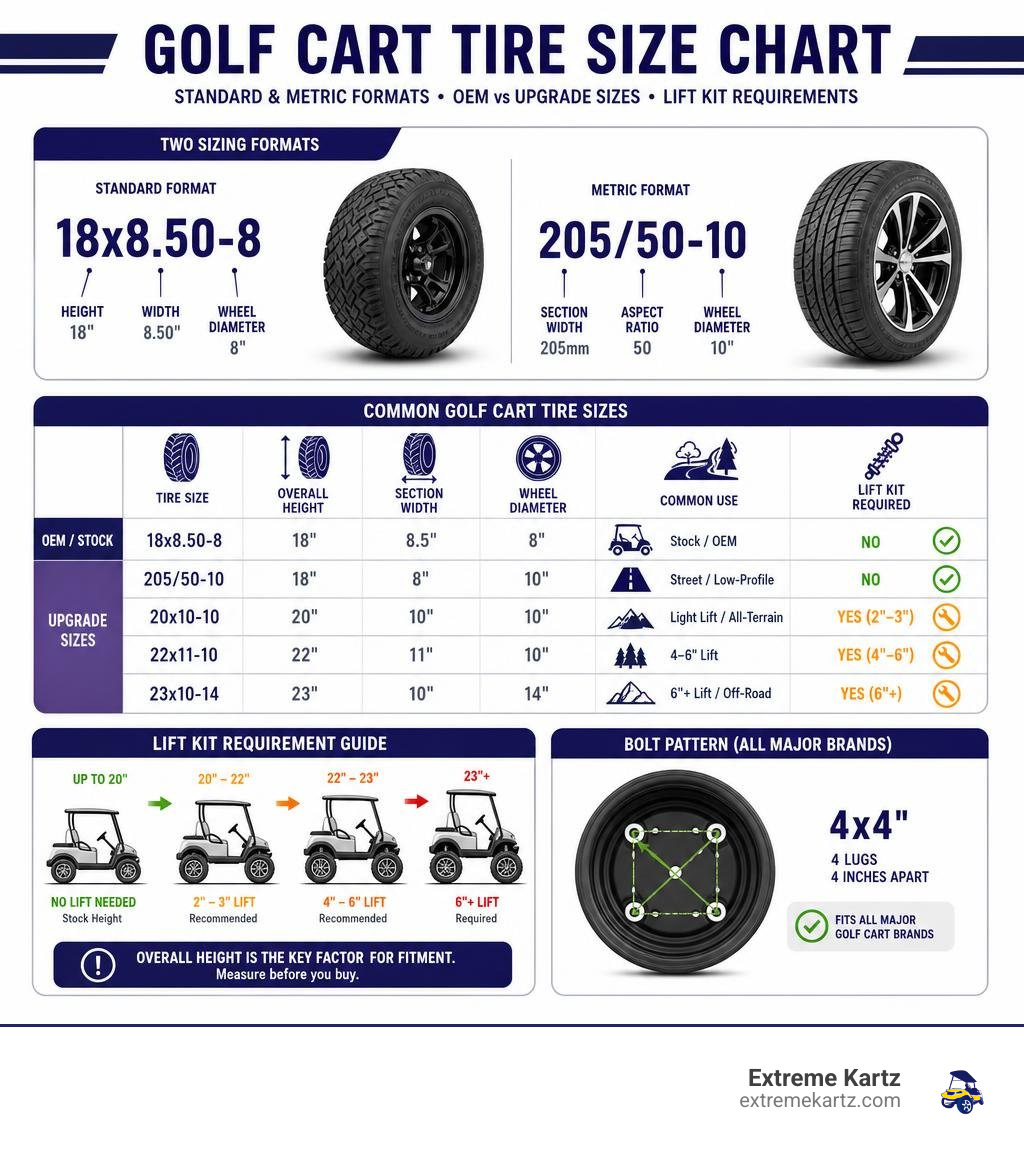
Golf cart tire sizes can be surprisingly confusing — the same cart might run an 18x8.50-8 turf tire from the factory, a 205/50-10 street tire after an upgrade, or a 23x10-14 all-terrain tire on a lifted build. Three different formats, three very different fitment outcomes.
Here is a quick reference for the most common golf cart tire sizes:
| Tire Size | Height | Width | Wheel Diameter | Common Use |
|---|---|---|---|---|
| 18x8.50-8 | 18" | 8.5" | 8" | Stock / OEM |
| 205/50-10 | 18" | 8" | 10" | Street / low-profile |
| 20x10-10 | 20" | 10" | 10" | Light lift / all-terrain |
| 22x11-10 | 22" | 11" | 10" | 4–6" lift |
| 23x10-14 | 23" | 10" | 14" | 6"+ lift / off-road |
The most important number is overall tire height. That single measurement determines whether a tire fits your cart without rubbing — more than wheel diameter, brand, or tread style.
A few key rules to know upfront:
- Most stock golf carts run 18" to 18.5" tall tires on 8" wheels from the factory
- Tires over 20" typically require a lift kit for proper clearance
- Golf cart tire sizes appear in two formats: standard (18x8.50-8) and metric (205/50-10)
- All major brands — Club Car, EZGO, and Yamaha — share the same 4x4-inch bolt pattern
There is a lot of conflicting information online about what fits what, which is exactly what makes this guide worth reading carefully before you order anything.
I'm Martin Davis, owner of Extreme Kartz, and over the years I've helped thousands of cart owners navigate golf cart tire sizes — from basic OEM replacements to full lifted builds with custom wheel packages. I'll walk you through everything you need to know to get the right tires for your specific cart and use case.
Understanding Golf Cart Tire Sizes and Sizing Formats
To make an informed purchase, we first have to demystify how manufacturers label these tires. If you have ever looked at a golf cart tire sidewall and wondered why one has three numbers separated by "x" and another looks like a European car tire, you are not alone.
Golf cart tires are unique because they cross over between turf, power sports, and light automotive engineering. As a result, the industry uses two distinct sizing systems: standard flotation sizing and metric sizing. Understanding these systems is the first step in our Golf Cart Tire Guide 2026. When upgrading your cart, matching your tires with the right rims is crucial, which we cover extensively in our Golf Cart Tires Rims Complete Guide.
Standard vs. Metric Golf Cart Tire Sizes
The standard format (also called flotation sizing) is the traditional system used for off-road, turf, and all-terrain tires. It uses direct measurements in inches.
A standard tire size looks like this: 22x11-10 (or sometimes written as 22x11x10).
- First Number (22): The overall height (diameter) of the inflated tire in inches.
- Second Number (11): The overall width of the tire tread in inches.
- Third Number (10): The wheel (rim) diameter in inches that this tire must be mounted on.
This system is incredibly straightforward because you instantly know how tall and wide the tire is. For a deeper look into a highly popular standard size, check out our 22-10-10 Golf Cart Tires Complete Guide.
The metric format (often used for low-profile street tires) is borrowed from the automotive industry. It requires a little bit of math to find the overall height.
A metric tire size looks like this: 205/50-10 (or sometimes written as 205-50-10 Golf Cart Tires or 205-50 X 10 Tires).
- First Number (205): The width of the tire tread in millimeters (205 mm is roughly 8 inches).
- Second Number (50): The aspect ratio. This represents the sidewall height as a percentage of the tire's width. In this case, the sidewall height is 50% of 205 mm, which is 102.5 mm (about 4 inches).
- Third Number (10): The wheel diameter in inches.
To find the overall height of a metric tire, you must double the sidewall height (since there is sidewall at the top and bottom of the wheel) and add the wheel diameter. For a 205/50-10 tire: 4" (bottom sidewall) + 4" (top sidewall) + 10" (wheel) = 18" overall height. This calculation helps ensure you select the correct tire height for your specific setup.
How to Read Golf Cart Tire Sizes on the Sidewall
When you look at the sidewall of your current tire, you will find these numbers molded directly into the rubber. Along with the size, you will also see the ply rating (such as 4-ply or 6-ply), the maximum load capacity, and the maximum recommended operating pressure (PSI).
Always make sure the final number in the tire size matches your wheel diameter exactly. You cannot mount a 10-inch tire on a 12-inch wheel, nor can you stretch an 8-inch tire onto a 10-inch wheel. If you are starting from scratch or looking to buy a pre-assembled package, our Golf Cart Rims and Tires Guide explains how to pair them perfectly.
Standard Factory Sizes vs. Popular Upgrade Options
Almost every fleet golf cart rolling off the assembly line in the United States ships with the same industry-standard tire size: 18x8.50-8. This classic turf tire is designed to protect golf course grass while providing a soft, reliable ride on paved paths. However, stock tires leave a lot of performance and style on the table.
Upgrading your Golf Cart Tires is one of the most popular modifications we handle. Whether you want a sleek, low-profile street cruiser or a rugged trail machine, changing your tire size completely transforms your cart's stance and capabilities.
Here is how standard factory configurations compare to the most popular upgrade sizes:
| Configuration | Tire Size | Overall Height | Rim Size | Lift Kit Required? |
|---|---|---|---|---|
| Stock OEM | 18x8.50-8 | 18" | 8" | No |
| Low-Profile Street | 205/50-10 | 18" | 10" | No |
| Low-Profile Street | 215/40-12 | 18.5" | 12" | No (most models) |
| Mid-Size Comfort | 215/50-12 | 20.5" | 12" | Yes (Club Car) / No (EZGO/Yamaha) |
| All-Terrain Cruiser | 20 Inch Golf Tires | 20" | 10" or 12" | Yes (Club Car) / No (EZGO/Yamaha) |
| Lifted Off-Road | 22x11-10 | 22" | 10" | Yes (3" to 5" Lift) |
| Extreme Lifted | 23x10-14 | 23" | 14" | Yes (5" to 6" Lift) |
Low-Profile and Street Tire Upgrades
If your golf cart rarely leaves the pavement, concrete driveway, or manicured neighborhood streets, low-profile tires are an excellent upgrade. These tires feature a shorter sidewall and a wider tread pattern, which dramatically improves steering response, cornering stability, and high-speed handling.
Low-profile tires are typically paired with larger wheels, such as 10-inch, 12-inch, or 14-inch rims. Because the overall tire height remains around 18" to 18.5", you get the look of a custom, high-end wheel package without needing to install a lift kit.
- For a classic street look, many owners choose 10 Inch Low Profile Golf Cart Tires.
- If you want to maximize wheel presence while keeping a smooth ride, our Golf Cart Tires Wheels 12 Inch Complete Guide details how to balance sidewall cushion with a larger rim.
Large Off-Road and All-Terrain Upgrades
For those who use their carts on gravel paths, muddy trails, hunting grounds, or hilly properties, standard turf tires simply will not cut it. Upgrading to larger, aggressive all-terrain or mud tires is essential for traction and ground clearance.
These larger formats typically range from 20 inches up to 25 inches in overall height. They feature deep tread blocks designed to dig into loose soil, mud, and sand.
- To explore your options for maximum traction, our Golf Cart Big Tires Complete Guide details what to expect when stepping up to larger sizes.
- If you are preparing your cart for rugged utility or trail use, check out our Golf Cart ATV Tires Guide 2026 for heavy-duty, puncture-resistant options.
Lift Kit Requirements and Brand-Specific Fitment
One of the most common mistakes cart owners make is ordering a beautiful set of 22-inch tires, only to find out during installation that the tires rub against the body work or inner fender wells. To prevent this, you must understand how your cart's brand and suspension system impact tire clearance.
Different manufacturers design their body panels and wheel wells with varying amounts of room. A tire size that fits perfectly on an EZGO might cause severe rubbing on a Club Car. For a complete breakdown of lifted tire dynamics, refer to our Ultimate Lifted Golf Cart Tires Guide.
Maximum Tire Sizes for Non-Lifted Carts
If you want to avoid the cost and installation time of a lift kit, you must stay within your cart's stock clearance limits. Overloading the cart with passengers or cargo can cause sagging leaf springs, which further reduces clearance and leads to tire rubbing.
Here are the maximum recommended tire heights for stock, non-lifted carts by brand:
- EZGO (TXT, RXV): EZGO carts are the most forgiving. Thanks to spacious fender wells, you can safely run up to 20.5-inch tires (such as a 215/50-12 or 205/65-10) on stock suspension without rubbing.
- Yamaha (Drive, Drive2): Yamaha's newer models also feature generous clearance, allowing up to 20.5-inch tires without modification. However, older Yamaha G-Series models (G19-G22) are limited to 18.5 inches without a lift.
- Club Car (DS, Precedent, Onward): Club Car models have much tighter wheel clearance. You cannot exceed an 18.5-inch tire height (such as a 205/50-10 or 215/40-12) on a stock suspension without experiencing rubbing during sharp turns or when carrying rear passengers.
If you are shopping for a stock replacement or a mild upgrade, our guide on Tires for Golf Cart will help you find the safest fit.
Lift Kit Compatibility for 20-Inch to 23-Inch Tires
If your heart is set on running large, aggressive off-road tires, a lift kit is non-negotiable. Lift kits raise the cart's frame and body, providing the necessary vertical and horizontal clearance for larger rubber while also increasing ground clearance. All of our lift kits ship in 1-2 business days, so you can get started on your build without delay.
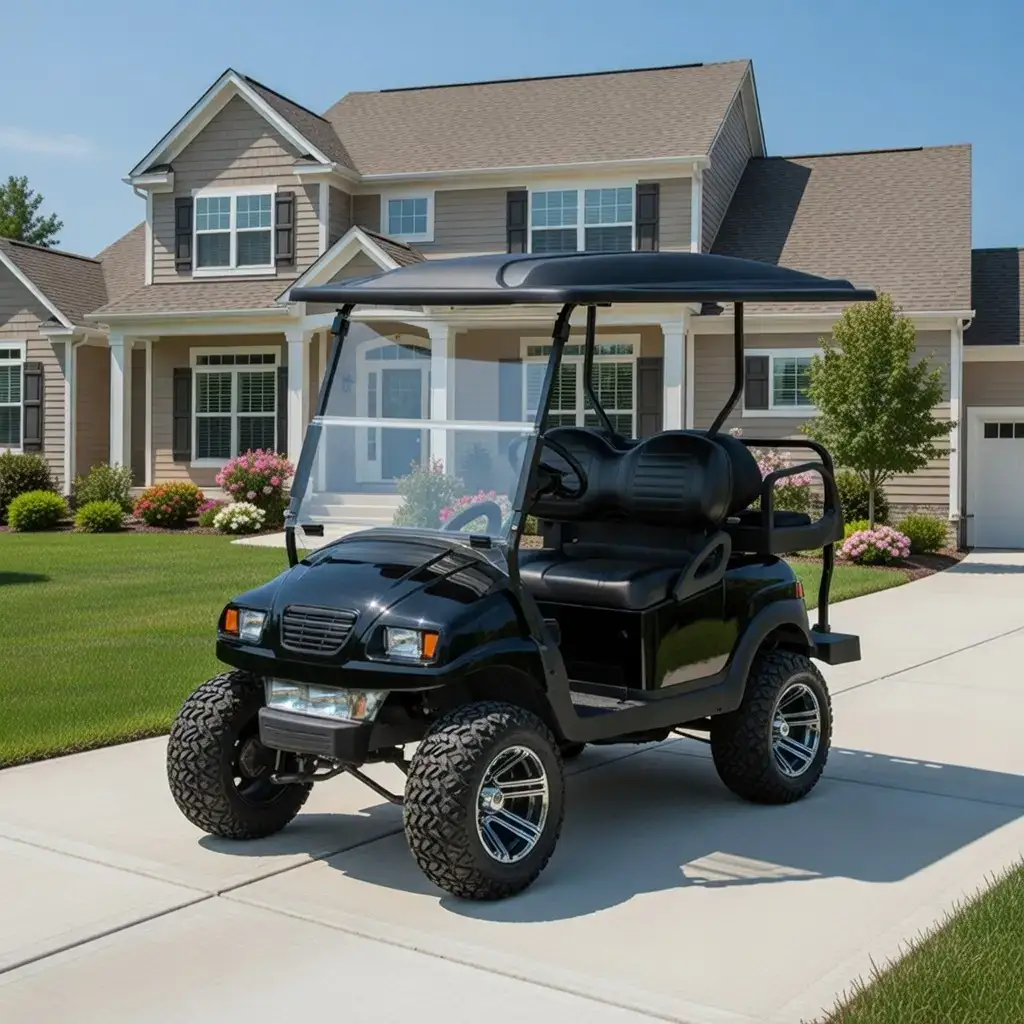
- 3-Inch Lift Kit: Perfect for running 20-inch tires comfortably on all brands. This setup provides extra clearance for rear seat passengers without making the cart too difficult to step into.
- 4-Inch Lift Kit: This is the sweet spot for running popular 22-inch tires, such as 22x11-10 Golf Cart Tires and Rims. It gives your cart a commanding stance and excellent off-road capability. For more details on this highly sought-after setup, check out our Golf Cart Tires 22x11x10 Complete Guide.
- 6-Inch Lift Kit: Required for massive 23-inch to 25-inch tires (like 23x10-14). This is the ultimate setup for extreme off-roading, trail riding, and custom builds.
For additional fitment details, you can consult our other comprehensive guides or contact our team to ensure a perfect fit.
Wheel Offset, Bolt Patterns, and Stability
When upgrading your wheels and tires, physical clearance under the fender is only half the battle. You also have to make sure the tires do not rub against the inner suspension components, frame, or steering linkage. This is where wheel offset and bolt patterns come into play.
Fortunately, bolt patterns are simple in the golf cart world. Virtually all major manufacturers (Club Car, EZGO, Yamaha, STAR, ICON, and Evolution) use a standard 4x4-inch bolt pattern (also written as 4x101.6mm). This means almost any aftermarket golf cart wheel will slide right onto your hub. However, always double-check your lug nut thread pitch, as Yamaha typically uses metric threads (M12x1.25) while Club Car and EZGO use standard threads (1/2"-20). For a complete overview of wheel dynamics, read our Golf Cart Wheels Complete Guide.
Understanding Negative Offset for Wide Tires
Wheel offset refers to the distance between the wheel's mounting surface (where it bolts to the hub) and its centerline.
- Centered Offset (0 Offset): The mounting surface is exactly in the middle of the wheel. This is typical for stock 8-inch wheels.
- Negative Offset: The mounting surface is pushed closer to the inside (cart side) of the wheel. This pushes the entire wheel and tire outward, away from the cart's frame.
Negative offset is highly beneficial when installing wider tires (like 10-inch or 11-inch wide off-road tires) or when installing a lift kit. By pushing the tires outward, negative offset prevents the rubber from rubbing against your cart's leaf springs, shocks, and steering arms.
Furthermore, widening your cart's track width significantly improves stability, reducing the risk of tipping—especially on lifted carts with a higher center of gravity. If your cart is equipped with hydraulic disc brakes (common on newer brands like ICON or Evolution), a negative offset wheel (typically 3+4 or 2+5) is required to clear the brake calipers. To learn how to select the perfect wheel offset for your cart, see our guide on Golf Cart Rims How to Select the Perfect Set.
Performance Impacts: Speed, Range, and Ride Quality
Changing your golf cart tire sizes does more than alter your cart's appearance—it fundamentally changes how the vehicle drives. At Extreme Kartz, we emphasize system-based performance upgrades because a change in tire size directly affects your drivetrain, motor, and power source.
Here is how upgrading to larger tires impacts your cart's performance:
- Top Speed Increase: Larger tires have a larger rolling circumference. Because they travel further with each rotation, installing taller tires (e.g., upgrading from 18" to 22") can increase your top speed by 3 to 5 mph without any motor modifications.
- Torque and Acceleration Reduction: The trade-off for higher top speed is a loss of low-end torque. Taller tires act like a higher gear ratio, making it harder for your motor to turn the wheels from a complete stop or when climbing hills. If you install 22-inch or 23-inch tires, we strongly recommend upgrading your controller or installing an AC conversion kit to regain that lost torque.
- Battery Range Reduction: Larger, heavier tires have higher rolling resistance. On an electric cart, upgrading to heavy off-road tires can reduce your battery range by 10% to 15%. To combat this and handle the extra load, many owners convert to high-performance lithium batteries from top-tier brands like Eco Battery, Bolt Energy, Lithium Rhino, or Bedrock Battery.
- Ride Comfort: The height of your tire's sidewall acts as a natural shock absorber. Low-profile street tires (with very short sidewalls) look incredible but deliver a firmer, sometimes harsher ride over bumps. Conversely, high-profile tires (with plenty of rubber sidewall) cushion the ride beautifully.
To find the perfect balance between traction, speed, and comfort, you can read our breakdown of Golf Cart Tires for Every Terrain.
Radial vs. Bias-Ply Golf Cart Tires
When shopping for tires, you will also need to choose between two construction types: radial and bias-ply.
- Bias-Ply Tires: The traditional choice for golf carts. The internal cords run diagonally across the tire. They are highly durable, have stiff sidewalls (excellent for carrying heavy loads), and are generally more budget-friendly. However, they can develop flat spots when parked for long periods and offer a rougher ride on hard pavement.
- Radial Tires: Constructed with steel belts or cords running at 90 degrees to the centerline. Radial tires allow the tread and the sidewall to flex independently. This design delivers 30% to 50% longer tread life, a significantly smoother ride on pavement, better wet-weather grip, and lower rolling resistance (which helps preserve battery range).
If your cart ever touches pavement or is driven at speeds over 15 mph, investing in radial tires is one of the best upgrades you can make. Learn more about making this choice in our guide to Golf Cart Tires and Wheels.
Tire Pressure and Maintenance Guidelines
To maximize the life of your new tires and ensure a safe, comfortable ride, proper maintenance is key. Underinflated tires increase rolling resistance (killing your battery range) and cause rapid wear on the outer edges of the tread. Overinflated tires ride incredibly harsh and wear out the center of the tread prematurely.
- Turf and Street Tires (Low Profile): Typically require 18 to 22 PSI for daily use, with a maximum limit usually around 25 to 30 PSI.
- Off-Road and All-Terrain Tires: Often run at lower pressures, between 12 to 15 PSI, to allow the tread to conform to rough terrain and provide better traction.
- Tire Rotation: Just like a car, your golf cart's front tires wear differently than the rear tires due to steering forces and alignment angles. We recommend rotating your tires every 6 months to ensure even tread wear.
For a complete breakdown of tire pressure recommendations by size and application, check out our Golf Cart Tire Pressure Guide, and keep your tread wearing evenly with our Golf Cart Tire Rotation Guide.
Frequently Asked Questions about Golf Cart Tires
What is the standard factory golf cart tire size?
The industry standard factory tire size found on almost 99% of fleet golf carts is 18x8.50-8. This tire is 18 inches tall, 8.5 inches wide, and mounted on an 8-inch diameter wheel. It features a turf-safe sawtooth tread pattern designed to protect golf course grass.
Can I install 20-inch tires on a stock golf cart without a lift kit?
It depends on the brand of your cart. If you own an EZGO (TXT or RXV) or a newer Yamaha (Drive or Drive2), you can safely run up to 20.5-inch tires on stock suspension without rubbing. However, if you own a Club Car (DS, Precedent, or Onward) or an older Yamaha, you will experience rubbing and must install at least a 3-inch lift kit to run 20-inch tires.
How does tire size affect electric golf cart battery range?
Upgrading to larger, heavier tires increases rolling resistance and rotational weight, which forces your motor to draw more amperage from your batteries. This typically reduces your overall battery range by 10% to 15%. To restore your range and power performance, we highly recommend upgrading to a premium lithium battery system from trusted brands like Eco Battery or Bolt Energy.
Conclusion
Choosing the right golf cart tire sizes is the foundation of any successful cart upgrade. Whether you are replacing worn-out factory turf tires, building a sleek neighborhood street cruiser, or lifting a cart to tackle rugged off-road trails, understanding how tire height, width, and wheel offset interact with your specific cart model is the key to preventing fitment issues and protecting your investment.
At Extreme Kartz, we are dedicated to helping you get your build right the first time. We specialize in system-based performance upgrades, ensuring that when you step up to larger tires, you have the suspension, controller power, and lithium battery performance to match.
If you have any questions about fitment, clearance, or matching the perfect wheel and tire combo to your cart, contact our expert team for a personalized fitment consultation. For a deeper dive into styling your ride, explore our Golf Cart Rims and Tires Complete Guide to start planning your next upgrade.
Related Products

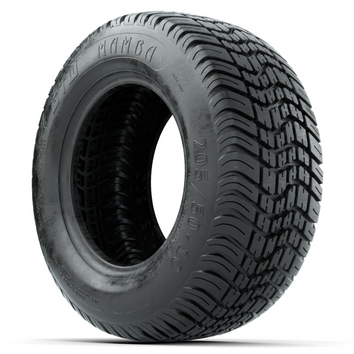
Vendor: 205/50-10 GTW® Mamba Street Tire (No Lift Required)


Vendor: 20x10-10 GTW® Barrage Mud Tire (Lift Required)


Vendor: 22x11-10 GTW® Predator A/T Tire


Vendor: RHOX Mojave II, 22x10-14 4 Ply


