


Go Big or Go Home with These Massive Golf Cart Tires
Why Golf Cart Big Tires Are Worth the Upgrade
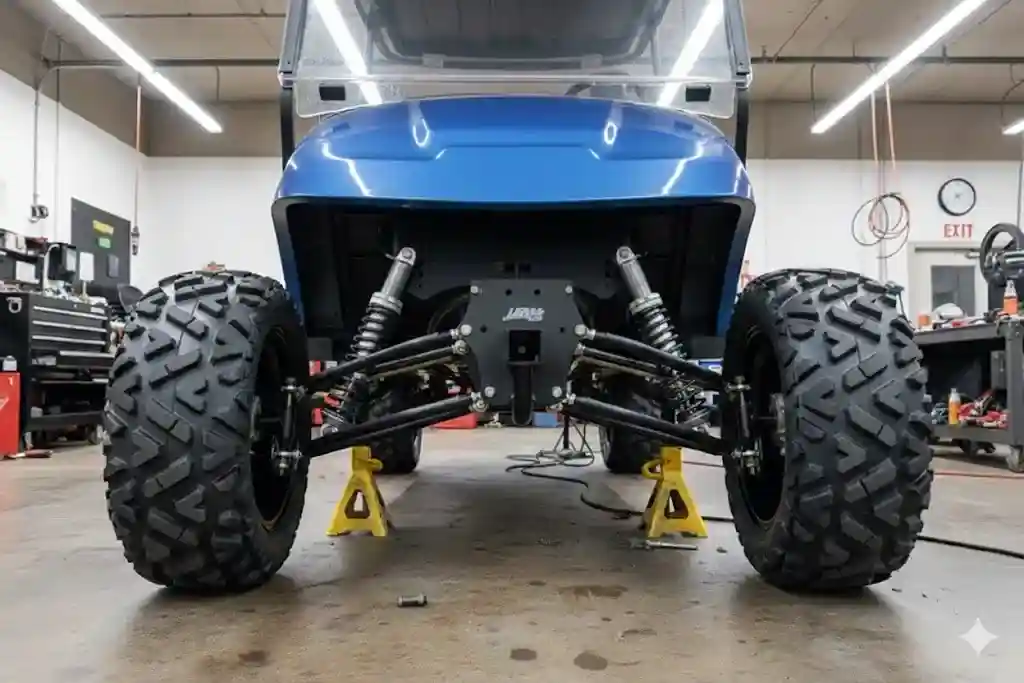
Golf cart big tires are one of the most impactful upgrades you can make to your cart — improving ground clearance, traction, stability, and looks all at once.
Here's a quick overview of the most common big tire sizes and what you need to know before buying:
| Tire Size | Height | Lift Kit Required? | Best For |
|---|---|---|---|
| 215/40R12 | 18.5" | No | Street use, non-lifted carts |
| 20x10-12 | 20" | No for EZGO/Yamaha Drive; Yes (3") for Club Car | All-terrain, trails, campgrounds |
| 215/35-14 | 21" | Yes (3" minimum) for most carts | Street/turf, lifted builds |
Tires over 20 inches tall typically need a lift kit on at least some cart models — always check your specific make and model before ordering.
The difference between stock golf cart tires and big tires comes down to more than just size. Standard golf cart tires usually measure around 18 inches tall and are designed for smooth fairways and paved paths. Big tires — generally 18.5 inches and above — are built for more demanding terrain, wider footprints, and a more aggressive look.
Whether you're cruising a campground, navigating a rough trail, or simply want your cart to stand out in the neighborhood, the right set of oversized tires can completely transform how your cart rides and handles.
I'm Martin Davis, owner of Extreme Kartz and a hands-on resource for golf cart owners navigating upgrades like golf cart big tires — from fitment questions to full wheel and tire combos. In the sections below, I'll walk you through everything you need to choose the right size, understand lift kit requirements, and get the right combo for your specific cart.
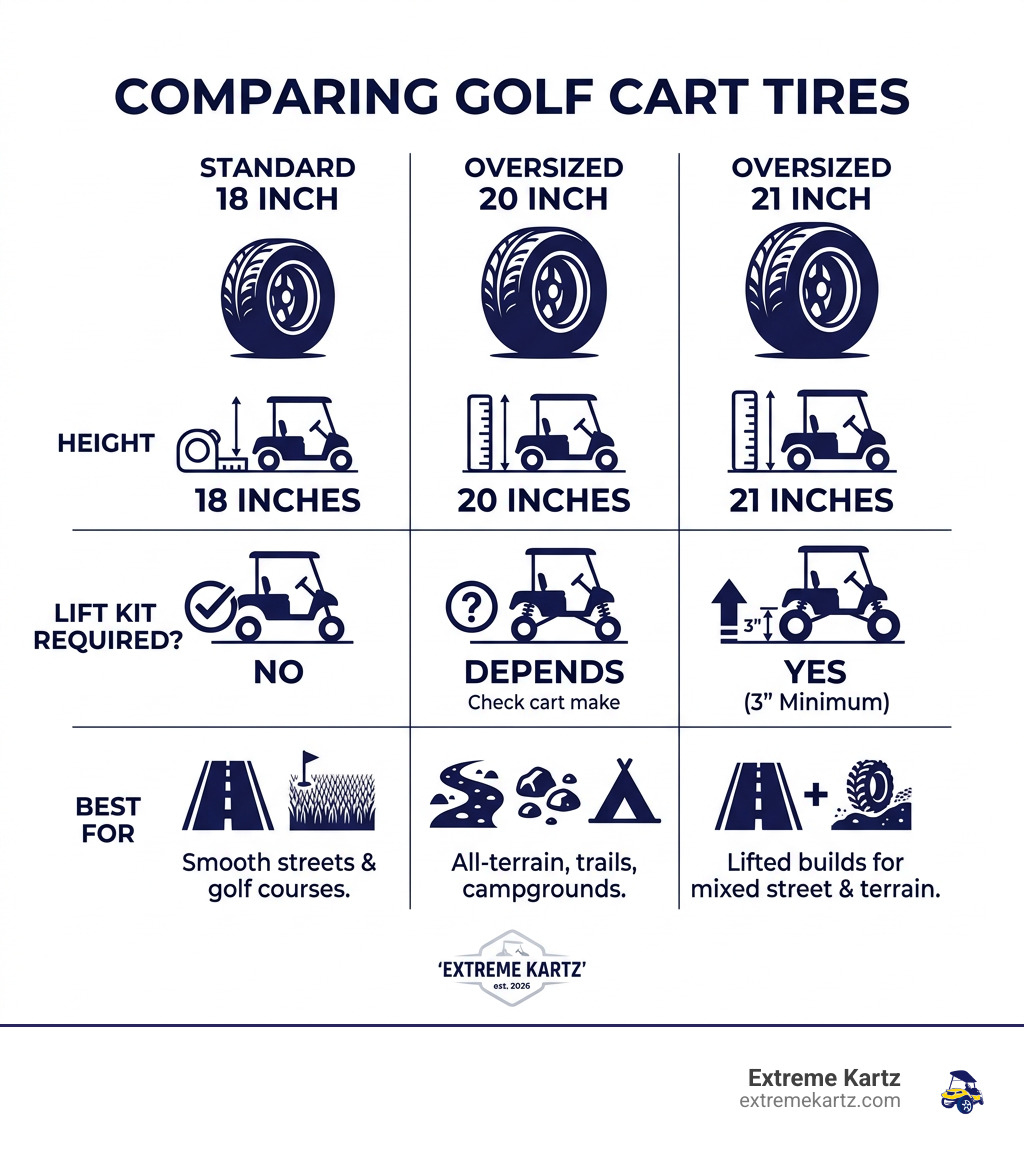
Understanding Sizing and Specs for Golf Cart Big Tires
When we talk about "big" tires, we are generally referring to anything that exceeds the standard 18-inch factory height. Navigating tires for a golf cart requires a basic understanding of how these measurements work.
Tire sizing is usually expressed in two ways: the traditional sizing (e.g., 20x10-12) or the metric sizing (e.g., 215/40R12). In the traditional format, the first number is the total height of the tire in inches, the second is the width, and the third is the wheel diameter it fits. In the metric format, the height is calculated based on the aspect ratio of the width.
- 18.5-inch Tires: These are often considered the "safe" upgrade. They provide a slightly beefier look than stock without requiring suspension modifications on most carts.
- 20-inch Tires: This is the sweet spot for many owners. A 20-inch tire offers a significant boost in ground clearance and a much more aggressive stance.
- 23-inch Tires: These are the true "massive" options. Installing these almost always requires a substantial lift kit (5" to 6") and may require power upgrades to handle the increased rolling diameter.
Beyond height, you must consider the ply rating and load capacity. Most high-quality big tires feature a 4-ply rating, which provides a balance between durability and ride comfort. For example, a 20x10-12 all-terrain tire typically offers a load capacity of around 800 lbs per tire at 20 psi, making it sturdy enough for a fully loaded four-passenger cart.
Popular Brands for Golf cart big tires
Choosing a reputable brand ensures that your tires are round, balanced, and durable. We often point customers toward brands that prioritize safety and engineering.
- Kenda Kruzer: This is a standout in the industry, particularly the Kenda Kruzer Radial Specifications. It is a steel-belted radial tire, meaning it stays cooler and lasts longer on pavement than traditional bias-ply tires. At 18.5" tall, it’s a perfect DOT-approved upgrade for street-legal carts.
- Wanda P3026: A very popular choice for all-terrain use. It features a non-directional tread that works well in dirt and grass without being overly noisy on the street.
- MadJax: Known for their innovative designs, the new madjax timberwolf and raptor series tires offer aggressive styling and excellent performance for those looking to take their cart off the beaten path.
Selecting the Right Tread for Golf cart big tires
Your choice of tread pattern should be dictated by where you spend 80% of your time driving. Choosing the wrong tread can lead to a bumpy ride or poor traction when you need it most. Check out our guide on golf cart tires for every terrain for a deeper dive, but here is the breakdown:
- Street/Turf: These have a flatter profile and tightly packed tread blocks. They are designed to be gentle on golf course grass and provide a quiet, smooth ride on asphalt.
- All-Terrain (A/T): These are the most versatile. They feature deeper grooves for mud and sand but maintain enough surface contact for stable street driving.
- Radial DOT Tires: If you use your cart as a neighborhood electric vehicle (NEV), radial tires are the gold standard. They offer automotive-style construction, providing the smoothest ride and the best longevity on hard surfaces.
Fitment Guide: Do Your Golf cart big tires Require a Lift Kit?
The most common question we get at Extreme Kartz is: "Will these tires rub?" Fitment depends entirely on the combination of tire height and your cart's make and model.
When you increase tire size, you run the risk of the tire hitting the wheel well or the suspension components when turning or hitting a bump. This is why understanding golf cart rims tires complete guide is essential before you click "buy."
| Cart Model | Max Tire Size (No Lift) | Lift Required for 20" Tires? | Lift Required for 22"+ Tires? |
|---|---|---|---|
| EZ-GO (TXT/RXV) | 20" | No | Yes (5" minimum) |
| Yamaha (Drive/Drive2) | 20" | No | Yes (5" minimum) |
| Club Car (DS/Precedent) | 18.5" | Yes (3" minimum) | Yes (6" minimum) |
| Yamaha (G2-G22) | 18.5" | Yes (3" minimum) | Yes (6" minimum) |
As you can see, EZ-GO and newer Yamaha models are much more forgiving. You can often bolt on a 20-inch tire combo and go. However, Club Car owners almost always need at least a 3-inch lift to accommodate anything larger than a standard tire.
Wheel Offset and Bolt Patterns
Fitment isn't just about height; it’s also about how far the wheel sticks out. This is determined by the offset. Most aftermarket wheels for golf cart big tires feature an "offset" (often ET-25mm). This pushes the wheel further away from the cart's frame, which helps prevent the inside of the tire from rubbing against the suspension or frame during tight turns.
To ensure you select the perfect set of rims, you must also match the bolt pattern. The industry standard for Club Car, EZ-GO, and Yamaha is 4x101.6mm (also known as 4x4). While the pattern is the same, the lug nuts differ. Club Car and EZ-GO typically use 1/2"x20 threads, while Yamaha uses metric 12mmx1.25 threads.
Performance Impacts and Terrain Selection
Upgrading to golf cart big tires changes the physics of your ride. It’s not just a cosmetic change; it’s a performance shift.
- Ground Clearance: This is the most immediate benefit. Larger tires lift the entire chassis further off the ground, allowing you to clear rocks, stumps, and tall grass that would high-center a stock cart.
- Top Speed: Because a larger tire travels further with each revolution, you will likely see a 2–4 mph increase in top-end speed.
- Torque Loss: The trade-off for speed is torque. Larger tires are harder for the motor to turn from a dead stop. If you live in a very hilly area, you might notice your cart struggling slightly on inclines unless you also upgrade your controller or motor.
- Stability: Wider, bigger tires provide a larger footprint. This increases stability on uneven terrain, though a lifted cart will have a higher center of gravity, so you should always take corners with caution.
Proper maintenance is key to preserving these performance gains. Keeping an eye on tire pressure for golf cart tires is vital. All-terrain tires usually perform best around 20 psi, while street-focused radials might require up to 30 psi for optimal fuel/battery efficiency.
Benefits of Upgrading to Large Tires
Beyond the technical specs, why do people love golf cart tires that are oversized?
- Smoother Ride: Larger tires have more "sidewall," which acts as a secondary cushion for bumps.
- Off-Road Capability: You simply cannot take a stock cart through a muddy campground or a sandy trail without getting stuck. Big tires make these environments accessible.
- Visual Impact: Let’s be honest—a lifted cart with aggressive tires looks incredible. It transforms a "utility vehicle" into a custom machine.
Selecting the Perfect Wheel and Tire Combo
At Extreme Kartz, we highly recommend purchasing golf cart tires with rims as a pre-mounted combo.
Buying a combo saves you the headache of trying to find a local shop that can mount small tires on custom wheels without scratching the finish. Most combos include:
- Four professionally mounted tires and wheels.
- Four center caps (often in chrome or black).
- 16 lug nuts matched to your specific cart brand.
Price ranges for these sets typically start around $600 for a basic 12-inch wheel and 20-inch tire set and can go up to $1,200+ for premium 14-inch radial setups. When shopping, look for sellers that offer free shipping, as a set of four wheels and tires can weigh between 80 and 125 lbs! At Extreme Kartz, our kits ship in 1-2 business days.
Installation and Maintenance of Oversized Combos
Installing a new set of golf cart big tires is a perfect Saturday afternoon DIY project. You don't need a professional shop; you just need a few basic tools: a floor jack, a lug wrench (usually 19mm or 3/4"), and some jack stands for safety.
If you're doing it yourself, follow our step-by-step guide on changing wheels and tires. Once they are on, don't forget about them! Regular maintenance will double the life of your investment. Because most golf carts have fixed alignment, the front tires tend to wear differently than the rear. Following a golf cart tire rotation guide every 6 months will ensure even tread wear and a quieter ride.
Frequently Asked Questions
Will 20-inch tires fit my cart without a lift kit?
It depends on the brand. If you have an EZ-GO TXT, RXV, or a Yamaha Drive/Drive2, yes, 20-inch tires usually fit without a lift kit. If you have a Club Car DS or Precedent, you will need at least a 3-inch lift kit to prevent the tires from rubbing the fenders.
What is the difference between bias-ply and radial golf cart tires?
Bias-ply tires are constructed with overlapping layers of nylon cords. They are rugged and great for off-road use but can develop "flat spots" if the cart sits for a while. Radial tires (like the Kenda Kruzer) are built like car tires. They offer a much smoother ride, better heat dissipation, and longer life on paved surfaces.
How do larger tires affect my electric golf cart's battery life?
Larger tires are heavier and have a larger rolling diameter, which means the motor has to work harder to get them moving. You may see a slight decrease in range (typically 5-10%). However, if you upgrade to a high-efficiency lithium battery system, this impact is often negligible.
Conclusion
Upgrading to golf cart big tires is the single best way to improve both the form and function of your vehicle. Whether you are looking for the rugged utility of a 20-inch all-terrain tire or the sleek, smooth performance of a 14-inch radial street setup, understanding your cart's specific fitment needs is the key to a successful upgrade.
At Extreme Kartz, we are committed to helping you get it right the first time. We focus on system-based solutions, ensuring that your tires, wheels, and lift kits work together in perfect harmony. We don't just sell parts; we provide the expertise to make sure those parts fit your Club Car, EZ-GO, or Yamaha exactly as they should.
Ready to elevate your ride? Explore our comprehensive Golf Cart Lift Kit Guide to ensure the perfect fit for your new tires and let us help you build the cart of your dreams.
Related Products


Vendor: 14" GTW Bravo Wheels with 22x10-14 GTW Timberwolf All-Terrain Tires (Set of 4)


Vendor: Madjax 23X10-14 Predator Series All Terrain Tire


Vendor: RHOX Mojave II, 22x10-14 4 Ply


Vendor: Barrage Series 25x10-14 Mud Tire 6-ply


