


The Complete Guide to Golf Cart Wheel Bolt Pattern Specs
Why the Golf Cart Wheel Bolt Pattern Is the First Thing You Need to Get Right
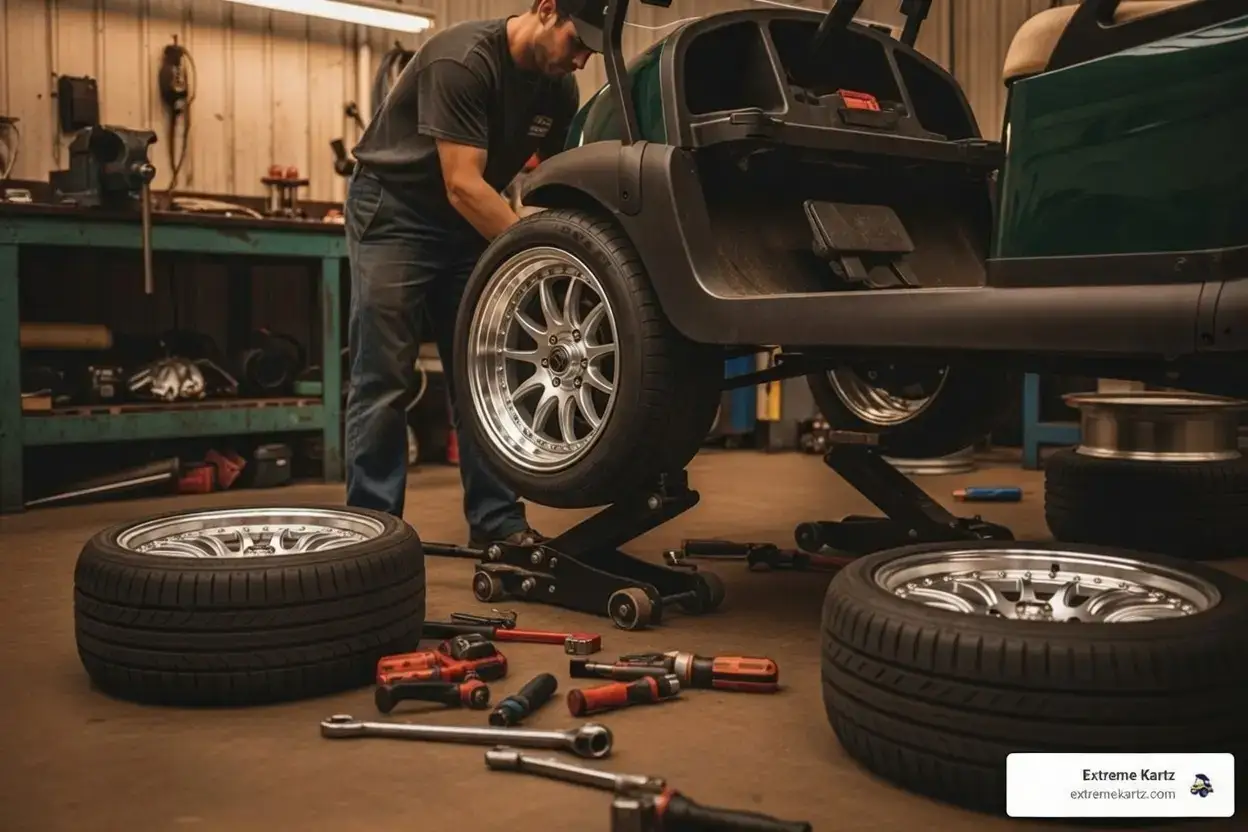
The golf cart wheel bolt pattern is the single most important spec to confirm before buying any new wheel or tire package. Get it wrong, and nothing fits — no matter how good the wheel looks.
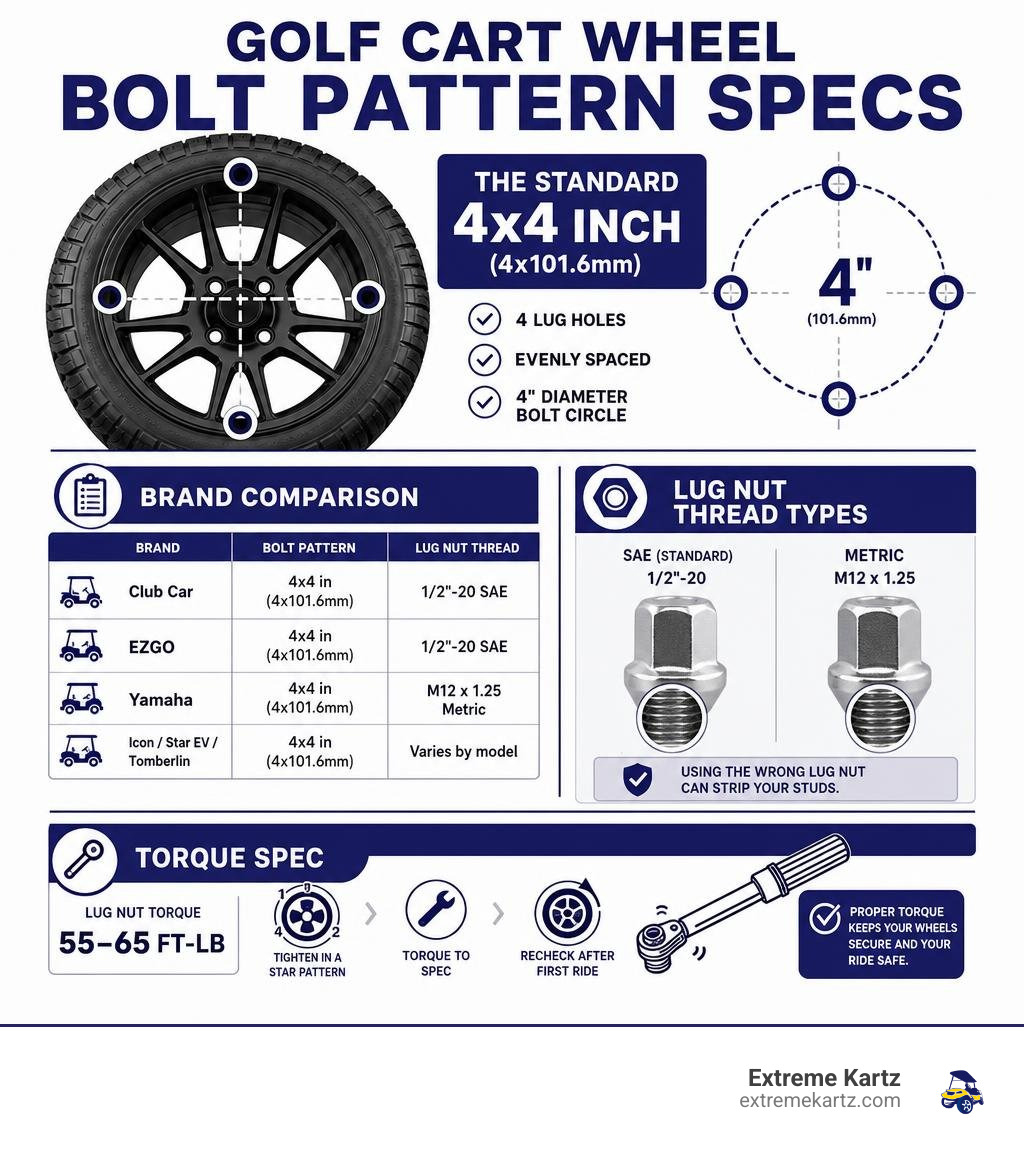
Here's the quick answer most people need:
| Brand | Bolt Pattern | Lug Nut Thread |
|---|---|---|
| Club Car | 4x4 in (4x101.6mm) | 1/2"-20 SAE |
| EZGO | 4x4 in (4x101.6mm) | 1/2"-20 SAE |
| Yamaha | 4x4 in (4x101.6mm) | M12 x 1.25 Metric |
| Icon / Star EV / Tomberlin | 4x4 in (4x101.6mm) | Varies by model |
Almost every major golf cart brand uses the same 4x4 inch (4x101.6mm) bolt pattern. That's four lug holes evenly spaced on a 4-inch diameter circle. This near-universal standard makes aftermarket wheel upgrades much simpler than on cars or trucks.
But there's a catch. Even though the bolt pattern matches across brands, lug nut thread sizes are not always the same. Club Car and EZGO use standard SAE threads (1/2"-20), while Yamaha uses metric threads (M12 x 1.25). Using the wrong lug nut will strip your studs.
There's also a common trap that catches a lot of buyers: confusing the 4x4 inch golf cart pattern (101.6mm) with the 4x100mm pattern used on many compact cars and ATVs. That 1.6mm difference seems tiny, but it can stress and bend your wheel studs — and create a real safety hazard.
This guide covers everything you need to know — how to measure your pattern correctly, what each major brand uses, how to pick the right lug nuts, and how offset and backspacing affect fitment.
I'm Martin Davis, owner of Extreme Kartz, and helping customers nail the golf cart wheel bolt pattern before they order is something my team deals with every day — whether it's a straightforward OEM replacement or a full custom wheel upgrade. Let's make sure you get it right the first time.
Explore our popular collections:
Understanding the Standard Golf Cart Wheel Bolt Pattern
When we talk about the golf cart wheel bolt pattern (often called the lug pattern), we are referring to the layout of the mounting holes on the wheel and the matching studs on your cart's hub. Having a firm grasp on this layout is the secret to a painless upgrade.
Most modern golf carts utilize a 4-lug setup. Unlike passenger cars that feature an endless variety of bolt circles, the golf cart industry settled on a single, highly convenient standard: the 4x4 pattern. For a deep dive into the physical construction of these rims, check out our Golf Cart Rims Complete Guide.
This universal standard means that whether you are browsing steel utility wheels or high-end aluminum split-spokes, the physical bolt configuration is almost always the same. It simplifies customization immensely, allowing you to focus on style, diameter, and tire choice rather than worrying about custom machining.
Why the Correct Golf Cart Wheel Bolt Pattern Prevents Hub Damage
Using a wheel with the exact matching bolt pattern is not just about getting the lug nuts to thread on. It is about structural integrity and safety. When a wheel's mounting holes align perfectly with the hub studs, the lateral and vertical loads are distributed evenly across the entire face of the hub.
If you attempt to force a wheel with a slightly incorrect bolt pattern onto your hub, you introduce severe mechanical stress. The studs will be forced slightly outward or inward, bending under the pressure of the lug nuts. This misalignment prevents the wheel from sitting completely flush against the brake drum or hub face. At best, you will experience annoying steering wheel vibrations; at worst, you risk shearing the studs entirely while driving, leading to a catastrophic wheel loss. For a look at how different brands handle these hubs, refer to our guide on Golf Cart Wheels for Yamaha EZGO ClubCar.
Standard 4x4 vs. Metric 4x101.6mm Specs
You will frequently see golf cart specifications listed in both imperial (inches) and metric (millimeters) formats.
- Imperial: 4x4 inches (4 lugs on a 4-inch diameter circle)
- Metric: 4x101.6mm (4 lugs on a 101.6mm diameter circle)
These two measurements represent the exact same physical dimension. Because 1 inch is equal to exactly 25.4 millimeters, 4 inches translates mathematically to 101.6mm. Manufacturers use these terms interchangeably. If a custom wheel is advertised as 4x101.6mm, it will slide perfectly onto your standard 4x4 inch golf cart hub.
How to Measure Your Lug Pattern Accurately
While the vast majority of golf carts on the road in 2026 use the standard 4x4 pattern, it is always smart to measure your existing setup before ordering. This is especially true if you bought a pre-owned cart that may have been modified by a previous owner with aftermarket high-speed hubs or heavy-duty utility axles.
How to Measure a Golf Cart Wheel Bolt Pattern
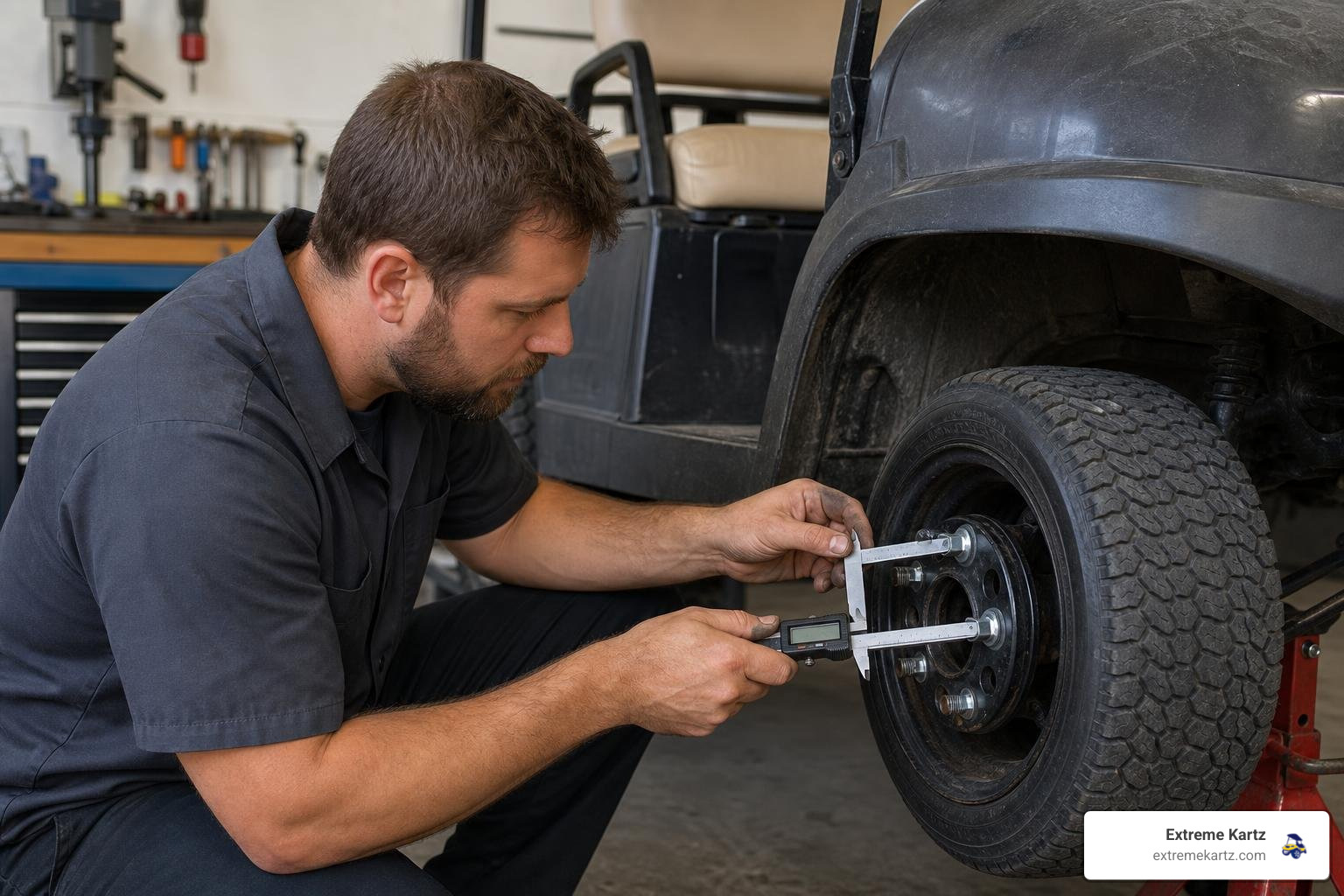
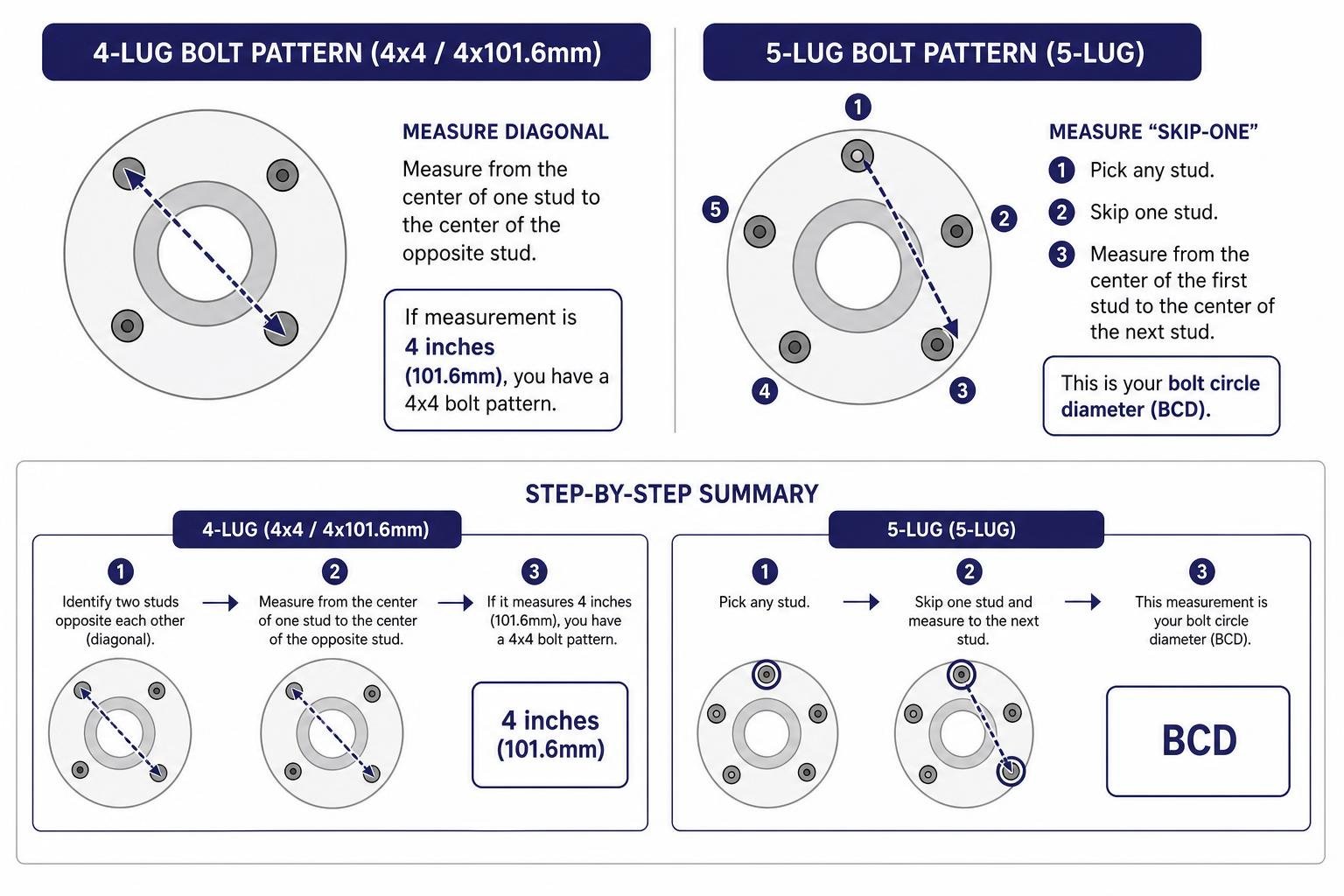
Measuring a 4-lug pattern is straightforward because the studs sit directly opposite one another. You do not need complex mathematical formulas; you just need a standard tape measure or a digital caliper for maximum precision.
To measure your 4-lug pattern:
- Locate two studs that are directly across from each other (diagonal).
- Measure from the exact center of the first stud to the exact center of the opposite diagonal stud.
- If the measurement is exactly 4 inches (or just over 101.5mm), you have a standard 4x4 golf cart hub.
For more details on matching these measurements to specific tire heights, take a look at our Standard Golf Cart Wheel Size Guide 2026.
Measuring Rare 5-Lug Utility Patterns
While 4-lug hubs are the standard for recreational golf carts, you might occasionally run into a 5-lug pattern. These are typically found on heavy-duty utility vehicles (like Kubota or John Deere work machines), multi-passenger limousine carts, or specialized off-road vehicles.
Measuring a 5-lug pattern is trickier because the studs do not sit directly opposite each other. To find the bolt circle diameter on a 5-lug layout, we use the "skip-one" method:
- Measure from the far back edge of one stud, skip the adjacent stud, and measure to the exact center of the third stud.
- Common 5-lug patterns on utility vehicles are typically 5x4.5 inches.
An important warning: Many stock steel golf cart wheels come equipped with plastic hub covers or chrome hubcaps. Some of these covers are designed to mimic the premium look of a 5-lug automotive wheel, featuring five fake molded plastic bolt heads. Do not let these cosmetic covers fool you! Always pop the hub cover off to count the actual steel studs on the hub before ordering new wheels. For a visual reference on standard patterns, you can read the Golf Cart Rim Bolt Pattern - Sewing Pattern Library.
Brand Compatibility and the 1.6mm Trap
One of the most common questions we get at Extreme Kartz is: "Can I swap wheels between different golf cart brands?" The short answer is yes, but the complete answer requires checking your lug nuts.
Club Car, EZGO, and Yamaha Fitment
Because Club Car, EZGO, and Yamaha all share the standard 4x4 inch (4x101.6mm) bolt pattern, the wheels themselves are physically interchangeable. A wheel designed for an EZGO TXT will slide onto a Club Car Precedent or a Yamaha Drive2 without any issues.
However, you must pay close attention to the wheel studs and lug nuts. While the spacing of the studs is identical, the threads are not:
- Club Car & EZGO: Use standard American SAE 1/2"-20 threads.
- Yamaha: Uses metric M12 x 1.25 threads.
If you are swapping a wheel and tire package from an EZGO to a Yamaha, you can reuse the wheels, but you must swap out the lug nuts to match the thread pitch of the receiving cart. Trying to force a 1/2"-20 SAE lug nut onto a metric Yamaha stud will instantly strip the threads and ruin your hub. For a step-by-step walkthrough on physically swapping these parts out, see our guide on How to Change Your Golf Cart Wheels Tires a Step by Step Guide. You can also explore the Are All Golf Cart Rims the Same? 2026 Bolt Pattern & Compatibility Guide - Tara Electric Vehicles for additional brand compatibility details.
The Danger of 4x100mm Automotive Wheels
Because custom golf cart wheels can sometimes be expensive, many DIY builders look for cheaper alternatives. A common idea is sourcing cheap, used steel or aluminum wheels from older compact cars (like a Honda Civic, Mazda Miata, or Volkswagen Golf) or compact ATVs. These vehicles frequently use a 4x100mm bolt pattern.
This is where the 1.6mm Trap comes into play.
A 4x100mm pattern is incredibly close to a 4x101.6mm (4x4 inch) pattern. The difference is a mere 1.6 millimeters (about 1/16th of an inch). Because the difference is so small, a 4x100mm car wheel will often slide onto your golf cart's studs with just a little bit of wiggling.
However, as you tighten down the lug nuts, they will not seat properly in the wheel's tapered recesses. The lug nuts will force the studs inward to bridge that 1.6mm gap. This puts immense bending stress on the studs, leading to:
- Stripped or sheared wheel studs.
- Severe wheel wobble and steering vibrations.
- Loose lug nuts that back off while driving.
- Cracked wheel centers around the lug holes.
We strongly advise against using 4x100mm wheels on a standard 4x4 golf cart hub. For a detailed breakdown of why this mechanical mismatch is so risky, check out How I Mastered Choosing the Perfect Golf Cart Wheel Bolt Pattern: An Expert’s Guide.
Choosing the Right Lug Nuts, Torque, and Offset
Once you have confirmed your bolt pattern, finishing your wheel upgrade safely requires selecting the right hardware and understanding how the wheel sits relative to your suspension.
Lug Nut Thread Pitch and Seat Styles
When purchasing new wheels, always buy a matching set of lug nuts designed specifically for your cart's studs. Beyond thread pitch (SAE vs. Metric), you must match the lug nut's seat style to the wheel:
- Tapered / Cone Seat: The bottom of the lug nut is angled (usually 60 degrees) to self-center the wheel as it is tightened. Almost all aftermarket aluminum golf cart wheels require tapered lug nuts.
- Flat Seat: The bottom of the lug nut is completely flat. These are typically used with standard OEM steel wheels.
Never use flat lug nuts on aftermarket wheels designed for tapered seats. Doing so prevents the wheel from centering on the hub, resulting in a dangerous, off-center mount.
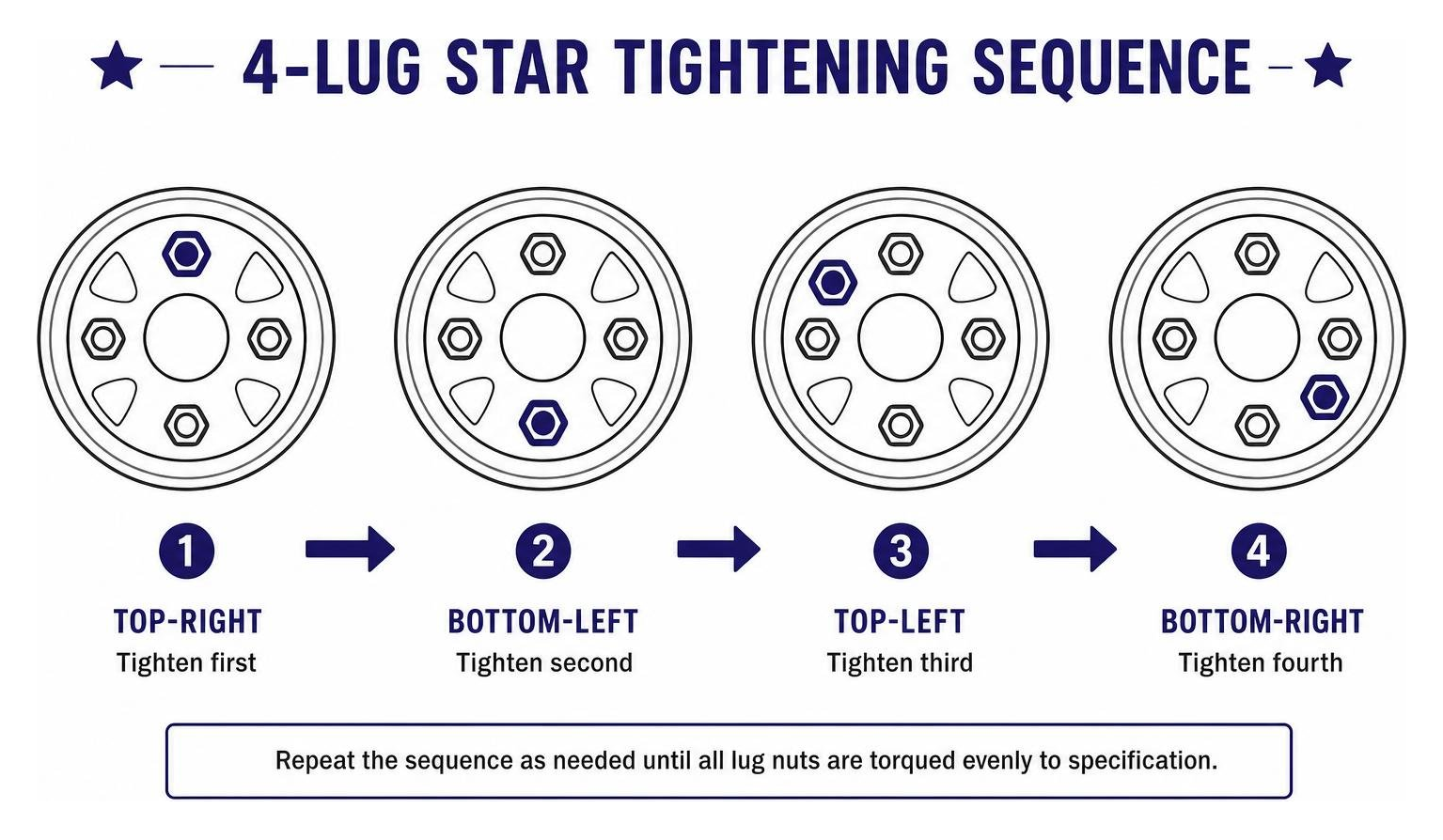
Proper Torque Specifications and Star Pattern
To prevent damage to your new aluminum or steel rims, always torque your lug nuts to the industry standard of 50 ft/lbs (some manufacturers allow up to 60-80 ft/lbs, but 50 ft/lbs is the safest sweet spot for most applications).
Always follow these critical installation steps:
- Hand-tighten first: Always thread the lug nuts on by hand for the first few turns to ensure they are not cross-threading.
- Do not use an impact gun: High-powered impact wrenches can easily over-torque, strip studs, or crack the delicate lug seats of aluminum wheels. Use a manual torque wrench instead.
- Use the Star Pattern: Tighten the lug nuts in a diagonal, crisscross sequence (Top-Right, Bottom-Left, Top-Left, Bottom-Right) to ensure the wheel draws flush against the hub evenly.
- Re-torque after driving: New wheels can settle slightly. We recommend checking and re-torquing your lug nuts after the first 10 to 15 miles of use.
Understanding Wheel Offset and Backspacing
Even if your bolt pattern is a perfect match, your new wheels might still rub against your cart's frame, leaf springs, or fender flares if the offset is incorrect. Wheel offset refers to where the mounting surface of the wheel sits in relation to its centerline.
- Centered Offset (3:5 or 0 offset): The mounting surface is directly in the middle. This keeps the tire centered in the wheel well and is common on stock, non-lifted carts.
- Negative Offset (offset pushing outward): The mounting surface is closer to the inside of the wheel, pushing the wheel and tire further outward away from the cart. This is highly common on lifted carts to provide clearance for wider all-terrain tires and prevent rubbing against the inner suspension.
When upgrading to larger tire packages, matching the correct offset to your cart's suspension setup is crucial. For an extensive look at how tire height and offset interact, explore our Golf Cart Tires and Wheels guide.
Frequently Asked Questions About Golf Cart Wheels
Can I use car or ATV wheels on my golf cart?
No, we do not recommend using standard car or ATV wheels on a golf cart without proper adapters. While some older compact cars use a 4x100mm pattern that looks close, forcing them onto a 4x4 (4x101.6mm) golf cart hub is unsafe. Additionally, automotive wheels have different load ratings, center bores, and dramatic offsets that can cause immediate tire rubbing and suspension wear.
Do I need wheel adapters or spacers for my cart?
You only need wheel adapters if you are determined to run a non-standard bolt pattern (like converting your 4x4 hub to a 4x100mm or 4x114.3mm automotive pattern).
However, wheel spacers are highly useful. If you are installing wider custom tires and find they are rubbing against your cart's inner fender or leaf springs, a set of 1-inch or 2-inch wheel spacers (maintaining the standard 4x4 to 4x4 pattern) will widen your track, clear the suspension, and give your cart a wider, more aggressive stance.
What is the proper torque specification for golf cart lug nuts?
The industry standard torque specification is 50 ft/lbs. Always use a manual torque wrench and tighten the lugs in a diagonal star pattern. Hand-tightening the nuts first prevents cross-threading and protects your studs from expensive thread damage.
Conclusion
Upgrading your golf cart's wheels is one of the most rewarding projects you can undertake, instantly transforming both its aesthetic appeal and its ride quality. By confirming your standard 4x4 inch (4x101.6mm) golf cart wheel bolt pattern, matching the correct lug nut threads (SAE for Club Car/EZGO, Metric for Yamaha), and torqueing the hardware to 50 ft/lbs, you ensure a safe and successful upgrade.
At Extreme Kartz, we specialize in helping you get the perfect fit the first time. We focus on system-based solutions, ensuring your wheels, tires, and lift kits work together in perfect harmony. All of our kits ship in 1-2 business days. If you are ready to pick out your next set of wheels or need expert advice on clearance and offset, explore our full collection of Golf Cart Tires and Wheels or reach out to our team today!
Related Products

Vendor: WH1001 10" Bulldog Black Alloy Wheel and TR1007 20" X10 -10 DOT All Terrain Tire - Set of 4

Vendor: WH1009 10" Revolver - Machined/Black and TR1007 20" X10 -10 DOT All Terrain Tire - Set of 4

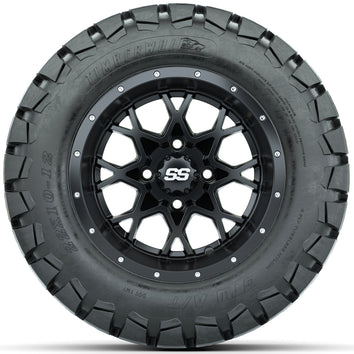
Vendor: Set of (4) 12 in GTW Vortex Wheels with 22x10-12 GTW Timberwolf All-Terrain Tires


