


The Ultimate Guide to Golf Cart Rims and Tires
Why the Right Golf Cart Rims and Tires Change Everything

Golf cart rims and tires are one of the most impactful upgrades you can make to your cart — affecting ride quality, ground clearance, speed, handling, and style all at once.
Here's a quick overview of what you need to know:
| Topic | Key Takeaway |
|---|---|
| Wheel sizes | 8", 10", 12", 14", and 15" are the most common |
| Tire diameters | 18" to 23"+ depending on lift status |
| Tire types | Turf, Street, All-Terrain, Mud-Terrain, Low-Profile, Hybrid |
| Cart compatibility | Club Car, EZGO, Yamaha, ICON, Star EV, Evolution |
| Lift kit required? | Yes, for tires over ~18–20" on most stock carts |
| DOT-approved tires | Required for street-legal use |
| Pre-mounted combos | Easiest option — comes balanced and ready to install |
| Shipping | Kits ship in 1-2 business days |
| Typical cost | $400–$1,100 for a complete set of four |
Whether you're replacing worn-out stock tires, going bigger for off-road trails, or upgrading the look of your neighborhood cruiser, the options can feel overwhelming. There are over 1,100 tire and wheel combinations available across just the major categories — and that's before you factor in your specific cart model, lift height, bolt pattern, and intended terrain.
This guide cuts through the noise. It covers everything from sizing and fitment to tire types, rim finishes, and long-term maintenance — so you can make a confident decision the first time.
I'm Martin Davis, owner of Extreme Kartz and an experienced guide in the golf cart upgrade space, helping owners find the right golf cart rims and tires for their exact cart, terrain, and goals. Let's start with the fundamentals so you can move forward with clarity.
Understanding Golf Cart Rims and Tires Sizes and Fitment
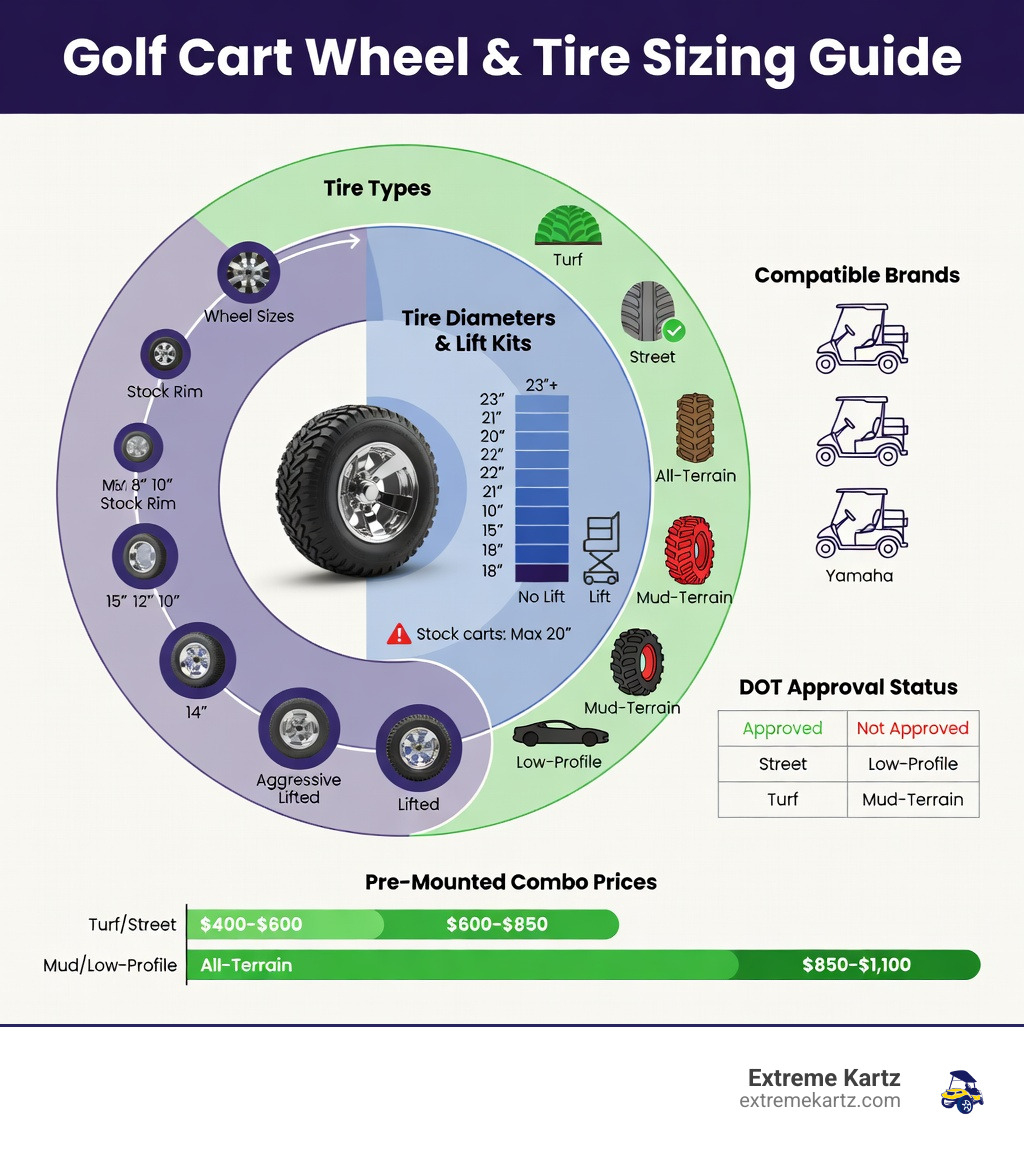
When we talk about golf cart rims and tires, we are looking at two distinct measurements that must work in harmony: the wheel diameter (the metal rim) and the tire's outside diameter (OD).
Standard golf cart wheels typically come in 8, 10, 12, 14, and even 15-inch sizes. The 8-inch and 10-inch sizes are common for "non-lifted" or stock carts. However, if you want that aggressive, modern look, 12-inch and 14-inch wheels are the industry favorites.
The tire height (OD) is where fitment gets tricky. Most stock carts come with 18-inch tall tires. As you move up to 20-inch, 22-inch, or 23-inch tires, you gain ground clearance but run the risk of the rubber rubbing against your cart's body or wheel wells. To help you navigate this, we've outlined the general requirements below.
Tire OD vs. Lift Kit Requirements
| Tire Outside Diameter (OD) | Lift Kit Required? | Notes |
|---|---|---|
| 18" | No | Standard OEM size for most carts. |
| 20" | Maybe | Fits most EZGOs; usually requires 3" lift for Club Car/Yamaha. |
| 22" | Yes | Requires a 4" to 5" lift kit. |
| 23" | Yes | Requires a 5" to 6" lift kit. |
| 25"+ | Yes | Extreme lift kits (6"+) and possible clearancing needed. |
For a deeper dive into brand-specific wheel options, check out our guide on Golf Cart Wheels for Yamaha, EZGO, ClubCar.
Impact of Wheel Size on Performance and Speed
Changing your wheel and tire size isn't just an aesthetic choice; it's a performance modification.
- Ground Clearance: Larger tires (22"–23") naturally sit higher, allowing you to traverse rocky trails or uneven neighborhood paths without scraping the undercarriage.
- Top Speed: A larger tire has a larger circumference. For every rotation of the motor, you travel further, which can increase your top speed by 1-2 mph.
- Torque Loss: The trade-off for speed is torque. Larger tires require more energy to get moving. If you have a heavy 4-passenger cart or live in a hilly area, you might notice a slight "sluggishness" on inclines when moving to 23-inch tires.
- Ride Quality: This is often determined by the sidewall. A 10-inch wheel with a "beefy" tire (like a 205/50-10) has more rubber to absorb bumps. Conversely, a 14-inch wheel with a low-profile tire (like a 215/40-12 or 205/30-14) offers a "stiffer," more automotive-like handling feel but transmits more vibration from the road.
How to Read Tire Sizes: Standard vs. Low-Profile
One reason bigger wheels don't always mean a taller cart is the tire's profile — the thickness of the rubber sidewall between the rim and the road.
- Standard / High-Profile: More rubber between the rim and the ground. These give a cushioned ride and are typical for 8" and 10" wheels.
- Low-Profile: A thin sidewall, usually paired with 12", 14", or 15" wheels. Low-profile tires deliver a sleek, automotive look and stay put in turns, but ride a little firmer because there's less rubber to absorb bumps.
This is why you can run a 14-inch wheel and still fit without a lift — pair it with a low-profile tire that keeps the total height at 18". When you read a size like 205/50-10 or 215/40-12, the first number is the tread width (mm), the second is the aspect ratio (sidewall height as a percentage of width), and the last is the wheel diameter (inches).
Matching Golf Cart Rims and Tires to Your Cart Model
Not all carts are created equal. While most major brands (Club Car, EZGO, Yamaha) use a standard 4x4 bolt pattern (4 bolts spaced 4 inches apart, or 4x101.6mm), the hardware and clearance differ.
- Club Car: Known for tighter wheel wells. Even a 20-inch tire often requires a small lift to avoid rubbing during sharp turns.
- EZGO: Generally the most "forgiving" for larger tires. Many stock EZGO TXT or RXV models can fit a 20-inch tire without a lift kit.
- Yamaha: Yamaha carts often use metric lug nuts (12mm x 1.25), whereas Club Car and EZGO typically use imperial (1/2" x 20). Always ensure your lug nut set matches your axle threads!
- Offset: Most aftermarket golf cart rims and tires feature a "negative offset." This pushes the wheel further away from the cart, widening the stance. This is crucial for stability on lifted carts and provides the necessary clearance for suspension components.
Brand-Specific Lift Requirements
The general OD table above is a good starting point, but clearance ultimately comes down to your exact platform. Here's how the big three break down:
- Club Car (DS / Precedent / Onward): The tightest of the bunch. A stock DS or Precedent typically maxes out around an 18.5" tire. Plan on a 1"–3" lift for 20" tires, a 4" lift for 22", and a full 6" A-arm lift for 23" all-terrains.
- EZGO (TXT / RXV): The most tire-friendly from the factory — many can run a 20.5" tire on stock suspension (2016+ models may vary). Step up to a 3" mid-rise kit for 22" tires and a 5"–6" lift for 23".
- Yamaha (G-Series / Drive / Drive2): Older G-series carts are tight like Club Cars and usually need a 3" lift for 20" tires. The newer Drive (G29) and Drive2 have larger wheel wells and often clear 20" stock, but 22"–23" tires need a 5"–6" A-arm kit for proper steering geometry.
Ready to go bigger? Explore Extreme Kartz lift kits to match the right suspension system to your model.
A Note on Disc Brakes and 10-Inch Wheels
If you've upgraded to a high-performance hydraulic disc brake kit, be careful with 10-inch wheels. Many 10-inch rims won't clear disc brake calipers when the rotors are larger than 7.9 inches — the caliper physically hits the inside of the rim. In those cases, move up to a 12-inch or 14-inch wheel for the internal clearance you need.
Ready to swap them out? Follow our How to Change Your Golf Cart Wheels & Tires: A Step-by-Step Guide for a smooth installation.
Choosing the Right Tires for Your Terrain and Use Case
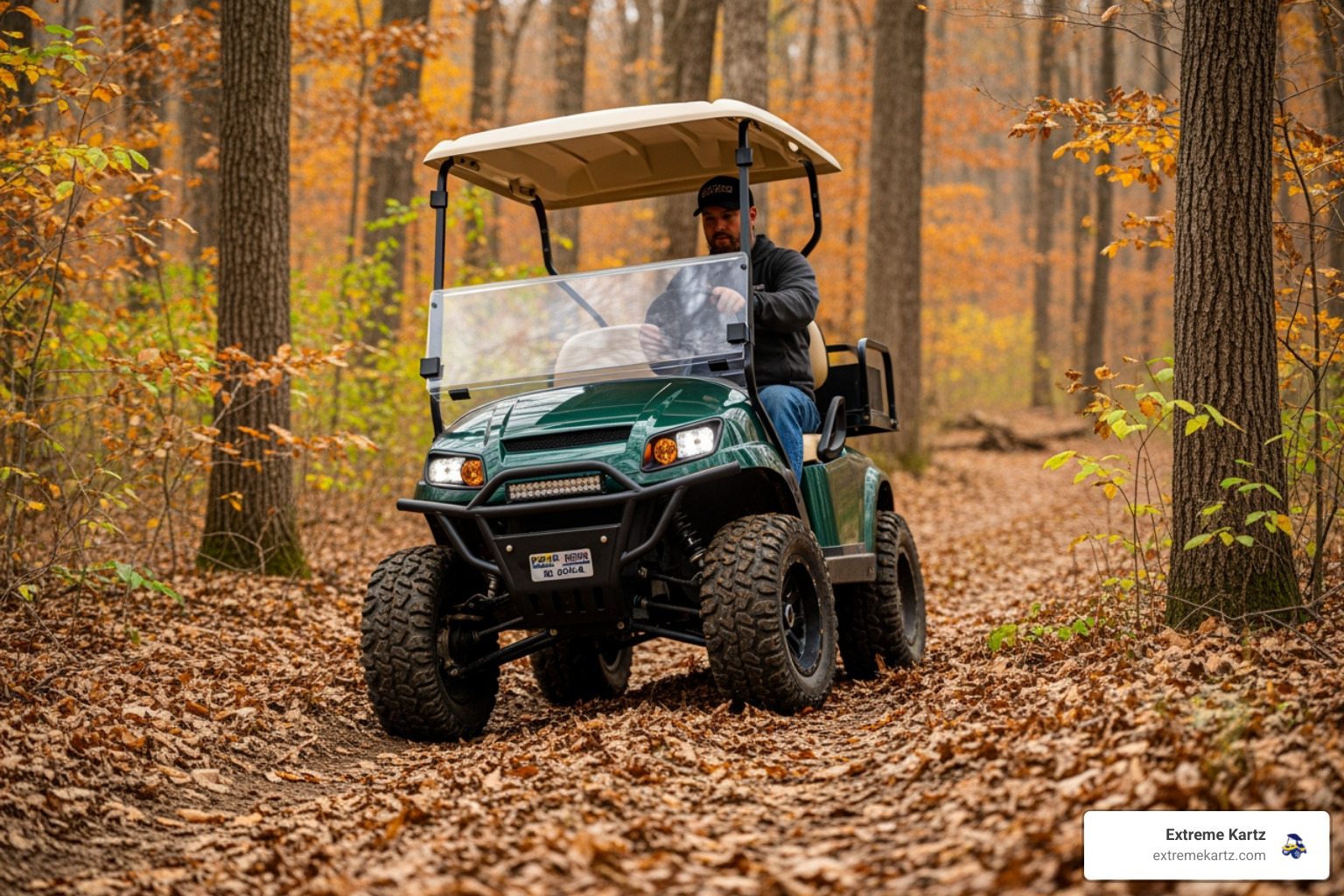
The "best" tire depends entirely on where you drive. We categorize tires into four main buckets:
- Turf Tires: These are the standard "S-pattern" or "Sawtooth" tires. They are designed specifically to be gentle on golf course grass while providing enough grip for paved paths.
- Street Tires: These look like miniature car tires. They offer the best grip on pavement and the quietest ride.
- All-Terrain (AT): The most popular choice for neighborhood "crossovers." They feature a deeper tread than street tires but aren't as aggressive as mud tires. They work well on gravel, dirt, and grass without being overly noisy on the road.
- Mud-Terrain (MT): These have massive lugs designed to "self-clean" in deep mud or loose sand. They look incredible on lifted carts but can be noisy and vibrate on smooth pavement.
For a detailed breakdown of tread patterns, visit Golf Cart Tires for Every Terrain.
DOT-Approved Tires for Street-Legal Use
If you plan on driving your cart on public roads (where local laws allow), you need DOT-approved tires. These tires meet U.S. Department of Transportation safety standards for speed, load, and durability.
Brands like GTW, Madjax, Nivel, and SteelEng offer excellent DOT-rated options for street-focused setups. Radial tires are a premium sub-set of DOT tires; they use a different internal construction (belt plies running 90 degrees to the direction of travel) that typically delivers a smoother ride, better heat dissipation, and longer tread life on hot pavement. You can learn more about these safety standards in our Golf Cart Tires overview.
Off-Road Performance and Lifted Combinations
For those taking their carts into the wild, a lifted combination is the only way to go. Pairing a 5-inch or 6-inch lift kit with 23x10-12 or 23x10-14 tires transforms a golf cart into a capable utility vehicle.
Popular off-road tire series like the Madjax Timberwolf and Raptor are designed with reinforced sidewalls (often 4-ply or 6-ply) to resist punctures from thorns and sharp rocks. A 6-ply rating is the gold standard for durability if you're hauling heavy loads or navigating brush. Check out the latest in off-road tech here: New Madjax Timberwolf and Raptor Series Tires.
Selecting Premium Rims, Finishes, and Maintenance
The rims are the "jewelry" of your golf cart. While basic steel wheels are durable and functional, most owners opt for cast aluminum alloy rims. Aluminum is lighter, dissipates heat better, and allows for much more intricate designs.
Popular Finishes
- Glossy Black: Sleek and modern; hides brake dust well.
- Matte Black: Offers a rugged, stealthy "tactical" look.
- Machined: This finish features aluminum that has been cut to a bright shine, often contrasted with black or gunmetal paint in the recesses.
- Gunmetal: A sophisticated matte or semi-gloss grey that hides brake dust exceptionally well — a great middle ground between black and machined.
- Chrome: The classic high-shine look. It requires the most maintenance to keep clean but offers unmatched "pop" in the sun.
Choosing the right look is a personal journey, but we have some tips to help: Golf Cart Rims: How to Select the Perfect Set.
Popular Wheel Designs and Pricing
Style is subjective, but a few designs have become community favorites. The Vampire wheel, with its aggressive multi-spoke look, is a best-seller for owners who want a rugged appearance, while Tempest and Matrix designs offer a more refined, concave face that works on both street and off-road builds. Galaxy wheels round out the premium end.
Pricing scales with the complexity of the design and the tire paired with it. A standard 12" wheel and low-profile tire kit typically starts around $760 for a set of four, while premium territory — like 14" Galaxy wheels paired with high-performance off-road tires — can reach $1,360 or more.
Recommended Tire Brands and Construction
For rims, MODZ is a powerhouse known for innovative designs and reliable finishes. On the tire side, Arisun and Wanda are go-to names — Arisun in particular produces the X-Armory line, which uses steel-belted radial construction.
Why does construction matter? Most standard golf cart tires are "bias-ply," which is fine at low speeds. But if you run a high-speed motor, spend a lot of time on pavement, or drive a heavier lithium-powered cart, 6-ply radials offer superior durability, better heat dissipation, and a much smoother ride under the added weight and torque.
The Benefits of Pre-Mounted Golf Cart Rims and Tires
At Extreme Kartz, we almost always recommend buying complete wheel and tire combos. Why?
- Professional Mounting: Tires are mounted to the rims using professional equipment, ensuring the bead is seated correctly without scratching your new rims.
- Convenience: They arrive at your door aired up and ready to bolt on. No trips to a local tire shop (many of which don't have the right equipment for small golf cart wheels). Plus, all our kits ship in 1-2 business days.
- Bundle Savings: Buying as a set of four is significantly cheaper than buying individual parts.
- Included Hardware: Most combos include the necessary center caps and a fresh set of lug nuts.
Once installed, don't forget the final step: alignment. A cart that pulls to one side will "scrub" the tread off your expensive new tires in months. See our guide: How to Properly Align Your Golf Cart Wheels for a Smooth Ride.
Long-Term Care and Durability
To get the most out of your investment, follow these maintenance rules:
- Torque & Re-Torque: Tighten lug nuts in a "star pattern" so the wheel sits flush against the hub, then re-torque them after your first 30 minutes of driving.
- Alignment (Toe-In): After new tires or a lift, check your toe-in. A slight toe-in of about 1/8 inch keeps the tires from scrubbing and wearing out in months rather than years.
- Tire Pressure: Check your PSI monthly. Most golf cart tires run between 15 and 25 PSI. Under-inflation causes sluggishness and sidewall wear; over-inflation leads to a harsh ride and center-tread wear.
- Rotation: Just like a car, your front tires wear differently than your rears (especially since the rear tires are the "drive" tires). Rotate them every 6–12 months. Use our Golf Cart Tire Rotation Guide for the correct patterns.
- Cleaning: Use mild soap and water. Avoid harsh "tire shine" chemicals that contain petroleum, as they can actually dry out the rubber over time and cause cracking (dry rot). Skip acid-based cleaners on aluminum or chrome rims.
Frequently Asked Questions about Golf Cart Rims and Tires
What is the largest tire I can fit without a lift kit?
It depends on the cart. For a stock EZGO, you can usually fit up to a 20.5-inch tire. For Club Car and Yamaha, we recommend sticking to 18.5 inches unless you are prepared for some minor rubbing or plan to install a lift.
Do I need special lug nuts for aluminum rims?
Yes. Most aftermarket aluminum rims require "tapered" lug nuts to seat properly in the wheel's mounting holes. Additionally, the lug holes on aluminum rims are often narrower than steel wheels, requiring a "thin-wall" socket or a specific spline-drive tool.
What is the difference between steel and aluminum rims?
Steel wheels are the "budget" option — durable but heavy and prone to rust over time. Aluminum (alloy) rims are lighter, which is easier on your battery range, and they come in a huge variety of finishes like machined, gloss black, and gunmetal. Most owners upgrading their look choose aluminum.
Can I use 10-inch wheels with disc brakes?
Often not. Most 10-inch wheels won't fit over hydraulic disc brakes with rotors larger than 7.9 inches — the caliper is too big to clear the inside of the rim. If you've upgraded to big disc brakes, plan on running at least a 12-inch wheel.
How do I know if my tires are street legal?
Look for the "DOT" symbol stamped into the sidewall of the tire. If it's there, the tire has been tested and approved for use on public roads. If it says "NHS" (Non-Highway Service), it is strictly for off-road or golf course use.
Conclusion
Upgrading your golf cart rims and tires is the fastest way to turn a standard fleet vehicle into a personalized performance machine. By understanding the relationship between wheel size, tire diameter, and lift requirements, you can ensure your cart not only looks better but drives better too.
At Extreme Kartz, we don't just sell parts; we provide system-based solutions. We focus on fitment accuracy and real-world performance to ensure that when your new wheels arrive, they work perfectly with your specific Club Car, EZGO, or Yamaha model.
Ready to transform your ride? Check out golf cart wheel and tire combos to get a matched set that fits and performs the way you want—and if you have any questions about sizing, bolt pattern, offset, or clearance, our team is here to help you dial in the right setup.
Related Products

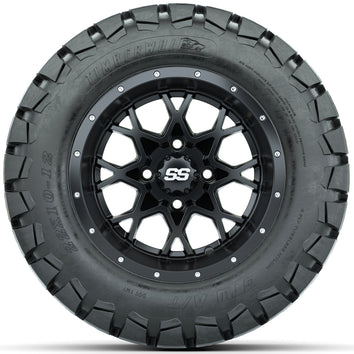
Vendor: Set of (4) 12 in GTW Vortex Wheels with 22x10-12 GTW Timberwolf All-Terrain Tires


Vendor: Set of (4) 15" GTW Spyder Red/Black Wheels with 23x10-R15 Nomad All-Terrain Tires

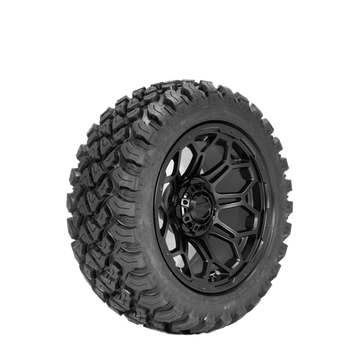
Vendor: Bravo 14" Matte Black Finish with 23X10-R14 Nomad Radial Tire Set of 4


Vendor: Set of (4) 15" GTW Bravo Matte Black Wheels with 23x10-R15 Nomad All-Terrain Tires


