


A – Z Guide to Golf Cart Wheels
Why Getting Your Golf Cart Wheels Right Changes Everything

Golf cart wheels are one of the most impactful upgrades you can make to your cart — affecting how it looks, handles, and performs across different terrain.
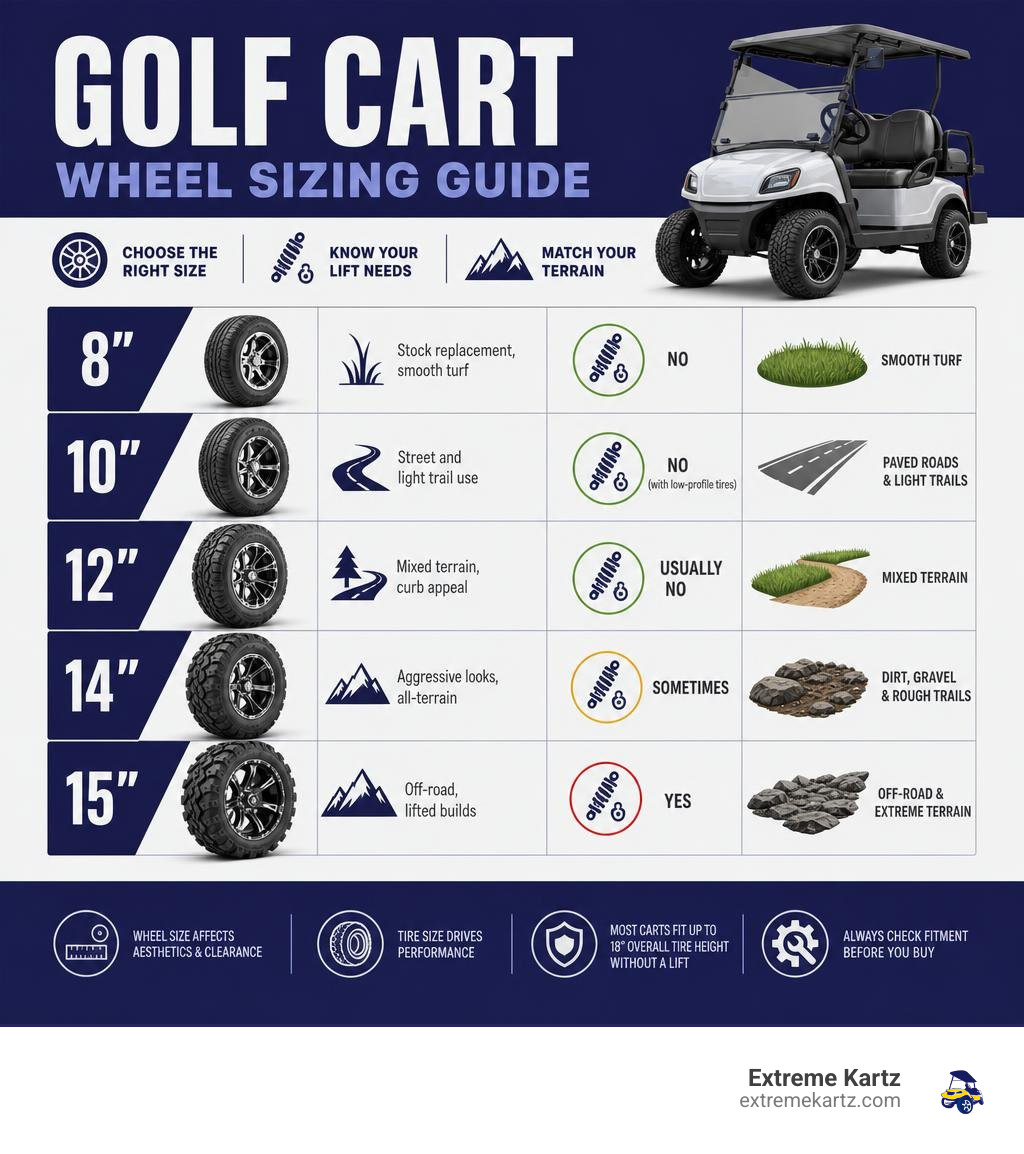
Here's a quick reference to the most common wheel sizes and what they're best for:
| Wheel Size | Best For | Lift Kit Needed? |
|---|---|---|
| 8" | Stock replacement, smooth turf | No |
| 10" | Street and light trail use | No (with low-profile tires) |
| 12" | Mixed terrain, curb appeal | Usually no |
| 14" | Aggressive looks, all-terrain | Sometimes |
| 15" | Off-road, lifted builds | Yes |
A few things worth knowing upfront:
- There are over 1,500 wheel and tire combinations available for golf carts
- Wheel size primarily affects aesthetics and clearance — tire size drives performance
- Most standard carts fit an 18" overall tire height without any lift kit
- Major brands like Club Car, EZGO, and Yamaha each have specific fitment requirements
Getting the right combination isn't complicated once you know what to look for — and that's exactly what this guide covers.
I'm Martin Davis, owner of Extreme Kartz, and I've spent the past several years helping golf cart owners across all 50 states find the right golf cart wheels for their specific cart, terrain, and budget. Whether you're replacing a worn-out set or building a fully lifted custom rig, the sections below will walk you through everything you need to know to make a confident decision.
Key Factors to Consider When Buying Golf Cart Wheels
When you begin shopping for new golf cart wheels, it is easy to get distracted by the beautiful finishes and aggressive designs. However, making a smart purchase requires understanding the underlying specifications. Choosing the wrong physical dimensions can lead to tires rubbing against your cart’s frame, poor steering clearance, or wheels that simply will not bolt onto your hubs.
Wheel Materials
The material of your wheel dictates its weight, durability, maintenance requirements, and overall style. The industry standard has shifted heavily toward cast aluminum alloys due to their lightweight properties and resistance to rust, though traditional steel options still have a firm place in utility and budget builds.
Offset and Backspacing
Offset is one of the most misunderstood concepts in wheel fitment, yet it is critical for preventing tire rub. Offset refers to the distance between the mounting surface of the wheel (where it meets the hub) and the physical centerline of the wheel.
Most stock golf cart wheels have a "centered" or "neutral" offset, meaning the mounting surface is directly in the middle of the wheel width. However, aftermarket wheels almost always feature a negative offset. A negative offset pushes the wheel outward, away from the cart's suspension and frame.
In the golf cart world, you will frequently see offset expressed as a ratio, such as 3+4 offset (often written as ET-15 or ET-25).
- The first number (3) represents the inboard width in inches (backspacing).
- The second number (4) represents the outboard width in inches.
A 3+4 offset wheel pushes the tire further out, widening your cart's overall stance. This provides the necessary clearance to prevent wider tires from rubbing against your shock absorbers, leaf springs, or frame rails while significantly improving lateral stability.
Width
Aftermarket golf cart wheels generally come in widths of 6", 7", or 8". Matching your wheel width to your chosen tire width is critical. If a wheel is too narrow for a tire, the tread will balloon outward, reducing your contact patch and causing uneven wear. If the wheel is too wide, the tire sidewall will stretch excessively, leaving the wheel rim vulnerable to curb damage and compromising ride comfort.
Bolt Patterns
Virtually all standard golf carts (including Club Car, EZGO, and Yamaha) utilize a standard 4x4 bolt pattern (also designated as 4x101.6mm). This means the wheel has four lug holes arranged in a circle with a diagonal measurement of 4 inches from the center of one bolt hole to the center of the opposite hole. While the bolt pattern is nearly universal, the lug nuts themselves are not—a detail we will cover in depth below.
Understanding Golf Cart Wheels Sizes and Performance
The physical diameter of your wheel plays a massive role in how your golf cart rides, handles, and looks. As we look at the market in June 2026, owners have more choices than ever before. Let's break down how each size performs in the real world.
8-Inch Wheels
This is the classic OEM size. Typically paired with balloon-like, high-profile tires (such as 18x8.5-8), 8-inch setups prioritize cushion and turf protection over style. Because there is a massive amount of rubber sidewall between the metal wheel and the ground, these wheels offer a very soft, forgiving ride. However, they lack stability at higher speeds and offer zero cornering performance.
10-Inch Wheels
A popular step up for owners who want to upgrade their look without installing a lift kit. Pairing a 10-inch wheel with low-profile tires keeps the overall height at 18 inches, ensuring a perfect fit on any stock cart. They offer a great balance: you get a modern, styled wheel while retaining enough tire sidewall to absorb pavement bumps. If you plan to install aftermarket front disc brakes, you must ensure your 10-inch wheels provide enough clearance, as some large-diameter disc brakes require a minimum of a 12-inch wheel.
12-Inch Wheels
Currently the "sweet spot" for many neighborhood cruisers. A 12-inch wheel offers a highly visible, stylized look. When wrapped in low-profile street tires, they provide crisp, responsive steering because there is less sidewall flex. The trade-off is a slightly firmer ride over potholes and uneven expansion joints.
14-Inch Wheels
If you want your cart to turn heads, 14-inch wheels are the standard. They allow for intricate spoke designs and deep-dish styling. Because they are typically paired with larger street or off-road tires, they often require a lift kit to prevent body rubbing. The minimal tire sidewall on 14-inch street setups means you will feel more of the road, but the handling precision is unmatched.
15-Inch Wheels
Reserved for ultimate custom builds and heavy off-road machines. These massive wheels look incredible but demand a high-quality lift kit and proper suspension clearance. They are built for those who want maximum ground clearance and a dominant visual presence.
| Wheel Size | Average Wheel Weight | Common Tire Pairing | Ride Quality | Handling/Steering Response |
|---|---|---|---|---|
| 8" | 4–6 lbs | 18x8.5-8 (High Profile) | Extremely Soft / Plush | Loose / High Body Roll |
| 10" | 6–8 lbs | 205/50-10 (Low Profile) | Soft / Comfortable | Controlled / Predictable |
| 12" | 8–10 lbs | 215/40-12 (Ultra-Low) | Moderate / Firm | Sharp / Responsive |
| 14" | 10–12 lbs | 205/30-14 (Street) or 23x10-14 (Off-Road) | Firm (Street) / Balanced (Off-Road) | Very Sharp / Minimal Flex |
| 15" | 12–15 lbs | 23x10-15 or 25x10-15 (Off-Road) | Firm / Off-Road Cushioned | Heavy / Aggressive |
Wheel Materials: Aluminum vs Steel
Choosing between aluminum and steel is about more than just budget—it affects your cart's performance, maintenance routine, and longevity.
Steel Rims
Steel wheels are the workhorses of the golf cart industry. They are incredibly durable, inexpensive, and easy to manufacture. If you bend a steel wheel on a rock or a curb, you can often hammer it back into shape.
- Pros: Highly affordable, structurally resilient, and perfect for utility, industrial, or budget-focused applications.
- Cons: They are heavy, which increases unsprung weight and saps motor torque. They are also highly susceptible to rust and corrosion if the powder coat or paint is chipped, and they offer very basic, utilitarian styling.
Cast Aluminum Wheels
Aluminum alloy wheels are the preferred choice for custom upgrades. By mixing aluminum with other metals, manufacturers create lightweight wheels that can be cast into stunning, complex geometric shapes.
- Pros: Extremely lightweight (which reduces strain on your motor and drivetrain), naturally resistant to rust and corrosion, and available in endless finishes (gloss black, matte bronze, chrome, machined, and metallic colors).
- Cons: More expensive than steel and can crack rather than bend under extreme, high-impact forces.
For those looking for high-end racing or performance applications, premium options like Golf Cart - Racing Wheels | Keizer Aluminum Wheels offer multi-piece, ultra-lightweight forged designs ranging from $200 to $425 per wheel. These specialized wheels provide maximum strength-to-weight ratios for racing and high-performance builds.
Choosing the Right Tire and Wheel Combo
Buying your wheels and tires together as a pre-mounted package is almost always the smartest move. It saves you a trip to a local tire shop, guarantees that the tire is properly matched to the wheel width, and often saves you money. Choosing a pre-configured combo ensures a hassle-free installation and optimal performance right out of the box.
To choose the perfect combo, you must first align your selection with where you actually drive.
Matching Golf Cart Wheels to Your Cart Brand
While the 4x4 bolt pattern is standard across the "Big Three" golf cart manufacturers, there are brand-specific nuances you must address before buying.
Club Car Fitment
Club Car models (such as the DS, Precedent, Onward, and Tempo) have notoriously tight front wheel wells. If you install an 18-inch overall height tire, it will fit without a lift kit. However, if you attempt to install a 20-inch tire on a stock Club Car, you will experience severe tire rub when turning. Club Cars generally require a 1-inch to 3-inch lift kit to run 20-inch tires safely. When shopping for your Club Car, always check our dedicated Club Car Parts & Accessories page to ensure proper suspension clearance.
EZGO Fitment
EZGO carts (such as the TXT, RXV, and Express) are much more forgiving. Their factory wheel arches are wider and taller. You can comfortably run up to a 20-inch overall diameter tire on a stock, non-lifted EZGO without rubbing. For anything larger (22-inch or 23-inch tires), you will need to step up to a 3-inch to 6-inch lift kit. Find compatible upgrades on our EZGO Parts & Accessories page.
Yamaha Fitment
Yamaha carts require extra attention. Older G-series models have very limited clearance, whereas the newer Drive (G29) and Drive2 models feature generous factory wheel wells that can accommodate 20-inch tires without a lift kit.
Crucially, Yamaha is the only major brand that uses metric lug nuts (M12 x 1.25), whereas Club Car and EZGO use standard imperial thread (1/2"-20). If you try to force imperial lug nuts onto a Yamaha's metric studs, you will strip the threads. Always specify your exact cart brand when ordering a combo package. Explore our tailored solutions on the Yamaha Parts & Accessories page.
Terrain-Specific Tire Selection
Choosing the correct tread pattern ensures you don't ruin your local golf course’s turf or get stuck in the mud on a weekend trail ride.

Street & Turf Tires
These tires feature a flat, smooth profile with shallow siping (grooves) designed to channel water away. They provide a quiet, smooth ride on asphalt and concrete while offering excellent grip on manicured grass without tearing it up. Many street tires are DOT-approved, meaning they meet federal safety standards for road use.
All-Terrain Tires
The ultimate all-rounder. All-terrain tires feature a slightly wrap-around tread pattern with deeper grooves than street tires, but they avoid the massive, loud lugs of pure off-road tires. They are perfect for neighborhood pavement, gravel pathways, and dry dirt trails.
Off-Road Tires
These tires feature aggressive, knobby tread designs (often called "mud tires") designed to dig into loose dirt, deep mud, sand, and rocky trails. They look incredibly tough, but they come with trade-offs: they are loud on asphalt, vibrate at higher speeds, wear down quickly on hard pavement, and will quickly tear up any golf course turf.
Tire Ply Ratings
Pay attention to the ply rating of your tires:
- 2-Ply: Very soft and lightweight, designed for maximum cushion on smooth golf courses. Highly susceptible to punctures.
- 4-Ply: The industry standard. Offers an excellent balance of puncture resistance, load capacity, and ride comfort.
- 6-Ply: Heavy-duty construction. Built for extreme off-road use, rocky environments, and utility carts carrying heavy loads. Excellent puncture resistance but rides noticeably firmer.
Lift Kit Requirements and Fitment Guide
If you want to run larger golf cart wheels and tires, a lift kit is often a necessity rather than an option. A lift kit raises the cart's frame and body, providing the vertical and lateral clearance needed to prevent the tires from contacting the body or mud flaps when turning or traveling over bumps. All of our high-quality lift kits ship in 1-2 business days.

There are several types of lift kits available, each serving a different style of riding:
- Spindle Lifts: Affordable and easy to install, these replace the stock steering spindles to lift the front of the cart. They widen the front track slightly, which increases stability, but they retain the stock suspension geometry.
- A-Arm Lifts: The gold standard for off-road performance. These replace the entire front suspension with an independent double A-arm setup, providing incredible suspension travel, adjustable camber/toe, and a much smoother ride over rough terrain.
- Drop Axle Lifts: Commonly used on older EZGO models, these replace the entire front axle with a dropped design. They are highly durable and economical for mild off-road use.
Sizing and Lift Height Chart
To make your upgrade seamless, use this sizing and lift height guide to determine exactly what your cart needs.
- 18-Inch Overall Height (e.g., 205/50-10, 215/40-12): Fits all standard, non-lifted carts (Club Car, EZGO, Yamaha) with zero modifications required.
- 20-Inch Overall Height (e.g., 205/65-10, 215/50-12): Fits stock EZGO and Yamaha Drive/Drive2 carts without a lift. Requires a 1-inch to 3-inch lift kit on Club Car models to prevent rubbing.
- 22-Inch Overall Height (e.g., 22x11-10, 22x10-12, 22x10-14): Requires a minimum of a 3-inch lift kit on EZGO and Yamaha carts, and a 4-inch lift kit on Club Car models.
- 23-Inch Overall Height (e.g., 23x10-12, 23x10-14): Requires a 5-inch to 6-inch lift kit across all brands to allow for proper suspension travel and steering articulation without body contact.
For a deep dive into suspension geometry and exact model-by-model clearance measurements, read our comprehensive Golf Cart Tires and Wheels Guide.
Frequently Asked Questions About Golf Cart Wheels
Do I need a lift kit for 12-inch or 14-inch wheels?
Not necessarily! This is one of the most common misconceptions. The wheel size does not dictate whether you need a lift kit; the overall tire diameter does.
For example, you can mount a 14-inch wheel wrapped in an ultra-low-profile street tire (such as a 205/30-14), and the overall height of the assembly will be 19 inches. This setup will fit on many stock, non-lifted carts. Conversely, if you mount a 12-inch wheel wrapped in a thick, knobby off-road tire (such as a 23x10-12), the overall height is 23 inches, which absolutely requires a 5-inch to 6-inch lift kit. Always focus on the overall tire diameter when calculating clearance.
What is wheel offset and why does it matter?
Wheel offset determines how far inward or outward your wheels sit relative to the cart's hubs. Standard stock wheels sit tucked inside the wheel wells. Aftermarket wheels almost always feature a negative offset (such as a 3+4 offset, which means the mounting surface is closer to the inside of the wheel, pushing the rest of the wheel outward).
This negative offset is crucial for two reasons:
- Clearance: It pushes wider tires away from your inner suspension components, steering linkages, and frame, preventing rubbing.
- Stability: It widens your cart's physical footprint (track width), which lowers its center of gravity and significantly reduces the risk of tipping, especially on lifted carts.
How do larger wheels affect my cart's speed and torque?
Installing larger overall diameter tires is like changing the gear ratio of your cart.
- Top Speed Increase: Because a larger tire has a larger circumference, it travels further with every single rotation of the motor. Upgrading from standard 18-inch tires to 23-inch tires can increase your top speed by 2 to 4 MPH without any motor modifications.
- Torque Reduction: The trade-off is a loss of low-end torque. Your motor has to work harder to turn those larger, heavier tires from a complete stop. You may notice slower acceleration and struggling performance when climbing steep hills or carrying heavy passenger loads.
If you are running large wheels and tires, we highly recommend upgrading to a high-capacity lithium battery system to maintain peak performance. Approved lithium brands like Bolt Energy, Eco Battery, Lithium Rhino, and Bedrock Battery deliver consistent, high-voltage power that prevents voltage sag, ensuring your cart has plenty of torque to turn large wheels up any hill.
Conclusion
Upgrading your golf cart wheels is the single best way to personalize your ride, improve trail clearance, and turn heads in your neighborhood. By understanding the relationships between wheel size, tire tread, offset, and lift kit requirements, you can build a setup that performs beautifully and safely.
At Extreme Kartz, we don't just sell individual parts—we focus on complete, system-based solutions. We want to ensure that every wheel, tire, and lift kit you purchase works in perfect harmony with your specific cart model. If you are unsure about fitment, clearances, or lug nut compatibility, don't guess! Reach out to our expert support team today for personalized recommendations and a fitment guarantee.
Ready to transform your cart? Explore our massive selection of premium upgrades and custom packages by visiting our Shop Extreme Kartz Golf Cart Accessories page.
Related Products

Vendor: RHOX RX281, White with Gloss Black, 14x7 ET-25

Vendor: RHOX RX284, Machined Silver, 12x6 ET-10

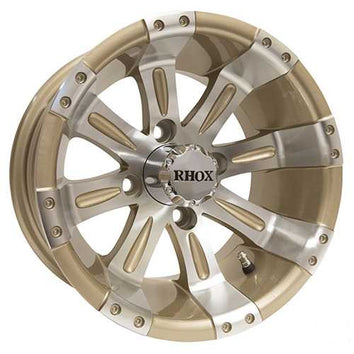
Vendor: RHOX Vegas, Machined w/Pearl w/ Center Cap, 12x7

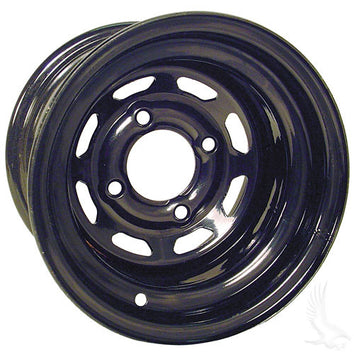
Vendor: Steel, Black 8 Window, 10x7 3:4 offset


