


The Aggressive Route: A Guide to Golf Carts with ATV Tires
Why Golf Cart Owners Are Switching to ATV-Style Tires
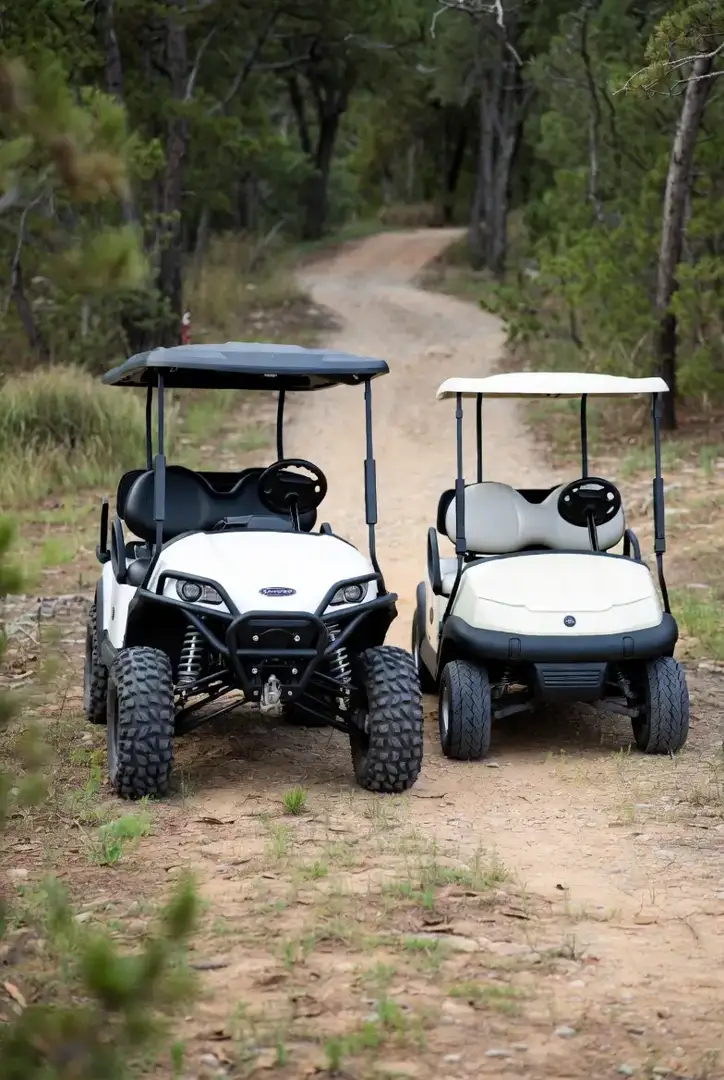
Golf cart ATV tires are a direct upgrade for cart owners who want to go beyond smooth pavement and manicured fairways. If you're trying to figure out how to install ATV tires on your cart, here's the short answer:
Quick-start guide to running ATV tires on a golf cart:
- Measure your current tire size — note height, width, and wheel diameter (e.g., 23x10.5-12)
- Check your lift height — most ATV-style tires 22" and up need at least a 3–6" lift kit
- Confirm wheel compatibility — bolt pattern, width, and offset must match your cart model
- Choose your ply rating — 4-ply for general use, 6-ply for heavier loads or rough terrain
- Verify DOT approval — required if you plan to drive on public roads
- Mount and test clearance — do a slow full-turn test before riding
That's the process in a nutshell. The sections below cover each step in detail.
Running ATV-style tires on a golf cart isn't just about looks. It changes how your cart handles gravel, grass, dirt trails, and uneven terrain — terrain that standard turf tires simply weren't built for. The golf cart tire market was valued at approximately $1.2 billion in 2023 and is growing fast, driven largely by owners customizing their carts for off-course and off-road use.
But this upgrade comes with real decisions. Tire size, lift height, wheel fitment, tread pattern, and DOT approval all affect whether your build works safely — or causes problems.
I'm Martin Davis, owner of Extreme Kartz, and I've spent years helping cart owners across the country navigate golf cart ATV tires — from basic size questions to full lifted builds on Club Car, EZGO, and Yamaha platforms. This guide covers everything you need to make a confident, compatible choice.
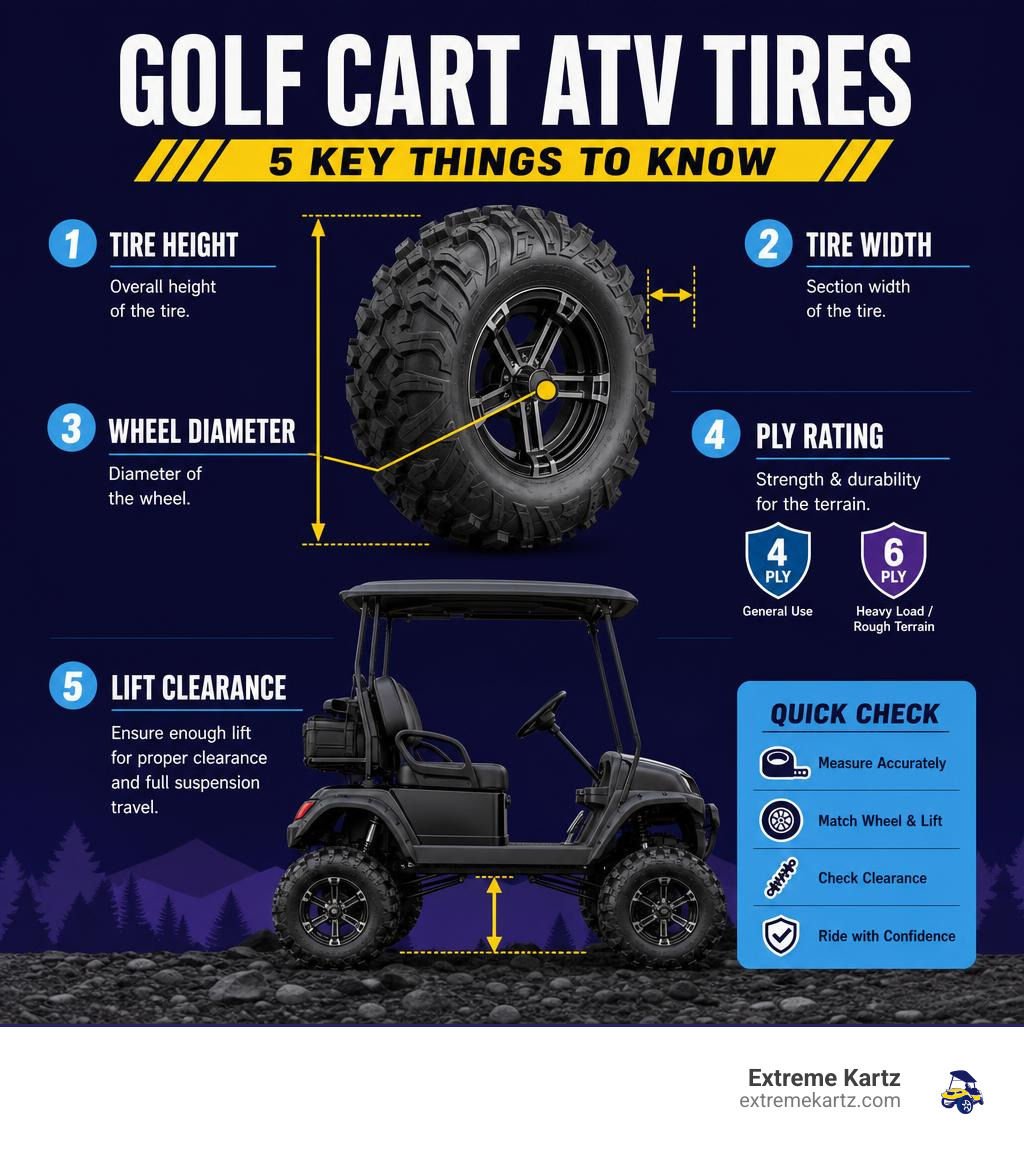
Golf cart ATV tires vs standard golf cart tires
When we look at standard turf tires side-by-side with ATV-style tires, the structural differences are obvious. Standard turf tires are designed with shallow, tightly packed tread blocks to protect delicate golf course grass. They are lightweight, have low rolling resistance, and offer a quiet ride on flat pavement.
ATV-style all-terrain tires, however, feature deep tread depths, thicker sidewalls, and aggressive shoulder lugs. They are built to dig into mud, gravel, loose dirt, and wet grass. This extra traction means more steering effort is required, and the aggressive tread can produce noticeable road noise on smooth pavement. The added weight of these tires also creates more rolling resistance, which can impact your cart's braking feel and overall battery range.
| Feature | Standard Turf Tires | ATV-Style All-Terrain Tires |
|---|---|---|
| Primary Terrain | Golf courses, manicured turf, smooth pavement | Trails, gravel, mud, sand, light off-road |
| Tread Depth | Shallow (approx. 5/32" to 7/32") | Deep (approx. 10/32" to 15/32" or more) |
| Sidewall Strength | Low (typically 2-ply bias) | High (4-ply or 6-ply rated) |
| Ride Height | Low (usually 18" total diameter) | High (20" to 24" total diameter) |
| Turf Protection | Excellent (will not tear grass) | Low (aggressive lugs can scar manicured lawns) |
| Road Noise | Silent | Moderate to high hum on pavement |
| Steering Effort | Low and light | Moderate to high (especially at low speeds) |
When Golf cart ATV tires make sense
Upgrading to golf cart ATV tires is the perfect route if your cart is a workhorse or an adventure vehicle. If you use your cart for trail riding, navigating gravel roads, hauling gear on hunting property, or driving around campgrounds and farms, aggressive tires are a necessity. They are also ideal for neighborhood cruisers that need to traverse beach paths or muddy, unpaved shoulders. If your cart is equipped with a rear seat kit or cargo box to carry heavier passengers and utility loads, the extra ply rating and tread bite of an ATV-style tire will prevent slipping on wet grass and loose surfaces.
Where standard golf cart tires still win
Standard turf tires are still the champion if your cart spends 90% of its time on golf courses or highly manicured turf. In fact, many golf course superintendents have strict rules banning aggressive knobby tires because they can easily tear up fairways and greens. Standard low-profile tires also provide a whisper-quiet ride on smooth pavement, offer minimal rolling resistance for maximum battery range, and do not require expensive lift kits to fit your vehicle.
Key performance tradeoffs before upgrading
Before making the leap, we always advise customers to weigh the performance tradeoffs. While you gain immense traction and an commanding off-road look, you will experience changes in ride comfort, steering feel, and braking distance due to the heavier tire weight. Furthermore, increasing your tire height changes your speedometer reading and places a higher load on your electric motor and speed controller. If your suspension is worn out, larger tires can easily hit common rubbing points like front fender wells and rear body panels when turning or carrying passengers. For a deeper look at balancing these factors, read our guide on Golf Cart Tires for Every Terrain.
How to choose the right size, ply rating, and wheel setup
Choosing the perfect tire and wheel combination requires understanding tire sizing numbers. When looking at a tire size like 23x10.5-12, the first number (23) is the overall tire height in inches when fully inflated. The second number (10.5) represents the section width of the tire in inches. The final number (12) is the wheel (rim) diameter in inches that the tire must be mounted on.

Most modern off-road tires are tubeless, meaning they do not require an inner tube, making them easier to patch and maintain. When choosing wheels, you must also consider wheel offset and the bolt pattern to ensure the wheel clears your suspension components. For a complete breakdown of tire sizes, check out our Golf Cart Tires 14 Complete Guide.
Common all-terrain golf cart tire sizes
All-terrain tires are available in heights ranging from 18 inches up to 24 inches, designed to fit wheel diameters from 8 inches to 15 inches.
- 18-inch tires (such as low-profile or standard turf replacements) typically fit on 8-inch or 10-inch wheels without a lift.
- 20-inch tires (like the popular 20x10-12 size) balance off-road capability with easy fitment. Learn more in our 20x10-12 Golf Cart Tires Complete Guide.
- 22-inch tires (e.g., 22x11-10) offer excellent ground clearance and require a moderate lift. Read our 22-10-10 Golf Cart Tires Complete Guide for details.
- 23-inch and 24-inch tires represent the largest aggressive options, requiring heavy-duty lift kits and larger 12-inch, 14-inch, or 15-inch wheels.
Ply ratings and load capacity
The ply rating of a tire indicates its strength, puncture resistance, and load capacity. Standard golf cart tires are typically 2-ply or 4-ply. However, heavy-duty all-terrain tires are commonly offered in 6-ply ratings, which provide up to a 30% increase in load capacity compared to standard 4-ply options. This extra rigidity is crucial for utility carts carrying heavy cargo or passenger carts fitted with rear seats. While a 6-ply tire offers incredible puncture resistance against sharp rocks and thorns, it does have a stiffer sidewall, which can make the ride slightly firmer. Always consult the manufacturer's load charts and maintain the recommended PSI (usually between 20 and 35 PSI depending on whether the tire is radial or bias-ply) to prevent uneven tread wear.
Wheel compatibility by cart make and model
Most major golf cart brands—including Club Car, EZGO, Yamaha, ICON, and Evolution—share a standard 4x4 bolt pattern (4 bolts spaced 4 inches apart, or 4x101.6mm). However, hub clearances, wheel well depths, and steering geometries vary significantly between brands. For instance, a 12x7 wheel with a standard offset (such as a -1" or 3+4 offset, which pushes the wheel outward) is often required to prevent the wider all-terrain tire from rubbing against the inner frame or shock absorbers. When upgrading, you can choose a tire-only purchase if you already have compatible wheels, or opt for pre-mounted wheel and tire combos to ensure a perfect bead seat right out of the box. For more details, explore our guides on Golf Cart Tires with Rims and Golf Cart Tires and Wheels.
How Golf cart ATV tires affect speed, torque, and range
Installing larger diameter tires changes your cart's final drive ratio. A taller tire (like a 23-inch tire compared to an 18-inch stock tire) will naturally increase your top speed on flat ground by 2 to 4 mph. However, this comes at the cost of reduced low-end climbing torque, longer braking distances, and increased battery draw. Your electric motor has to work harder to turn the larger tires, which can lead to speed controller heat buildup.
To combat this loss of torque and range, we highly recommend upgrading to a high-output lithium battery system. We only recommend and supply premium, approved lithium brands to ensure your cart has the necessary continuous current to spin aggressive tires up steep hills:
Lift kit requirements and fitment checks before installation
To safely run larger golf cart ATV tires, you will likely need to install a lift kit to provide adequate clearance for both the body and the mechanical steering components. Lift kits come in several configurations, including spindle lifts, drop axle lifts, and heavy-duty A-arm suspension lifts. Lift kits ship in 1-2 business days.
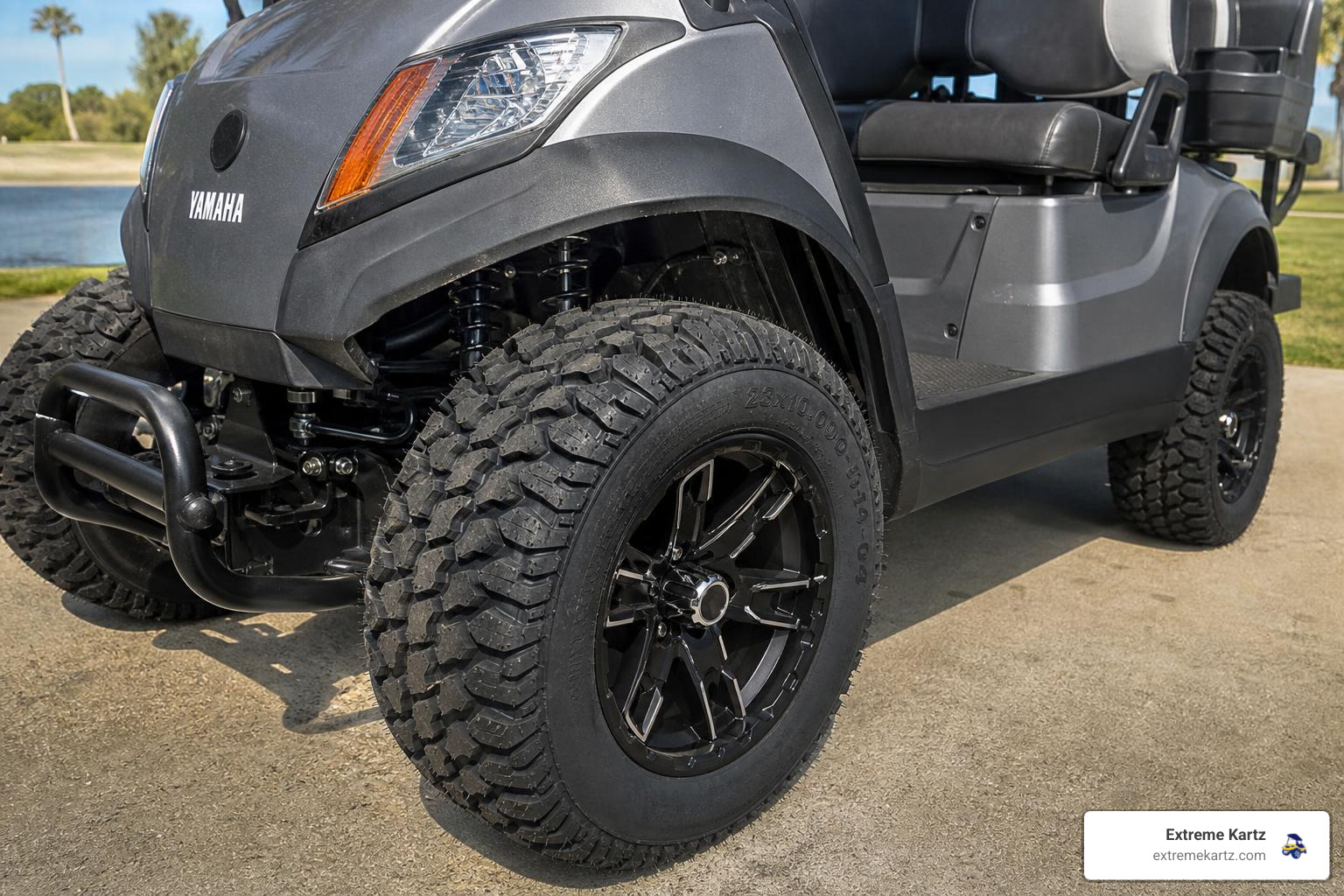
Without the correct lift height, larger tires will rub against the inner fender wells, especially when taking sharp turns or when the suspension compresses under a heavy passenger load. For a comprehensive look at how to pair these upgrades, refer to our Ultimate Lifted Golf Cart Tires Guide.
No-lift and low-lift tire options
If you do not want to install a tall lift kit, you still have excellent options. Many 18-inch and 20-inch all-terrain tires can fit stock-height carts with little to no modification. On EZGO and Yamaha DRIVE models, 20-inch tires can often be installed without a lift, though minor plastic body trimming might be required. Club Car models have tighter wheel wells and typically require a modest 1-inch block lift or minor trimming to prevent rubbing. Choosing street-friendly, low-profile all-terrain tires is a great way to get aggressive styling without raising your cart's center of gravity. For more on these compact options, see our guides on 10 Inch Low Profile Golf Cart Tires and 205-50-10 Golf Cart Tires.
Lift kit guidance for 20-inch, 22-inch, and 23-inch tires
As a general rule of thumb, use the following lift kit guidelines to ensure your new tires have plenty of room to breathe:
- 20-inch tires: Can usually run on stock suspension for EZGO/Yamaha; Club Car models require a 1-inch to 3-inch lift. Learn more in our 20 Inch Golf Tires guide.
- 22-inch tires: Require a minimum of a 3-inch to 4-inch lift kit to prevent contact with the body panels during suspension flex. Check out our Golf Cart Tires 22x11x10 Complete Guide.
- 23-inch and 24-inch tires: Require a heavy-duty 5-inch to 6-inch lift kit. This height ensures the tires clear the footrests, front bumper, and rear body panels even when carrying a full load of four passengers.
Fitment checklist before ordering
Before placing your order, take these essential measurements to prevent ordering the wrong parts:
- Measure current clearance: Check the distance between your current tire and the closest part of the fender weld.
- Verify wheel bolt pattern: Confirm your cart uses the standard 4x4 (4x101.6mm) pattern.
- Check suspension sag: Older leaf springs can sag over time, reducing your actual clearance by an inch or more.
- Account for rear seat weight: If you have a rear seat kit, ensure your rear leaf springs are heavy-duty to prevent bottoming out.
- Confirm wheel offset: Make sure your wheels have a negative offset to push the tire away from the inner frame.
Tread patterns, construction types, and DOT approval
The tread pattern and construction of your golf cart ATV tires will dictate how they perform on different surfaces. Tread designs generally fall into three categories: knobby, hybrid, and turf-safe.
Additionally, you must choose between traditional bias-ply tires and modern steel-belted radial tires, while also deciding if your driving habits require DOT (Department of Transportation) approved models. For a thorough overview of these technical specs, check out our core guide on Golf Cart Tires.
Knobby, hybrid, and turf-safe tread performance
- Knobby Tread: These tires feature deep, widely spaced tread blocks (similar to a traditional quad or mud tire). They provide maximum bite in deep mud, loose sand, and wet clay. The wide voids are self-cleaning, throwing out mud as the tire spins. However, they vibrate and hum loudly on pavement and will quickly scar manicured grass.
- Hybrid Tread: A hybrid tread combines a tight center tread pattern with aggressive shoulder lugs. This design offers a smooth, quiet ride on pavement while still providing excellent grip on gravel, dirt trails, and wet grass.
- Turf-Safe All-Terrain: These tires utilize a closely packed, dimpled, or blocky design. They are approved for golf course use because they distribute weight evenly without tearing turf, yet they still offer far more off-road traction than standard street tires.
Steel-belted radial vs bias-ply tires
Historically, most golf cart tires were bias-ply, meaning the internal nylon cords ran diagonally across the tire. While bias-ply tires have stiff sidewalls that offer excellent stability for slow-speed utility hauling, they can flat-spot when parked and offer a rougher ride.
Modern steel-belted radial tires are built like automotive tires, with steel belts running perpendicular to the tread. Radials offer superior heat dissipation, a much smoother ride, and even pressure distribution. In fact, high-quality steel-belted radial golf cart tires can last over 30,000 miles, vastly outlasting traditional bias-ply tires while protecting against sharp punctures.
DOT-approved vs non-DOT Golf cart ATV tires
If you plan to drive your golf cart on public neighborhood roads, master-planned community streets, or designated low-speed vehicle (LSV) routes, DOT-approved tires are often legally required. DOT-approved all-terrain tires undergo rigorous testing to ensure they can handle sustained road heat and load limits. For example, many DOT-rated radial tires are rated for speeds up to 87 mph and can support loads exceeding 900 lbs per tire at their recommended PSI. Non-DOT tires are intended strictly for off-road or closed-course utility use. Driving on non-DOT tires on public roads can result in fines and may void your insurance coverage. Learn more about matching wheels with road-legal tires in our guide to Golf Cart Tires and Wheels.
Buying, installing, and maintaining all-terrain golf cart tires
When shopping for golf cart ATV tires in 2026, comparing top brands is the best way to get the most value for your budget. Popular options include the ultra-durable SunF G003 (known for its excellent mud traction and puncture resistance) and the classic Carlisle Knobby (highly rated for hard-surface utility work). If you want an industry-leading smooth ride, steel-belted radial options like the GTW Maverick or the Sierra Rover provide automotive-grade longevity. For those seeking heavy-duty capacity, the ARISUN X-Trail offers a rugged 6-ply construction that handles heavy cargo loads with ease. For a complete look at the current market, see our Golf Cart Tire Guide 2026.
How to compare brands, prices, and warranties without overbuying
To get the best deal, we recommend looking at pre-mounted tire and wheel combos, which often save you money on mounting costs and guarantee compatibility. While premium steel-belted radials carry a higher price tag, their 30,000-mile lifespan makes them more cost-effective in the long run if you drive frequently on pavement. For strictly off-road utility or hunting use, a budget-friendly 4-ply or 6-ply bias-ply tire like the SunF G003 or Carlisle Knobby will deliver all the traction you need without the premium cost of a radial.
Installation considerations for aggressive tread tires
While mounting tires to wheels is best left to a professional shop with a bead-seating machine, installing the pre-mounted wheel assemblies onto your cart is a straightforward DIY project. Always use a torque wrench to tighten your lug nuts to the manufacturer's recommended torque specs (typically 50-80 ft-lbs depending on your cart model). Once installed, perform a slow-speed full-turn test in your driveway to check for rubbing against the body or steering linkages before taking your cart out on the trails. For step-by-step guidance, refer to our Golf Cart Tires Rims Complete Guide.
Maintenance and safety best practices
To maximize the life of your new aggressive tires, we recommend following these simple maintenance steps:
- Check air pressure monthly: Running tires under-inflated causes rapid shoulder wear and reduces battery range, while over-inflation leads to a harsh ride and center-tread wear.
- Rotate your tires: Rotate your tires front-to-back every 6 to 12 months to ensure even tread wear, especially on carts with independent front suspensions.
- Inspect for trail damage: Regularly check the sidewalls for deep cuts from rocks or branches, and inspect the tread for embedded thorns or nails.
- Torque check: Re-torque your lug nuts after the first 5 to 10 miles of driving to ensure they have seated properly against the new aluminum wheels.
Frequently Asked Questions about Golf cart ATV tires
Can I put ATV tires on a golf cart?
Yes! You can absolutely put ATV-style tires on a golf cart, provided you match the wheel diameter and bolt pattern. Most golf carts use a 4x4 (4x101.6mm) bolt pattern, while many standard ATVs use different patterns. To make installation seamless, we recommend choosing ATV-style tires specifically designed and sized for golf cart wheels (such as 10-inch, 12-inch, or 14-inch rims) to guarantee proper clearance and load ratings.
What size all-terrain tires fit a golf cart without a lift?
On most EZGO and Yamaha carts, you can fit 20-inch all-terrain tires (such as a 20x10-10 or 20x10-12) without a lift kit, though you may experience minor rubbing at full steering lock. Club Car models have smaller wheel wells and typically require a small 1-inch to 2-inch block lift to clear 20-inch tires. If you want to keep your cart at stock height with zero risk of rubbing, stick to an 18-inch aggressive tire or a low-profile option like those detailed in our guide to 205-50 X 10 Tires.
Are DOT-approved all-terrain tires required for street use?
In most jurisdictions, yes. If your local municipality allows golf carts or low-speed vehicles (LSVs) on public roads, the law typically requires tires that carry the "DOT" stamp on the sidewall. DOT-approved tires are constructed to withstand the friction and heat of paved roads, ensuring your cart remains safe, stable, and compliant with local insurance and registration requirements.
Conclusion
Upgrading your golf cart to aggressive ATV-style tires is one of the most rewarding modifications you can make. It transforms your cart from a simple neighborhood cruiser into a highly capable utility vehicle ready to tackle mud, gravel, sand, and trails.
To ensure your upgrade is a success, always prioritize fitment compatibility first. Measure your clearance, choose the right lift kit height for your desired tire size, select a tread pattern that matches your daily terrain, and invest in a heavy-duty 6-ply or steel-belted radial design if you carry heavy loads.
If you have any questions about wheel offset, lift kit compatibility, or finding the perfect tire size for your specific Club Car, EZGO, or Yamaha model, we are here to help. Reach out to our team at Extreme Kartz for expert, personalized fitment recommendations. Ready to browse your options? Explore the complete golf cart tire guide to find the perfect setup for your next adventure.
Related Products


Vendor: Madjax 23X10-14 Predator Series All Terrain Tire


Vendor: RHOX Mojave II, 22x10-14 4 Ply


Vendor: Duro Desert, 22x11-10, 6 ply


Vendor: 22x11-10 GTW® Predator A/T Tire


