


How to Find the Right Golf Cart Tire Size in 5 Steps
What a Golf Cart Tire Size Calculator Actually Tells You (And Why It Matters)
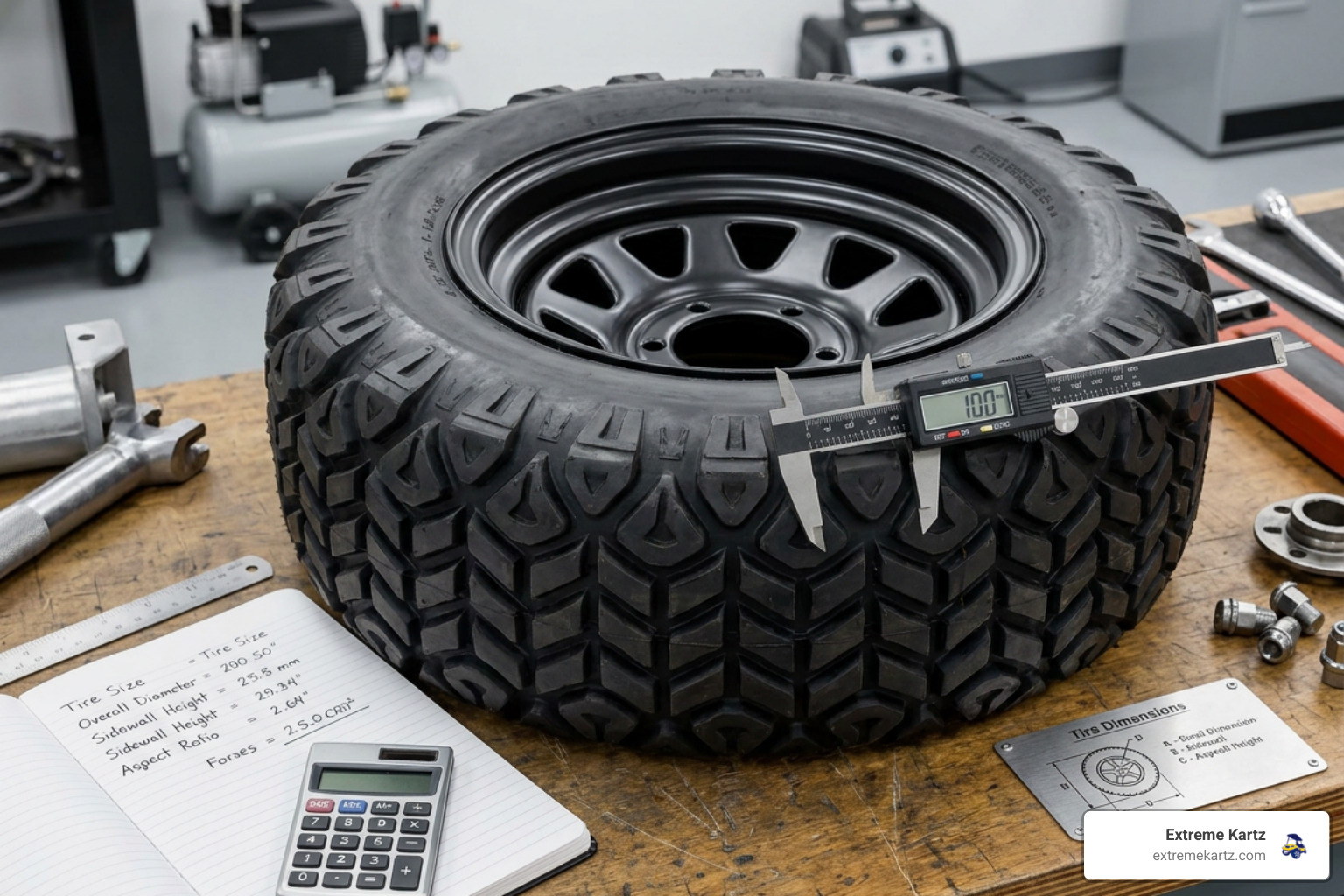
Using a golf cart tire size calculator takes the guesswork out of one of the most confusing parts of owning a cart: knowing whether a new tire will actually fit before you buy it.
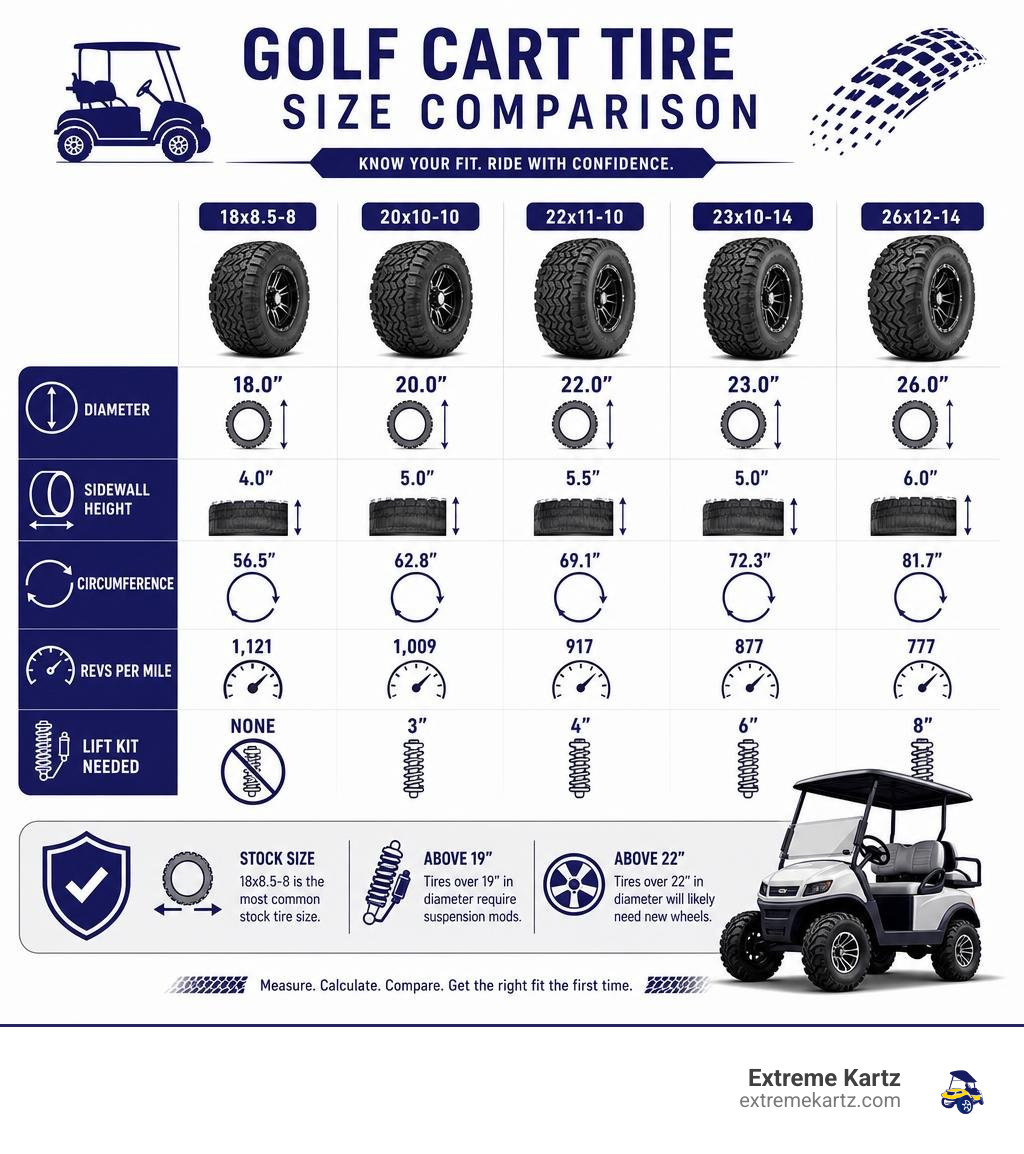
Here's a quick reference for the most common golf cart tire sizes and what you need to know about each:
| Tire Size | Overall Diameter | Circumference | Revs/Mile | Lift Kit Needed |
|---|---|---|---|---|
| 18x8.5-8 | 18.0" | 56.5" | 1,121 | None |
| 20x10-10 | 20.0" | 62.8" | 1,009 | 3" |
| 22x11-10 | 22.0" | 69.1" | 917 | 4" |
| 23x10-14 | 23.0" | 72.3" | 877 | 6" |
| 26x12-14 | 26.0" | 81.7" | 777 | 8" |
The short answer: Most stock golf carts run 18x8.5-8 tires and need no lift kit. Go above 19 inches in overall diameter and you'll need suspension modifications. Go above 22 inches and you'll likely need new wheels too.
Most golf cart owners run into the same problem. They find a tire they like, order it, and only then discover it rubs against the body — or that it needs a lift kit they don't have. A tire size calculator helps you catch those issues before they cost you money.
This guide walks you through exactly how to use one, step by step.
I'm Martin Davis, owner of Extreme Kartz, and I've helped hundreds of cart owners navigate the exact fitment challenges that a golf cart tire size calculator is designed to solve — from decoding metric vs. flotation sizing to matching the right lift kit height for a specific brand and model. Let's break it down in a way that's actually useful.
Before diving in, you might also want to check out our guides on golf cart tire pressure, lifted golf cart tires, and golf cart rims and tires to get a complete picture of your setup.
Step 1: Decode Your Tire Size Format
Before you can punch numbers into any calculator, you have to understand what those numbers on your tire's sidewall actually mean. Unlike automotive tires, which almost exclusively use metric designations, golf cart tires are written in two completely different formats: Standard Flotation Sizing and Metric Sizing.
If you are trying to cross-reference dimensions, checking a detailed resource like our Golf Cart Tire Guide 2026 is an excellent starting point to see how these formats apply to real-world builds.
Standard Flotation Sizing (The Inch Format)
This is the most common format for off-road, all-terrain, and standard turf tires. It is written as three numbers separated by "x" or "-" (for example, 18x8.5-8 or 23x10-14).
- First Number (Height): The overall diameter of the tire in inches when fully inflated. In a "23x10-14" tire, the tire stands 23 inches tall.
- Second Number (Width): The section width of the tire in inches. In our example, the tire is 10 inches wide at its widest point.
- Third Number (Rim Size): The wheel diameter in inches that the tire is designed to mount on. A "23x10-14" tire must be mounted on a 14-inch wheel.
Metric Sizing (The Automotive Format)
Most street-legal, turf-friendly, and low-profile tires use the metric format (for example, 205/50-10 or 215/40-12). This format consists of a width, an aspect ratio, and a wheel diameter:
- First Number (Width): The width of the tire in millimeters. A "205/50-10" tire is 205 mm wide (roughly 8 inches).
- Second Number (Aspect Ratio): The height of the sidewall expressed as a percentage of the tire's width. In "205/50-10", the sidewall height is 50% of 205 mm, which equals 102.5 mm.
- Third Number (Rim Size): The wheel diameter in inches. This tire is designed to mount on a 10-inch rim.
To visualize how these physical dimensions differ across various profiles, you can review standard tire size charts or consult our detailed fitment guides.
Reading Sizes with a Golf Cart Tire Size Calculator
Converting metric sizes to standard inches is critical because golf cart clearance is always measured in inches. If you are comparing a metric tire to a standard tire, you can use these simple math formulas or input them into a digital tool:
-
Convert Width to Inches: Divide the metric width by 25.4 (since there are 25.4 millimeters in an inch).
-
Formula:
Width (mm) / 25.4 = Width (inches) -
Example:
205 mm / 25.4 = 8.07 inches
-
Formula:
-
Calculate Sidewall Height: Multiply the width in inches by the aspect ratio percentage.
-
Formula:
Width (inches) * (Aspect Ratio / 100) = Sidewall Height (inches) -
Example:
8.07 * 0.50 = 4.03 inches
-
Formula:
-
Calculate Overall Height (Diameter): Multiply the sidewall height by two (for the top and bottom of the tire) and add the wheel diameter.
-
Formula:
(Sidewall Height * 2) + Wheel Diameter = Overall Height -
Example:
(4.03 * 2) + 10 = 18.06 inches
-
Formula:
By doing this math, we discover that a 205/50-10 metric tire is essentially identical in size to a standard 18x8-10 tire. Knowing these conversions prevents you from accidentally ordering a tire that is too tall or too short for your setup.
Step 2: Use a Golf Cart Tire Size Calculator to Compare Dimensions
When you are upgrading your wheels and tires, you rarely stay with the stock size. You want to know exactly how much bigger, wider, or taller your new setup will be compared to your old one. This is where a digital Tire Size Calculator or a specialized Tire Calculator becomes invaluable.
By comparing your current tire to your target upgrade, you can analyze several critical dimensions:
- Overall Diameter: The total height of the tire. This dictates whether the tire will rub against your inner fenders or require a lift kit.
- Sidewall Height: The distance from the rim edge to the outer tread. A taller sidewall means more air cushion and a softer ride, whereas a shorter sidewall (low-profile) offers a stiffer, sportier ride.
- Circumference: The total distance around the outside of the tire.
- Revolutions Per Mile: How many times the tire rotates over a distance of one mile.
- Speedometer Error: Because speedometers calculate speed based on wheel revolutions, changing the tire's circumference will change your actual speed relative to what is displayed.
For a deeper dive into how these dimensional shifts affect your daily driving, check out our Ultimate Golf Cart Tires Guide 2026.
Calculating Performance Changes with a Golf Cart Tire Size Calculator
Changing your tire size is not just an aesthetic upgrade; it directly alters the mechanical physics of your golf cart.
If you swap your stock 18-inch tires for 23-inch tires, you are increasing your tire diameter by 27.8%. This means your top speed will increase by roughly 27.8% because the larger tire travels further with each rotation.
However, physics is a game of trade-offs. What you gain in speed, you lose in torque:
- Torque Reduction: Taller tires increase the "lever arm" that the motor must overcome to turn the wheels. This reduces your hill-climbing power and acceleration.
- Rolling Resistance: Wider tires increase the contact patch with the ground, creating more friction.
- Motor and Controller Load: The extra weight and reduced torque leverage put a higher thermal load on your motor and speed controller, which can lead to overheating if you don't upgrade your electrical system.
To calculate these changes precisely before you buy, you can use the Tire Size Calculator to compare your stock dimensions against your dream upgrade.
Step 3: Select the Right Tread Pattern and Profile
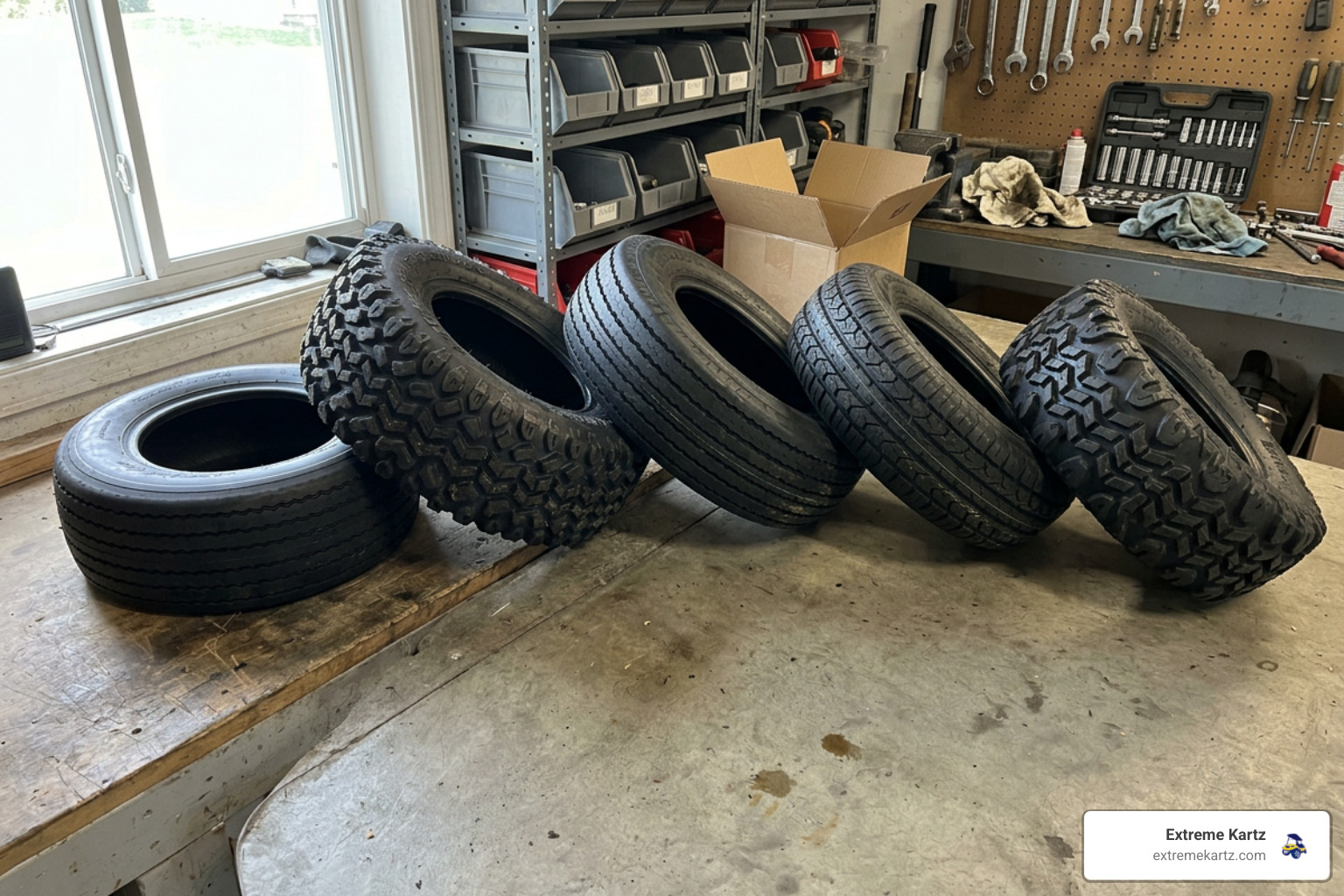
Choosing the right size is only half the battle; you also need to select a tread pattern and tire profile that match your primary driving environment. Using the wrong tread on the wrong surface can ruin your turf, wear out your tires prematurely, or give you a bone-jarring ride.
Our Golf Cart Tires for Every Terrain guide details these options extensively, but here is a quick breakdown:
Street and Turf Tires
These tires are designed with a smooth, shallow tread pattern (often called "sawtooth" or "ribbed"). They are engineered specifically to protect golf course grass from tearing while providing a smooth, quiet ride on paved neighborhood streets. Over 70% of golf cart owners choose street or low-profile turf tires.
All-Terrain (A/T) Tires
All-terrain tires feature deeper, more aggressive tread blocks. They are the perfect compromise if you split your time between paved streets, gravel paths, and light backyard trail riding. They provide excellent traction on loose dirt without making an excessive amount of noise on asphalt.
Mud Tires
Featuring massive, widely spaced lugs, mud tires are built for serious off-road use, muddy trails, and farm work. They act like paddles to clean themselves of debris. However, they should never be used on manicured golf courses, and they will produce a loud, bumpy ride on hard pavement.
Profiles: Low-Profile vs. High-Profile
- Low-Profile Tires: Typically paired with larger 12-inch, 14-inch, or 15-inch wheels, these tires have very short sidewalls. They look incredibly sleek and modern, offering sharp handling on pavement. The downside? There is very little rubber and air to cushion bumps, leading to a much stiffer ride.
- High-Profile Tires: These have thick, tall sidewalls (usually paired with smaller 8-inch or 10-inch wheels). They absorb bumps, rocks, and potholes beautifully, providing a plush ride. They are highly recommended for rough gravel roads or off-road trails.
Understanding Ply Ratings
A tire's ply rating tells you how many layers of material make up its construction, directly correlating to its strength and load capacity:
- 2-Ply / 4-Ply: Standard for lightweight golf course use. They are highly flexible and gentle on turf.
- 6-Ply: Heavy-duty construction. These are highly puncture-resistant and ideal for utility carts carrying cargo, rear seat passengers, or tackling rocky trails.
Step 4: Account for Wheel Diameter and Offset
When upgrading your tires, you must also look at your wheels. You cannot mount a 12-inch tire on an 8-inch wheel, and you cannot mount a highly offset wheel without checking your clearance.
For a complete breakdown of wheel and rim styles, refer to our Golf Cart Rims and Tires Guide.
Wheel Offset Explained
Wheel offset is the distance from the mounting surface of the wheel to its true centerline. This measurement dictates how far inward or outward your wheels will sit under the fender flares.
| Offset Type | Description | Best For | Clearance Impact |
|---|---|---|---|
| Positive Offset | Mounting surface is closer to the street side. Wheels sit tucked deep inside the fender wells. | Stock, non-lifted carts running small street tires. | Can cause wide tires to rub against the inner frame or suspension. |
| Zero Offset | Mounting surface is perfectly centered. | Mild upgrades on standard carts. | Equal clearance on both sides. |
| Negative Offset | Mounting surface is closer to the cart's suspension. Wheels are pushed outward. | Lifted carts, off-road builds, and carts with front disc brakes. | Pushes the tire away from the frame to prevent inner rubbing, but requires fender clearance. |
Backspacing and Disc Brake Clearance
Many modern golf carts, including newer models from brands like ICON and Evolution EV, come equipped with front mechanical or hydraulic disc brakes. These brake calipers stick out further than standard drum brakes.
If you try to mount a standard wheel with a high positive offset, the wheel spokes will hit the brake caliper. These carts require wheels with a specific negative offset (typically a 3+4 or 2+5 offset layout) to push the wheel face outward and clear the brake assembly.
Lug Nut Thread Pitch
Before finalizing your wheel purchase, make sure you have the correct lug nuts.
- Yamaha Carts: Exclusively use metric lug nuts (typically M12x1.25).
- Club Car & EZGO Carts: Typically use standard imperial lug nuts (typically 1/2"-20).
Step 5: Verify Brand-Specific Fitment and Lift Kit Requirements

You can use a golf cart tire size calculator to get the exact physical dimensions of a tire, but the calculator does not know what brand of golf cart you drive. Different manufacturers build their frames, wheel wells, and suspensions with different clearance limits.
If you are planning to install taller tires, our Ultimate Lifted Golf Cart Tires Guide is an essential resource to help you plan your suspension modifications.
EZGO Fitment Limits
EZGO carts are generally the most forgiving when it comes to tire clearance.
- Non-Lifted: You can comfortably fit up to 20-inch street or all-terrain tires (such as a 205/65-10) without any rubbing, provided your factory leaf springs are in good condition.
- Lifted: To run popular 22-inch or 23-inch off-road tires, you will need a minimum of a 5-inch or 6-inch lift kit.
Club Car Fitment Limits
Club Car models (like the Precedent, Onward, and DS) have much tighter, narrower front wheel wells.
- Non-Lifted: The absolute maximum tire height you can run without rubbing is 18.5 inches (such as a 205/50-10 or 215/40-12). Trying to squeeze a 20-inch tire onto a stock Club Car will result in heavy rubbing when turning the steering wheel.
- Lifted: To run 22-inch tires, you need a 4-inch lift. For 23-inch tires, a 6-inch lift kit is mandatory.
Yamaha Fitment Limits
Yamaha carts (especially the Drive and Drive-2 models) fall right in the middle.
- Non-Lifted: You can fit up to a 20-inch low-profile street tire (such as a 205/65-10) without modifications. However, if you add a rear passenger seat kit, the extra weight will compress the rear suspension and cause rubbing unless you upgrade your rear leaf springs.
- Lifted: To run 22-inch or 23-inch tires, a 6-inch lift kit is highly recommended.
Suspension Wear, Leaf Springs, and Body Accessories
Even if a calculator says a tire size should fit, real-world wear and tear can change things:
- Sagging Leaf Springs: Over time, factory leaf springs lose their tension and sag. If your cart is several years old, a sagging suspension will reduce your clearance and cause tires to rub.
- Heavy Rear Loads: If you install a rear flip-seat kit or cargo box, the added weight of passengers or gear will compress your rear suspension. We always recommend upgrading to heavy-duty dual-action leaf springs to maintain proper ride height.
- Fender Flares: If you install wide, aggressive off-road tires that stick out past your body panels, you will want to add a set of rugged fender flares, such as the Doubletake Spartan Fender Flare Set, to keep mud and water from spraying into the cabin.
To find the perfect matching wheel and tire setup for your specific cart, you can consult our team of experts at Extreme Kartz for a personalized fitment check and tailored recommendations. Plus, all of our upgrade kits ship in 1-2 business days.
Frequently Asked Questions about Golf Cart Tires
Do larger golf cart tires require a lift kit?
Yes, if the overall diameter of the tire exceeds 19 inches. While stock golf cart tires measure 18 inches tall and require no suspension modifications, upgrading to taller tires requires a lift kit to prevent the rubber from rubbing against your cart’s body panels, frame, and suspension components during sharp turns or when driving over bumps.
As a general rule:
- 18" to 19" Tires: No lift kit required.
- 20" to 20.5" Tires: Requires a 3" lift kit (though some non-lifted EZGO and Yamaha carts can squeeze these in on flat ground).
- 22" Tires: Requires a minimum of a 4" lift kit.
- 23" Tires: Requires a minimum of a 6" lift kit.
- 24"+ Tires: Requires an 8" lift kit or long-travel suspension.
How do larger tires affect golf cart speed and torque?
Installing larger tires increases your top-end speed because the tire has a larger outer circumference, allowing it to cover more ground with every single motor revolution. However, this comes at the cost of torque. Because the motor must work harder to turn a larger wheel, your acceleration and hill-climbing power will decrease.
If you upgrade to heavy 22-inch or 23-inch off-road tires, we highly recommend upgrading to a high-output AC motor and controller system to regain your lost torque. Additionally, upgrading your power source to a premium lithium battery brand is one of the best ways to shed dead weight and boost your cart's performance. At Extreme Kartz, we recommend and support top-tier lithium solutions from:
What is the difference between radial and bias-ply golf cart tires?
- Radial Tires: Constructed so the internal cord plies run perpendicular to the direction of travel. This allows the tread and the sidewall to function independently. Radial tires offer superior flexibility, a much smoother ride on hard pavement, better heat dissipation, and a longer overall lifespan.
- Bias-Ply Tires: Constructed with diagonal, criss-crossing cord plies. This creates a very stiff, rigid sidewall. While bias-ply tires are highly durable and excellent at carrying heavy loads or resisting punctures on rugged off-road trails, they tend to ride much rougher on flat pavement.
Conclusion
Finding the perfect tire size for your golf cart is a balancing act between aesthetics, physics, and brand-specific clearance. By taking the time to decode your tire format, running the numbers through a digital golf cart tire size calculator, selecting a terrain-specific tread, and verifying your wheel offset and lift kit requirements, you can build a cart that looks incredible and performs flawlessly.
If you are ready to upgrade your ride but want to double-check your fitment before making a purchase, we are here to help. Contact our team of experts at Extreme Kartz for personalized recommendations tailored to your specific cart model and upgrade goals.
Ready to find your perfect setup? Shop Golf Cart Tires and Wheels today and customize your cart with complete confidence!
Related Products

Vendor: Kenda Pro Tour, 205/50-10, DOT, 4 Ply


Vendor: Duro Desert, 22x11-10, 6 ply

Vendor: RHOX RXAT Tires 23x10.5-12, 4 Ply

Vendor: RHOX Road Hawk, 20x10R10 Radial DOT, 4 Ply


