


Everything You Need to Know About Golf Cart Tires
Why the Right Golf Cart Wheel Tires Make a Bigger Difference Than You Think

Choosing the right golf cart wheel tires is one of the most impactful upgrades you can make — affecting how your cart looks, handles, and performs on every surface.
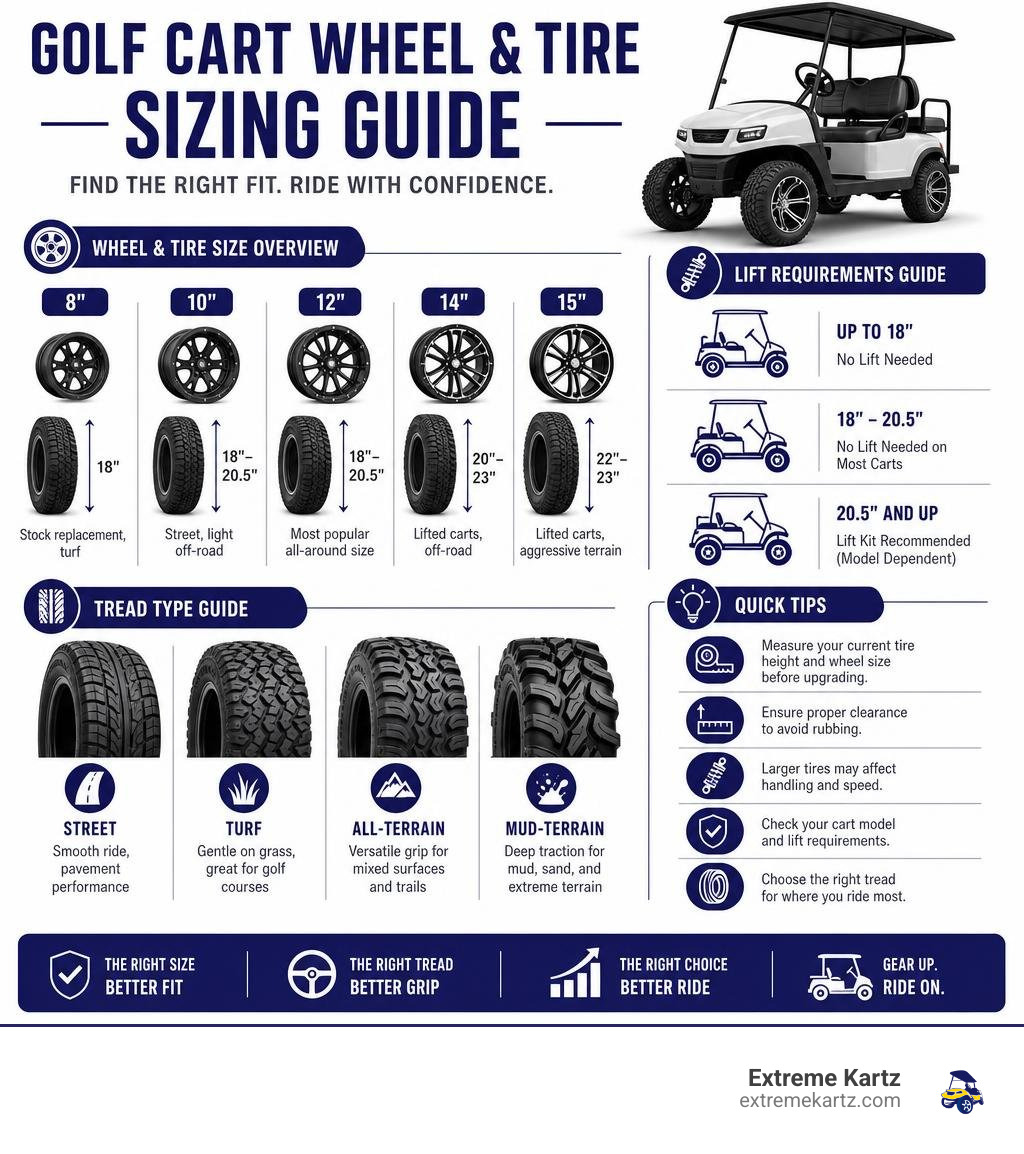
Quick answer: most common golf cart wheel and tire sizes
| Wheel Size | Tire Overall Height | Best For |
|---|---|---|
| 8" | 18" | Stock replacement, turf |
| 10" | 18"–20.5" | Street, light off-road |
| 12" | 18"–20.5" | Most popular all-around size |
| 14" | 20"–23" | Lifted carts, off-road |
| 15" | 22"–23" | Lifted carts, aggressive terrain |
The most important things to know upfront:
- 18" and 20" overall diameter combos fit most non-lifted golf carts
- 12" wheels are the most popular size, with the widest selection available
- Club Car, EZGO, and Yamaha each have different fitment requirements
- Some 20" tires require a lift kit on certain models (especially Club Car and older Yamaha G-Series)
- Tread type matters — street, turf, all-terrain, and mud-terrain are not interchangeable
Whether you're doing a simple OEM replacement or upgrading to a custom look, the wrong choice can mean rubbing, handling problems, or a return trip to the shop.
I'm Martin Davis, owner of Extreme Kartz, and I've spent years helping golf cart owners across all 50 states navigate the often confusing world of golf cart wheel tires — from stock fitment questions to full custom builds. Let's break down everything you need to make a confident, compatible choice.
Understanding Golf Cart Wheel Tires Sizing and Brand Compatibility
When upgrading your golf cart wheel tires, the very first thing we must establish is compatibility. Unlike standard automotive upgrades where a single tire size might easily cross over multiple vehicle platforms, golf cart manufacturers design their wheel wells and suspension systems with highly specific clearances.
To help you visualize how the major brands differ in their stock, non-lifted configurations, we have compiled the baseline clearance limits below:
| Golf Cart Brand & Model | Stock Wheel Size | Max Tire Height (No Lift) | Clearance Notes / Potential Rub Areas |
|---|---|---|---|
| EZGO TXT / RXV | 8" | 20.0"–20.5" | Excellent stock clearance; fits low-profile 20" tires easily. |
| Club Car DS | 8" | 18.5" | Very tight wheel wells; anything over 18" usually rubs without modifications. |
| Club Car Precedent / Onward / Tempo | 8" | 18.5"–19.0" | Fits up to 18.5" safely; 20" tires will rub the front bumper or passenger-side wire harness. |
| Yamaha G-Series (G1–G22) | 8" | 18.5" | Tight rear body clearance; requires a lift kit for taller setups. |
| Yamaha Drive (G29) / Drive2 | 8" | 20.5" | Generous stock clearance; easily accepts 20" and some 20.5" tires without lifting. |
As you can see, what works perfectly on an EZGO RXV might cause severe rubbing on a Club Car Precedent. If you are starting your upgrade journey, we highly recommend reading our detailed guide on Extreme Kartz Wheels and Tires to understand how these dimensions affect your cart's geometry.
Sizing Guide for Non-Lifted Golf Cart Wheel Tires
If you plan on keeping your cart at its stock ride height, you are generally limited to an overall tire height of 18 to 20 inches.
- 18-Inch Overall Height Tires: This is the standard OEM height. It is highly versatile and fits every major cart model without any risk of rubbing. You can pair 18-inch tires with 8-inch, 10-inch, or even 12-inch wheels (using low-profile tires).
- 20-Inch Overall Height Tires: These offer a taller, more aggressive look and slightly higher ground speed. However, they are right on the edge of compatibility. While they bolt directly onto stock EZGO and Yamaha Drive models, they will rub the front fenders or inner wheel wells of a stock Club Car.
When selecting wheels for non-lifted carts, 8-inch wheels are standard for utility and course use. Moving up to 10-inch or 12-inch wheels allows you to run low-profile street tires, which maintain the safe 18-inch overall outer diameter while giving your cart a modern, automotive-inspired look. For those looking to keep their stock EZGO running perfectly, check out our dedicated collection of EZGO parts and accessories.
Choosing the Right Golf Cart Wheel Tires for Your Terrain
Your driving environment should dictate your tire selection. If you primarily cruise paved neighborhood streets, a siped street tire offers a smooth, quiet ride and exceptional longevity.
For golf course enthusiasts, turf protection is non-negotiable. Most golf courses require "turf-safe" or "turf-approved" tread patterns (like the classic sawtooth design) to prevent tearing up the fairways.
If you live on a farm, ranch, or in a wooded community, you will want an all-terrain tire that balances off-road traction with a relatively smooth ride on hard surfaces. For Yamaha owners looking to optimize their setup for specific terrains, explore our curated selection of Yamaha parts and accessories.
Selecting the Right Wheel Diameters and Tire Heights
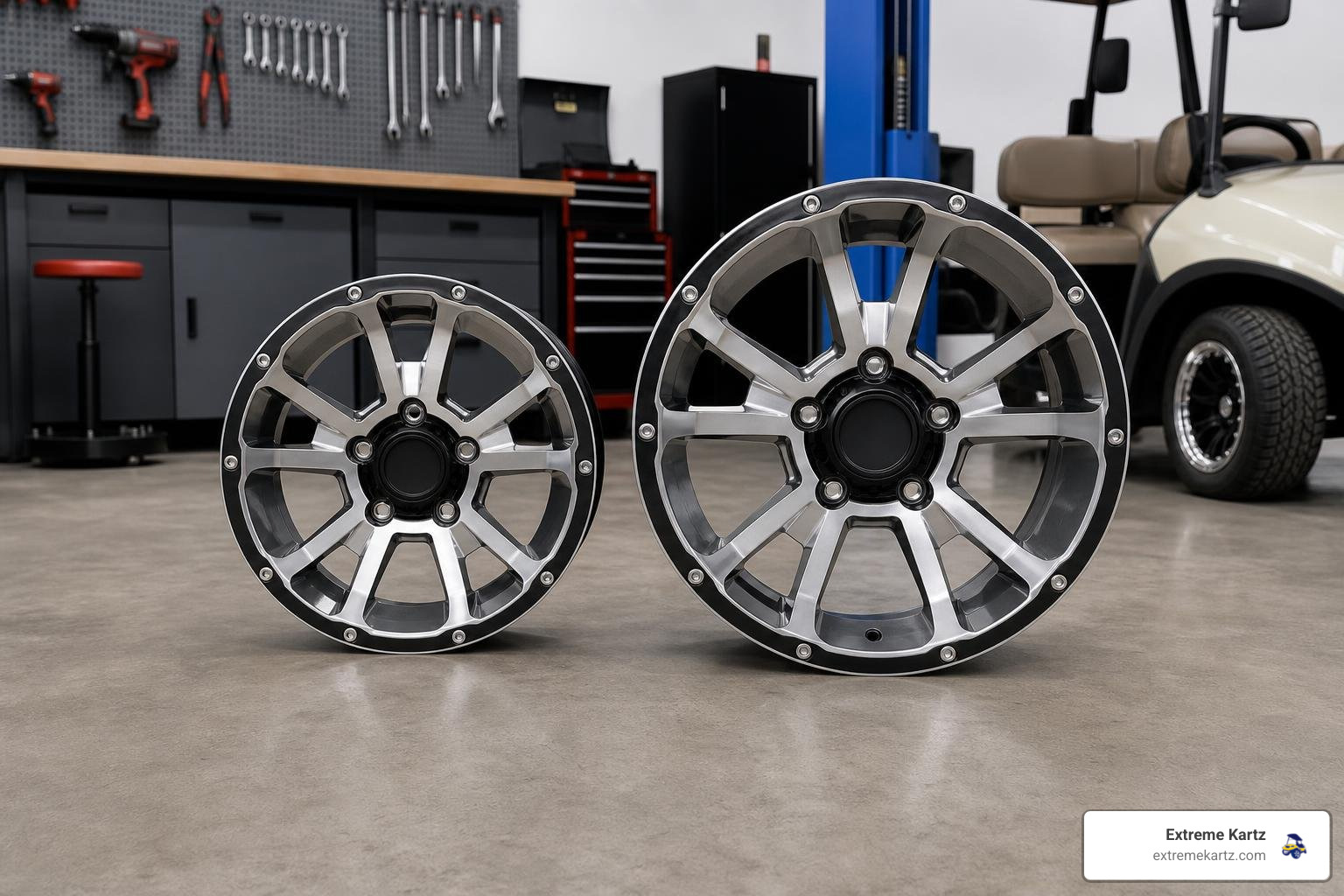
Upgrading your wheel diameter is the fastest way to change your cart’s personality. Today, 12-inch wheels are the undisputed champions of the market, with over 1,433 custom listings available across the industry. They offer the perfect balance: enough aluminum styling to stand out, yet plenty of remaining tire sidewall to cushion your ride.
At the same time, consumer demand for taller, beefier tires has exploded. There are over 475 tire options in the 20-inch size category alone.
If you want a truly aggressive look, 14-inch and 15-inch wheels are excellent choices, but they require careful planning:
- 14-Inch and 15-Inch Wheels: These larger wheels look incredible but leave very little room for tire sidewall if you aren't lifted. On a non-lifted cart, you must run ultra-low-profile tires (such as a 205/30-14), which can result in a stiffer ride because there is less rubber to absorb bumps.
- Tire Height Performance Trade-offs: It is a simple law of physics — taller tires increase your top-end speed because they cover more ground per rotation, but they reduce your low-end hill-climbing torque. If you install heavy 23-inch tires on a stock electric motor, you will notice a sluggish start and slower performance on inclines.
For Club Car owners trying to find that perfect balance of wheel styling and ride comfort, we offer tailored solutions in our Club Car parts and accessories collection.
Tread Types: Street, Turf, All-Terrain, and Mud-Terrain
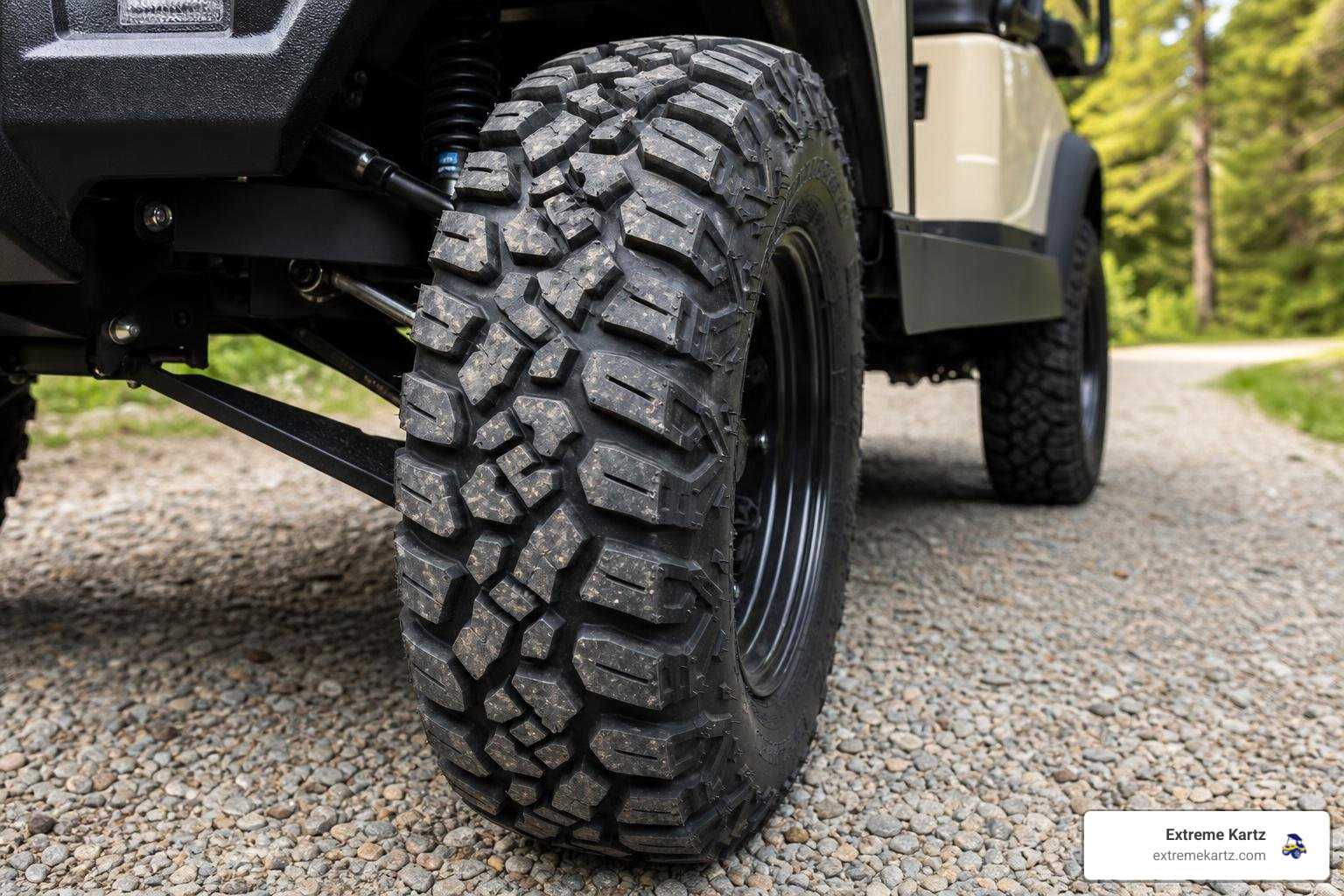
The tread pattern you choose directly impacts ride quality, noise levels, and terrain capability. Let’s break down the four main categories:
- Sawtooth / Turf Tires: The standard OEM tread. It features shallow, looping grooves designed to maximize contact with the ground without digging into grass. It is exceptionally gentle on lawns and golf courses.
- Siped Street Tires: Designed specifically for pavement, these look like miniature car tires. The sipes (small slits in the tread blocks) channel water away to prevent hydroplaning, offering a quiet, smooth, and highly stable ride at higher speeds.
- All-Terrain (A/T) Tires: Featuring deeper, wider tread blocks, A/T tires account for 463 listings in major databases, highlighting their massive popularity. They provide excellent grip on gravel, dirt, and wet grass while remaining civilized enough for pavement.
- Mud-Terrain (M/T) Tires: These feature massive, widely spaced lugs designed to self-clean in deep mud and loose soil. They are highly capable off-road but will produce a noticeable hum and a rougher ride on paved surfaces.
Understanding Ply and Load Ratings
Tire construction is just as important as the tread. The ply rating tells you how tough the tire is:
- 2-Ply: Soft, lightweight, and designed purely for light golf course use. Highly susceptible to punctures.
- 4-Ply: The industry standard for mixed-use carts. It offers a great balance of puncture resistance and ride comfort.
- 6-Ply: Heavy-duty construction. Excellent for utility carts, off-roading, and carrying heavy rear passenger loads. It rides firmer but is highly resistant to thorns, rocks, and debris.
To browse our comprehensive inventory of treads and ply ratings, visit the Extreme Kartz Wheels and Tires Selection.
Lift Kit Requirements and Fitment Limitations
If you have fallen in love with the look of 22-inch or 23-inch off-road tires, you must install a lift kit. Attempting to bolt these larger sizes onto a stock cart will result in severe tire rubbing against the body and frame, which can damage both your cart and your brand-new tires.
- Club Car Models: Because of their compact front suspension design, Club Car models almost always require a 1-inch to 3-inch low-profile lift kit to clear 20-inch tires, and a full 4-inch to 6-inch A-Arm lift kit to clear 22-inch or 23-inch tires.
- Yamaha G-Series: Older Yamaha models (G1 through G22) have very tight clearance in the rear body arches. You will need a minimum of a 3-inch lift kit to run 20-inch tires safely.
- Yamaha Drive & Drive2: These models are highly accommodating. They feature oversized factory wheel wells that allow you to run 20.5-inch tires with zero suspension modifications.
Kits ship in 1-2 business days.
When lifting your cart to accommodate premium wheel setups, you may also want to upgrade your body styling and fender flares. We highly recommend exploring Doubletake golf cart accessories for high-quality, color-matched body kits and styling upgrades that integrate seamlessly with lifted suspension systems.
Technical Specifications: Offsets, Bolt Patterns, and Lug Nuts
To get a perfect, rub-free fit, you need to understand the technical side of wheel geometry.
Wheel Offset Explained
Most custom golf cart wheels feature a negative offset (often written as ET-20mm or ET-25mm, or expressed as a "3+4" offset).
A negative offset means the mounting surface of the wheel is pushed inward toward the cart, which forces the wheel and tire outward. This wider stance is highly beneficial: it provides extra clearance from the inner frame and suspension parts, and it significantly improves the lateral stability of lifted carts.
Esthetics and Finishes
Style is personal, but market data shows that glossy black is the most popular wheel finish by a wide margin, appearing in 1,037 product listings. Other popular options include matte black, machined face, bronze, and classic chrome.
Bolt Patterns and Lug Nuts
Almost all major golf cart brands (EZGO, Club Car, Yamaha, Star, EVolution) use a standard 4x4 bolt pattern (4 holes arranged in a square, technically measured as 4x101.6mm). While the wheels will slide onto the hubs of any of these carts, the lug nuts themselves are brand-specific:
- EZGO & Club Car: Use standard imperial threads (1/2" x 20).
- Yamaha: Uses metric threads (M12 x 1.25).
Pro-tip: Always double-check your lug nut thread type before ordering a new wheel set, as using the wrong thread will strip your wheel studs!
DOT-Approved vs. Standard Golf Cart Tires
If you plan to drive your golf cart on public roads, street legality is a major factor.
- DOT-Approved Tires: These tires have undergone rigorous testing to meet Department of Transportation safety standards. They feature a higher speed rating (often "N" rated for up to 87 MPH, though golf carts should never go that fast!) and are built with tougher rubber compounds to handle the heat and friction of hot asphalt.
- Radial Construction: Premium DOT tires often utilize steel-belted radial construction (similar to automotive tires) rather than traditional bias-ply construction. Radial tires lay flat on the pavement, providing a significantly larger contact patch, superior cornering grip, a quieter ride, and a tread life that can easily exceed 30,000 miles.
- Standard Tires: These are perfect for turf and off-road use, but they wear down rapidly on asphalt and can feel "lumpy" or unstable at speeds over 20 MPH.
Frequently Asked Questions About Golf Cart Wheels and Tires
Do I need a lift kit for 20-inch tires?
It depends entirely on your cart brand. If you drive an EZGO or a Yamaha Drive/Drive2, 20-inch tires will fit without a lift kit. If you drive a Club Car or an older Yamaha G-Series, you will need at least a 1-inch to 3-inch lift kit to prevent the tires from rubbing when turning or carrying passengers.
What is the difference between radial and bias-ply golf cart tires?
Bias-ply tires are constructed with overlapping nylon belts running diagonally. They are highly durable for off-road use but tend to flat-spot when parked and offer a rougher ride on pavement. Radial tires feature steel belts running at 90 degrees to the centerline. They provide a much smoother ride, better handling, and vastly superior tread life on hard surfaces.
How do larger tires affect my golf cart's battery life and performance?
Taller tires can increase top speed, but they also require more energy to turn. That added load can reduce low-end torque, make hill climbs feel slower, and slightly decrease battery range—especially with heavier 22-inch or 23-inch tire setups. If performance drops after upgrading, review the full wheel-and-tire setup, cart weight, controller settings, and battery condition before making additional upgrades.
Conclusion
Upgrading your golf cart wheel tires is one of the most rewarding projects you can undertake, but getting the fitment right is crucial to enjoying the ride. At Extreme Kartz, we don't just sell individual parts — we specialize in complete, system-based solutions. We want to make sure your wheels, tires, suspension, and power systems work in perfect harmony.
If you have any questions about clearance, offsets, or which setup is right for your specific model, reach out to us for a personalized fitment consultation. Ready to transform your cart? Explore our complete collection and Upgrade Your Ride with Extreme Kartz Wheels and Tires today!
Related Products


Vendor: 22x11-10 GTW® Predator A/T Tire

Vendor: Kenda Pro Tour, 205/50-10, DOT, 4 Ply


Vendor: RHOX Mojave II, 23x10.5-12, 4 Ply


Vendor: 20x10-10 GTW® Barrage Mud Tire (Lift Required)


