


The 7 Best Golf Cart Performance Upgrades Compared
Why Most Golf Cart Owners Start Upgrading — and What Actually Works

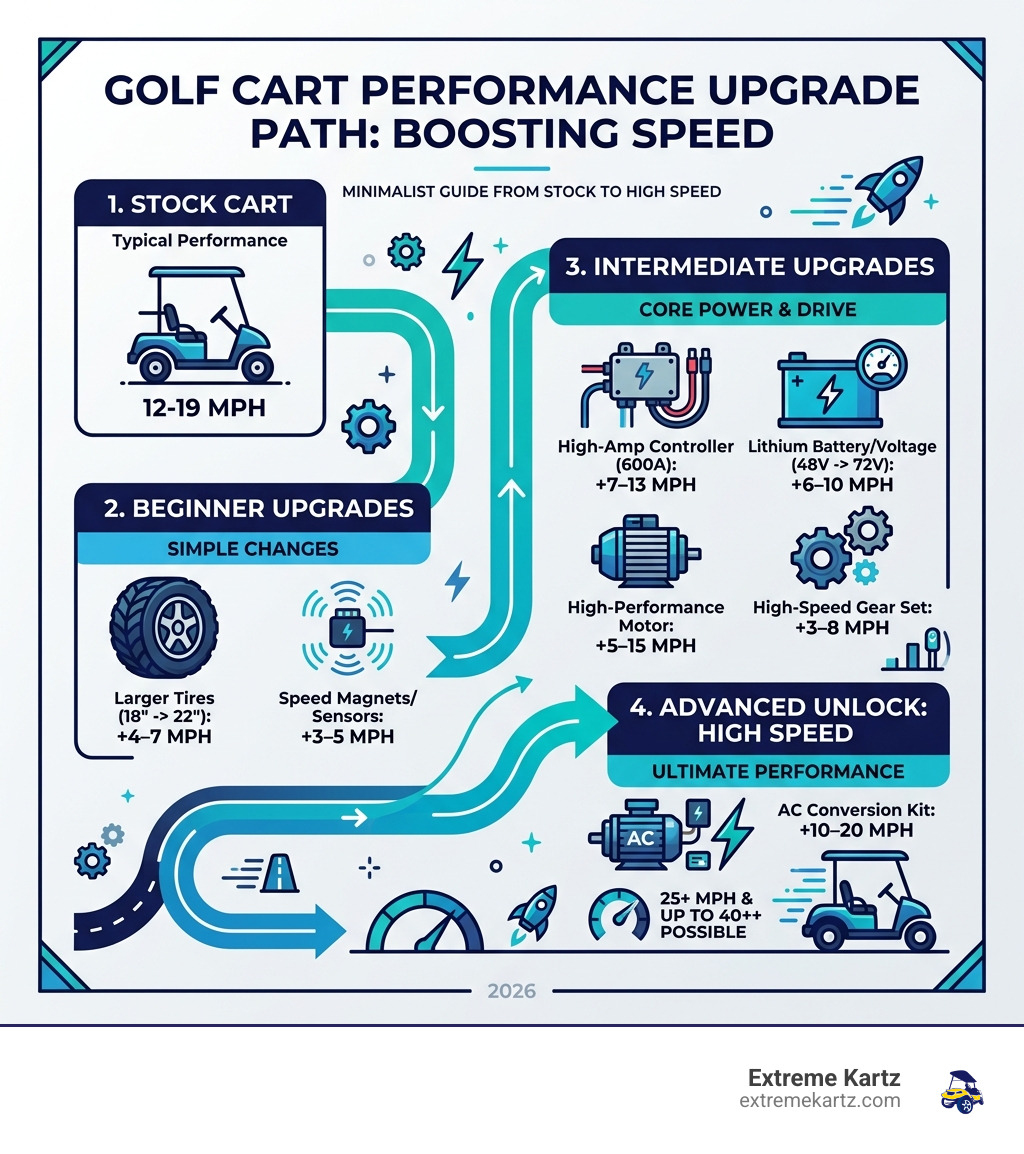
Golf cart performance upgrades are one of the fastest-growing areas of cart customization — and for good reason. Stock carts top out around 12–19 MPH, which simply isn't enough for neighborhood commutes, hilly terrain, or utility work on larger properties.
Here are the 7 best golf cart performance upgrades, ranked by impact:
| Upgrade | Estimated Speed Gain | Difficulty | Cost Range |
|---|---|---|---|
| AC Conversion Kit | +10–20 MPH | Advanced | $1,500–$4,000 |
| High-Amp Controller (600A) | +7–13 MPH | Intermediate | $150–$800 |
| Lithium Battery / Voltage Upgrade (48V → 72V) | +6–10 MPH | Intermediate | $500–$2,000+ |
| High-Performance Motor | +5–15 MPH | Intermediate | $300–$1,200 |
| High-Speed Gear Set | +3–8 MPH | Intermediate | $150–$400 |
| Larger Tires (18" → 22") | +4–7 MPH | Beginner | $200–$600 |
| Speed Magnets / Sensor Mods | +3–5 MPH | Beginner | $10–$50 |
The challenge most owners face isn't motivation — it's knowing which upgrades to combine, in what order, without wasting money on parts that don't work together. A 600A controller on stock lead-acid batteries, for example, will drain your pack fast and underdeliver on speed. A bigger tire without enough torque means sluggish acceleration on any incline.
This guide cuts through the noise. Whether you're chasing 25 MPH on neighborhood streets, better hill-climbing torque on your property, or a cleaner, more powerful electric drivetrain overall — the right upgrade path makes all the difference.
I'm Martin Davis, owner of Extreme Kartz and a hands-on resource for owners navigating golf cart performance upgrades across Club Car, EZGO, and Yamaha platforms. Since 2022, I've worked directly with manufacturers and technicians to help owners find compatible, reliable upgrades that deliver real-world results. Let's break down exactly what works — and what's worth your money.
Top-Tier Golf Cart Performance Upgrades for Speed and Torque
When we talk about serious power, the conversation always starts with the "brain" of the cart: the speed controller. Think of the controller as a valve that regulates how much "juice" flows from your batteries to the motor. Stock controllers are typically rated around 250A to 300A, which is fine for a flat golf course but leaves a lot to be desired when you're carrying four adults up a steep driveway.
Programmable Controllers: Navitas vs. Alltrax
The most effective way to unlock hidden potential in your DC motor is by installing a high-amp programmable controller. Brands like Navitas and Alltrax are the gold standard here.
A Navitas 600 Amp Controller doesn't just increase your top speed to the 22–28 MPH range; it provides "On-The-Fly" (OTF) adjustments. This means you can have a dashboard knob to dial back the speed when the grandkids are driving, then crank up the torque when you're hauling a trailer. To learn more about how these units function, check out our guide on Golf Cart Speed Controllers: A Basic Understanding of Controllers.
Amperage vs. Voltage
It is a common misconception that more amps equals more speed. In reality:
- Amperage (Amps) = Torque: Higher amperage (like moving from 300A to 600A) gives you that "head-snap" acceleration and the ability to maintain speed on hills.
- Voltage (Volts) = Top Speed: Increasing your system voltage (moving from 36V to 48V or 72V) increases the motor's RPM, directly impacting how fast you can go on flat ground.
Matching Golf Cart Performance Upgrades for Club Car and EZGO
You cannot simply "drop in" a high-performance controller and expect everything else to survive. When you increase the flow of electricity, the factory components often become bottlenecks or, worse, fire hazards.
To avoid damaging your cart, we recommend a system-based approach:
- Solenoid Upgrades: Your stock solenoid is likely rated for 200A. If you install a 600A controller, that solenoid will eventually weld itself shut. Always pair a high-amp controller with a heavy-duty 400A or 600A solenoid.
- Heavy-Duty Cables: Stock 6-gauge wires are too thin for high-performance builds. Upgrading to 4-gauge heavy-duty battery cables (or even 2-gauge for 72V builds) reduces electrical resistance and heat.
- Forward/Reverse Switch: On older EZGO TXT or Club Car DS models with manual "lever" shifters, the high amperage can melt the internal contacts. Upgrading to a heavy-duty F/R switch is essential for these models.
AC Conversion Kits and Lithium Battery Systems
If you want the ultimate in golf cart performance upgrades, you have to look at AC (Alternating Current) conversion. Most older carts use DC (Direct Current) motors. While DC is reliable, it is less efficient and runs hotter.
The Power of AC Conversion
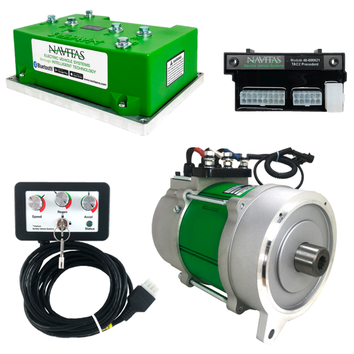
An AC conversion kit replaces your entire motor and controller system. Systems like the Navitas 5KW AC kit are game-changers. Because AC motors are brushless, they offer significantly more torque and can sustain higher RPMs without the risk of burning out brushes.
| Feature | Stock DC Motor | Navitas AC Conversion |
|---|---|---|
| Top Speed | 14–19 MPH | 25–35+ MPH |
| Maintenance | High (Brushes) | Zero (Brushless) |
| Hill Climbing | Struggles | Effortless |
| Efficiency | Lower | 20–30% Better Range |
For a deeper dive into why this technology is taking over, read AC Motors: Why All the Hype? It's the Future. If you own an EZGO, we have specific guides for the EZGO AC Conversion Kit and the Navitas AC Conversion EZGO TXT Guide.
The Lithium Advantage
Pairing an AC motor with a lithium battery is the "cheat code" for performance. Lithium batteries, such as 72V LiFePO4 packs, offer a much higher continuous discharge rate (often 300A vs. 150A for lead-acid). This means when you hit a hill, the voltage doesn't "sag," and your speed stays constant.
Beyond the power, you're also shedding 300–400 lbs of weight by removing lead-acid batteries. This weight reduction alone can add 2–3 MPH to your top speed. Curious about the transition? See our articles on Will Lithium Batteries Make My Golf Cart Faster and how to Upgrade to Lithium Golf Cart Batteries.
Mechanical Enhancements: Gearing and Tires
Not every performance gain has to come from the electrical system. Mechanical changes can drastically alter how your cart handles different terrains.
Understanding Gear Ratios
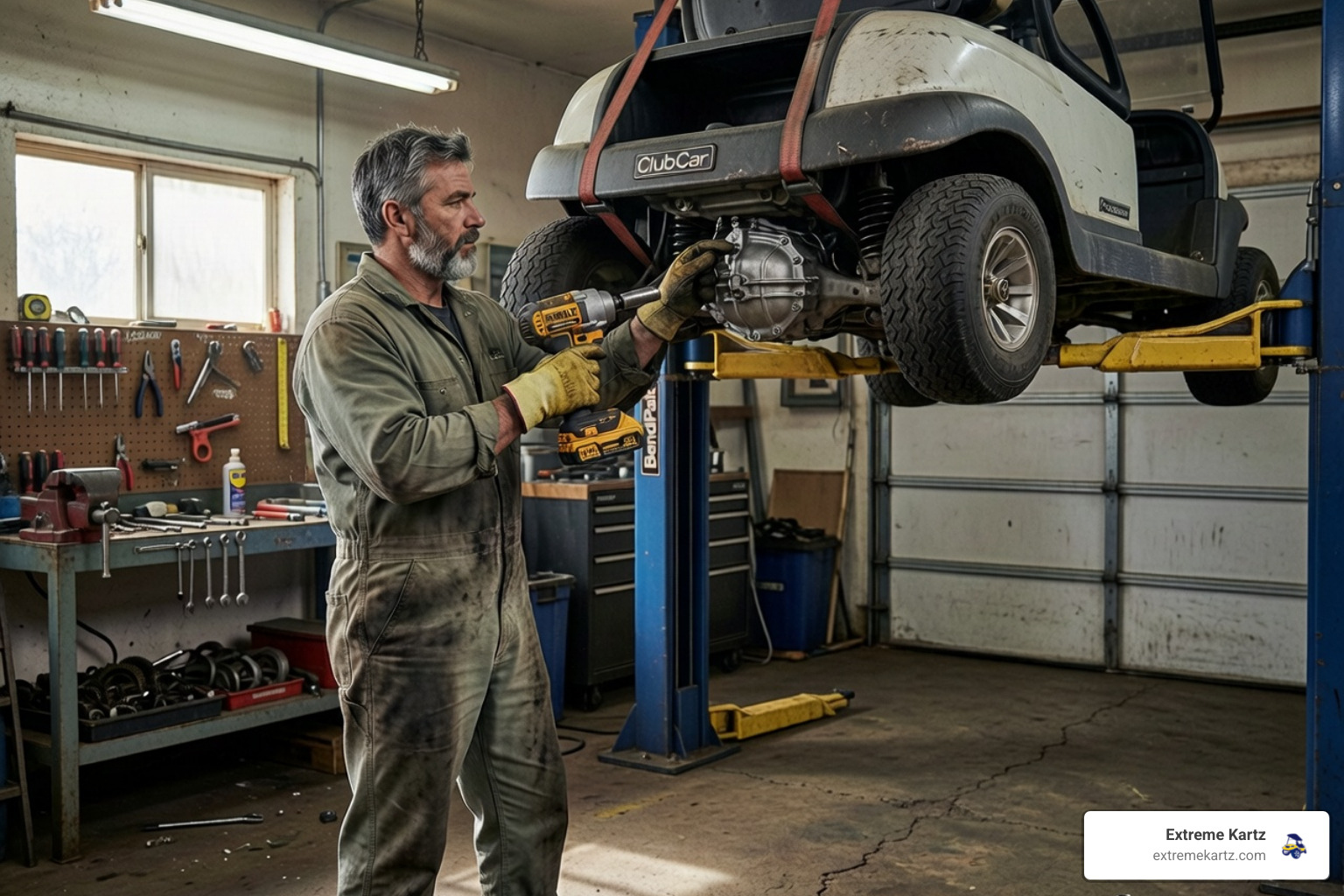
Your gear ratio determines the balance between speed and torque.
- High-Speed Gears (8:1 or 6:1): These allow the wheels to turn more times for every motor revolution. This can add 8–10 MPH to your top speed, but it reduces torque by about 15–20%. We only recommend this for flat neighborhood use.
- High-Torque Gears (15:1): These are for the climbers. If you use your cart for hunting or farming on steep inclines, these gears provide massive pulling power at the expense of top-end speed.
Tire Diameter and Maintenance
The simplest mechanical upgrade is increasing your tire size. Moving from a stock 18-inch tire to a 22-inch tire increases your "final drive ratio." Essentially, every time the axle spins once, you travel further. This can add 4–7 MPH to your speed. However, like high-speed gears, larger tires require more torque to turn. If you don't have an upgraded controller, your cart might feel "doggy" or slow to take off.
Don't overlook tire maintenance. Keeping your tires inflated to the recommended PSI (usually 18–25) reduces rolling resistance. It’s a "free" way to gain 1–2 MPH.
Budget-Friendly Golf Cart Performance Upgrades Under $100
You don't need thousands of dollars to see a difference. If you're on a budget, try these:
- Speed Sensor Magnets: For Club Car Precedent or DS models with an IQ system (ADC motor), a Speed Magnet can "trick" the motor into thinking it's spinning slower than it is, bypassing the electronic speed limiter. This can jump your speed from 15 MPH to 19–21 MPH for under $30.
- Weight Reduction: Removing heavy rear seats or unused brush guards can improve your power-to-weight ratio.
- Governor Adjustments: On gas models, a simple adjustment to the governor linkage can allow the engine to reach higher RPMs, though you must be careful not to over-rev the engine.
Essential Safety and Suspension Modifications
Speed is fun, but safety is mandatory. As we often tell our customers at Extreme Kartz, "If you're going to go 30 MPH, you'd better be able to stop like you're going 30 MPH."
Stopping Power: Hydraulic Disc Brakes
Stock golf cart brakes are usually drum-style and only on the rear wheels. They were never designed to stop a 1,000 lb vehicle traveling at 25+ MPH. Upgrading to a rear disc brake kit provides significantly more stopping power and better heat dissipation, which is vital if you're driving in hilly areas.
Suspension and Stability
High-speed carts can feel "twitchy" or unstable. To fix this:
- Heavy-Duty Leaf Springs: If you’ve added a rear seat or a heavy battery pack, stock springs will sag, affecting your steering geometry.
- Lift Kits: If you're installing 22-inch or larger tires, a quality lift kit is required. Check out our Golf Cart Lift Kit Guide to find the right fit for your model.
- Alignment: Even a slight "toe-in" or "toe-out" issue can cause speed wobbles at 20 MPH. Always align your front end after any suspension work.
Street Legality and Regulations
Once your cart exceeds 20 MPH, it may be classified as a Low-Speed Vehicle (LSV) depending on your state. For example, the FL DMV has specific requirements for LSVs, including windshields, turn signals, and VIN registration. Always check your local ordinances before taking your high-speed cart on public roads.
Frequently Asked Questions
Will performance upgrades void my factory warranty?
In most cases, yes. Installing an aftermarket controller, motor, or altering the speed settings will typically void the drivetrain portion of a manufacturer's warranty. We always recommend keeping your stock parts so you can revert to the original configuration if needed.
How does increasing tire size affect hill-climbing torque?
It’s a trade-off. A larger tire (e.g., 23" vs 18") increases your top speed because of the larger circumference, but it makes the motor work harder to get the cart moving. Without a high-amp controller (like a Navitas 600A), you will notice a significant loss in hill-climbing torque.
Can I install a 600A controller with stock battery cables?
We strongly advise against it. Stock 6-gauge cables are the "weakest link" in the chain. Under the high current draw of a 600A controller, stock cables can overheat, melt their casings, or even cause a fire. Upgrading to 4-gauge or 2-gauge cables is a mandatory safety step for any high-amp build.
Conclusion
Upgrading your golf cart is about more than just speed; it's about making the vehicle more capable for your specific lifestyle. Whether you choose a simple speed magnet or a full EZGO TXT AC Conversion, the key is compatibility.
At Extreme Kartz, we focus on system-based solutions. We don't just want to sell you a part; we want to ensure that your motor, controller, and batteries work in harmony to give you the best possible experience. For more tips on getting started, read our Six Proven Tips to Boost Your Golf Cart Performance.
Ready to transform your ride? Focus on the "Big Three": Controller, Motor, and Batteries. Match them correctly, and you'll have a cart that's the envy of the neighborhood. Plus, all our performance kits ship in 1-2 business days.
Related Products


Vendor: Bolt Energy 48V 105Ah MINI Golf Cart Lithium Battery Bundle - Professional or Standard Kit

Vendor: Club Car Navitas AC Conversion Kit for Precedent / Onward / Tempo - CAN enabled


Vendor: 14" GTW Bravo Wheels with 22x10-14 GTW Timberwolf All-Terrain Tires (Set of 4)

Vendor: Club Car Precedent / Onward / Tempo / IQ Navitas Controller Kit - 600 amp or 440 amp


