


Beginner's Guide to Ezgo Golf Cart 36V Controller
What You Need to Know About the EZGO Golf Cart Controller 36V
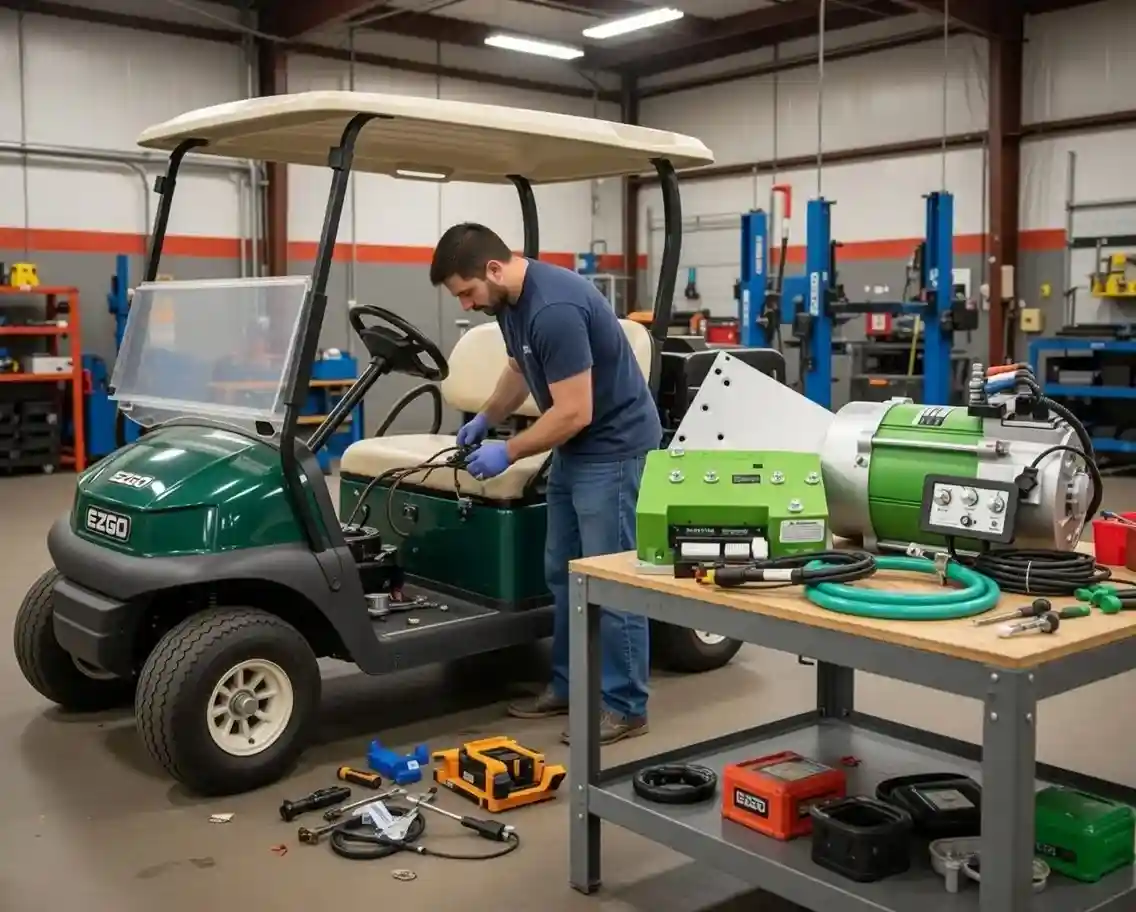
An EZGO golf cart controller 36V is the brain of your electric cart's drivetrain. It regulates how much power flows from your batteries to the motor — controlling speed, torque, and overall performance.
Here's a quick summary of what you need to know:
| Topic | Key Facts |
|---|---|
| What it does | Controls motor speed and power output via PWM signal |
| Compatible models | EZGO TXT, Medalist, Marathon — most 1994 and newer |
| Common amperage ratings | 300A (stock), 350A (upgrade), 400A+ (performance) |
| System types | Series, DCS (1995–2000), PDS (2000–Up) |
| Popular brands | Curtis (OEM), Navitas, Alltrax, VEVOR |
| Throttle type | ITS (Inductive Throttle Sensor) on most PDS models |
If your EZGO feels sluggish, cuts out unexpectedly, or just isn't performing like it used to — the controller is one of the first places to look. And if you're planning an upgrade, choosing the right controller for your specific system matters more than most people realize.
This guide breaks it all down in plain language: what the controller does, how to identify your system type, what amperage rating you actually need, and how to replace or upgrade it without making a costly mistake.
I'm Martin Davis, owner of Extreme Kartz and a hands-on guide to EZGO golf cart controller 36V upgrades and replacements for owners across all 50 states. Whether you're troubleshooting a failing unit or chasing more torque, the sections below walk you through everything step by step.
Understanding Your EZGO Golf Cart Controller 36V
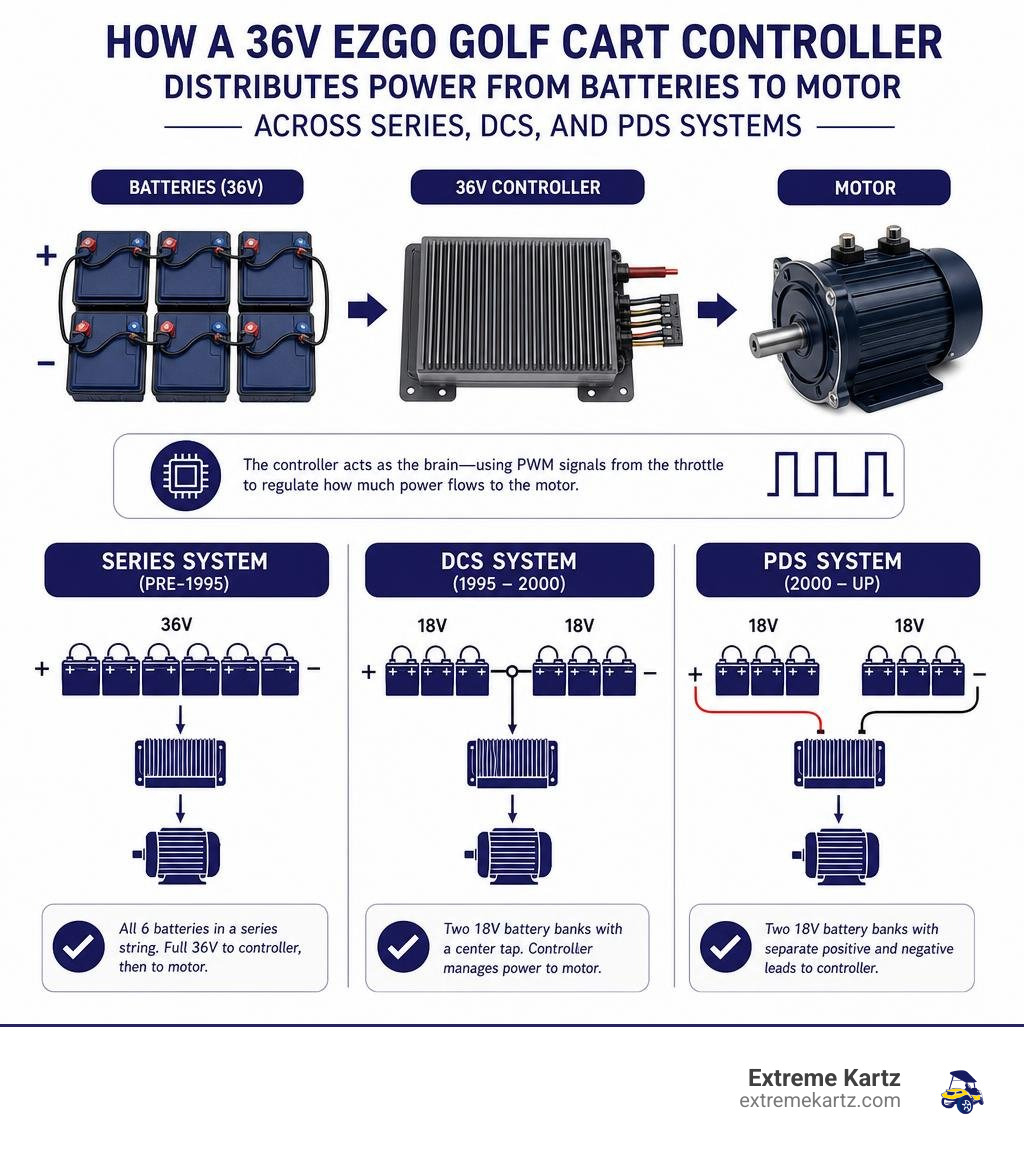
To get the most out of your EZGO, it helps to understand what the speed controller actually does. Think of it as a highly sophisticated gatekeeper. Your 36-volt battery pack holds a massive amount of electrical energy, but your motor cannot handle all that raw power dumped into it at once.
If you want a Golf Cart Speed Controllers: A Basic Understanding of Controllers, you will learn that the controller takes the high-voltage direct current (DC) from your battery pack and translates the physical position of your accelerator pedal into a safe, usable electrical signal for the motor.
Without a controller, your golf cart would only have two modes: completely stopped, or launched forward at full speed. The controller bridges this gap, allowing you to cruise smoothly at 2 mph in a crowded parking lot or hit top speeds out on the fairway.
How the EZGO Golf Cart Controller 36V Manages Power
Most modern and classic 36V controllers use Pulse Width Modulation (PWM) to regulate speed. Instead of reducing the voltage (which would waste massive amounts of energy as heat), the controller rapidly switches the power on and off thousands of times per second.
This switching frequency typically operates around 15.6 kHz. Because this happens so fast, the motor reacts to the average power of these pulses.
- At a light press of the pedal, the "on" pulses are very short, meaning less average power and slower speeds.
- When you floor the pedal, the "on" pulses become continuous, sending full voltage and maximum current to your motor.
This high-frequency regulation ensures that your motor runs cool, responds immediately to throttle inputs, and operates with maximum electrical efficiency.
Identifying Your System: Series, DCS, or PDS
Before buying a replacement or upgrade, you must know which drive system your EZGO uses. EZGO utilized three primary electric motor systems for their 36V models: Series, DCS (Drive Control System), and PDS (Precision Drive System). Installing the wrong controller type can permanently damage your electrical system.
To figure out what is currently sitting under your seat, check out our guide on Golf Cart Controller Location: Detective EZGO, Yamaha, and Club Car Locations Revealed.
Here is how to tell them apart:
-
Series System (1994–Up Medalist & TXT):
- The Giveaway: Your Forward/Reverse (F&R) switch is a physical, mechanical lever located by your right leg near the floorboard.
- The Tech: These systems use a series-wound motor where the field and armature windings are connected in series. They are legendary workhorses known for high torque, but they lack regenerative braking.
-
DCS - Drive Control System (1995–2000):
- The Giveaway: You have a Run/Tow switch under the seat, but your F&R control is still a mechanical lever by your leg.
- The Tech: This was EZGO's first Separately Excited (SepEx) system. The controller manages the armature and field windings independently, producing about 60% less heat than traditional series setups.
-
PDS - Precision Drive System (2000–Up):
- The Giveaway: Your Run/Tow switch is under the seat, and your F&R switch is a modern rocker switch mounted directly on the dash.
- The Tech: A highly efficient SepEx system. It features an Inductive Throttle Sensor (ITS) and is compatible with speed chips or electronic programming. PDS systems require specific controllers, such as the Curtis 1206MX or upgraded 350A models.
Amperage Ratings and Performance Upgrades
When researching an ezgo golf cart controller 36v, you will constantly see amperage ratings like 300A, 350A, or 500A. Amperage represents electrical flow, which directly translates to torque (pulling power).
| Controller Amperage | Best Use Case | Performance Impact | Supporting Upgrades Needed |
|---|---|---|---|
| 300 Amp (Stock) | Flat, paved paths; standard neighborhood cruising | Baseline speed and torque; struggled on steep hills | None (standard stock wiring) |
| 350 Amp (Mild Upgrade) | Hilly terrain, light utility work, moderate passenger loads | ~15-20% increase in climbing torque; holds speed better | Recommended: heavy-duty solenoid |
| 400 Amp+ (Performance) | Heavy off-road use, lifted carts, large rear seats | Dramatic torque increase; superior hill climbing | Required: 4-gauge cables, heavy-duty solenoid |
If you are looking for a noticeable EZGO Speed Upgrade, moving from a stock 300A controller to an aftermarket 350A or 400A unit is one of the most cost-effective modifications you can make. It provides the extra muscle needed to climb steep hills without your cart slowing to a crawl.
Upgrading Your EZGO Golf Cart Controller 36V for Maximum Torque
An upgraded controller can only output as much power as your electrical system can deliver. If you install a high-amperage controller but keep your thin, worn-out stock wiring, those wires will choke the current flow and overheat.
To build a reliable, high-torque system, we recommend upgrading in stages:
- Heavy-Duty Solenoid: Your solenoid is the heavy-duty switch that handles high current. A stock solenoid will quickly burn its contacts when paired with a 400A controller. Upgrade to a 200A or 400A continuous solenoid with silver contacts.
- 4-Gauge Battery Cables: Replace your factory 6-gauge wires with thick, high-quality 4-gauge (or even 2-gauge) copper cables to ensure unrestricted power flow.
- Heavy-Duty F&R Switch: For older Series carts, the mechanical F&R switch must be upgraded to handle the higher amperage.
- Premium Lithium Conversion: If you want the ultimate performance jump, pairing a high-amperage controller with a premium lithium battery pack from Eco Battery, Bolt Energy, Lithium Rhino, or Bedrock Battery will drop up to 300 lbs from your cart while delivering consistent, fade-free voltage.
OEM vs. Aftermarket Replacements
When it comes to replacing your controller, you have two main routes: sticking with original equipment manufacturer (OEM) style Curtis replacements, or upgrading to premium aftermarket brands like Navitas or Alltrax.
- OEM Curtis Replacements: These are direct, plug-and-play units. For instance, the Curtis 1206 36V 350A controller is a highly reliable direct replacement for older 1994-Up TXT/Medalist models (replaces OEM part numbers like 73326-G02, 73326-G03, and 73326-G07). They offer factory-level reliability and require zero programming.
- Aftermarket Upgrades (Navitas & Alltrax): If you want to customize your cart's performance, brands like Navitas offer incredible control. Their TSX3.0 series features On-The-Fly (OTF) programmers that let you adjust top speed, regenerative braking, and acceleration on the fly.
To compare your options further, read our comprehensive Golf Cart Controller Comparison: Club Car, EZGO, and Yamaha Upgrades Explained.
For those looking to source reliable replacement parts, you can check out EZGO Controllers and Parts to see what options fit your budget. If you are running a classic Series setup, you might also consider specialized performance packages like the EZ-GO Series Electric Golf Cart Motor & Controller , or explore high-speed configurations at EZGO Controller - High Speed, USA | DD Motor Systems .
Troubleshooting and Replacing a 36V EZGO Controller
Is your controller actually broken, or is the issue coming from another component? Because controllers are solid-state electronic devices, they rarely show obvious physical signs of damage unless they have suffered a catastrophic internal short.
Before spending money on a replacement, it is vital to run a few basic diagnostic tests. Check out our detailed guide on Golf Cart Controller Troubleshooting: Common Problems and How to Fix Them to pinpoint the exact failure.
Symptoms of a Failing Controller
Watch out for these common warning signs that your 36V controller is on its last legs:
- Intermittent Throttle Response: The cart hesitates, stutters, or cuts out completely while driving, but works fine after you cycle the key switch.
- The "Dead Cart" Syndrome: Your solenoid clicks when you press the accelerator, but the motor doesn't spin at all.
- Sudden "Slow Mode": The cart suddenly refuses to go faster than 2 to 3 mph, even with fully charged batteries. This often indicates the controller has entered thermal protection mode due to excessive heat buildup.
- Excessive Heat or Odor: The controller case feels extremely hot to the touch, or smells like burnt electronics.
Step-by-Step Installation Guide
Replacing an ezgo golf cart controller 36v is a straightforward DIY project that takes about 45 to 60 minutes.
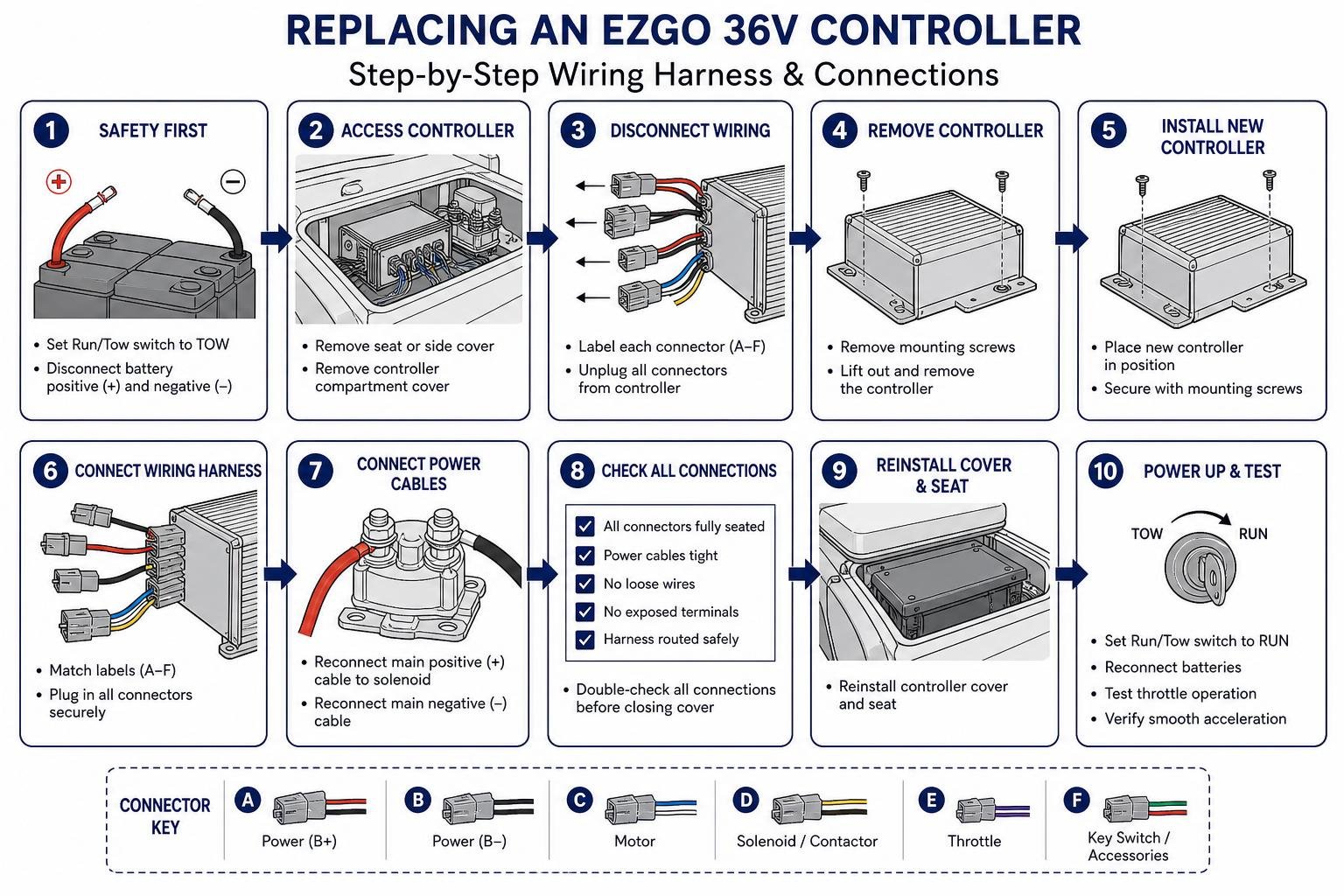
Step 1: Safety First
Before picking up any tools, flip your Run/Tow switch to TOW (if equipped) and disconnect the main positive and negative cables from your battery pack. This prevents accidental shorts that can destroy your new controller or cause severe injury.
Step 2: Access the Controller
Remove the plastic environmental cover located under the seat (or on the passenger side frame rail depending on your model year) to expose the controller and solenoid.
Step 3: Document the Wiring
Take a clear, high-resolution photo of the existing wiring connections. Note where the large power cables (usually labeled B+, B-, and M-) and the multi-pin control plugs (5-pin or 9-pin connectors) attach.
Step 4: Disconnect and Remove
Carefully unplug the wire harness, then use an insulated wrench to remove the heavy-duty power cables. Unbolt the old controller from the mounting plate. Clean the mounting surface to ensure optimal heat transfer for the new unit.
Step 5: Install the New Controller
Mount the new controller using the factory hardware. Reconnect the heavy-duty cables and plug in the control harness exactly as shown in your reference photo. Ensure all connections are tight but do not over-torque the brass terminals.
Step 6: Reconnect and Test
Reconnect your battery pack, flip the Run/Tow switch back to RUN, and test the cart on jack stands first to ensure the wheels spin in the correct direction.
For a deeper dive into modern speed controller options, reference our Golf Cart Speed Controllers Guide 2026.
Frequently Asked Questions about EZGO 36V Controllers
Can I use a speed chip with a 350A controller?
No, standard EZGO speed chips (which plug into the J2 port on factory PDS controllers to change performance profiles) are generally not compatible with aftermarket 350A or higher controllers. Upgraded controllers are pre-programmed for maximum output or use advanced programming software, making external speed chips unnecessary.
Will a 36V controller work on a 48V system?
Typically, no. Standard 36V controllers (like the Curtis 1206) have strict over-voltage protection limits and will shut down or suffer permanent damage if connected to a 48V battery pack. However, some premium aftermarket controllers (such as certain Alltrax or Navitas models) are dual-voltage rated and can run on both 36V and 48V systems. Always check the manufacturer's specifications before changing system voltage.
Do I need to upgrade my solenoid when replacing the controller?
If you are installing a standard stock 300A replacement, your original solenoid is fine. However, if you are upgrading to a 350A or higher performance controller, we highly recommend upgrading to a heavy-duty continuous solenoid with silver contacts. A stock solenoid will quickly wear out under the increased current load, leading to contact welding and system failure.
Conclusion
Upgrading or replacing your ezgo golf cart controller 36v doesn't have to be a stressful or confusing project. By taking the time to identify your drive system (Series, DCS, or PDS) and choosing the right amperage rating for your terrain, you can easily restore your cart's performance or unlock incredible new hill-climbing power.
At Extreme Kartz, we focus on delivering complete, system-based solutions rather than just individual parts. We want to make sure you get the right cables, solenoids, and controllers that work together seamlessly.
If you are ready to upgrade your ride or have questions about fitment, check out our extensive selection of EZGO Parts and Accessories. Our team of experts is always here to help you choose the perfect setup for your specific cart and driving goals!
Related Products


Vendor: Navitas 440-Amp 36/48 Volt Series Controller Kit E-Z-GO

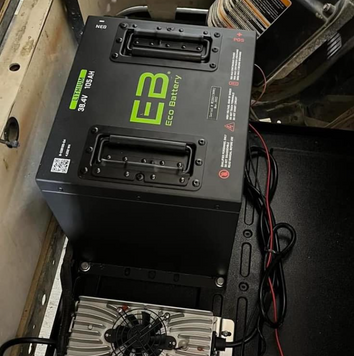
Vendor: Eco Battery 36V 105Ah Lithium Bundle — Club Car DS, EZGO TXT & Yamaha G-Series

Vendor: Alltrax 48 Volt 500 Amp EZ-GO TXT48 Controller


