


A Quick Start Guide to Golf Cart Seat Belt Options
Why Golf Cart Seat Belts Matter More Than Most Owners Think
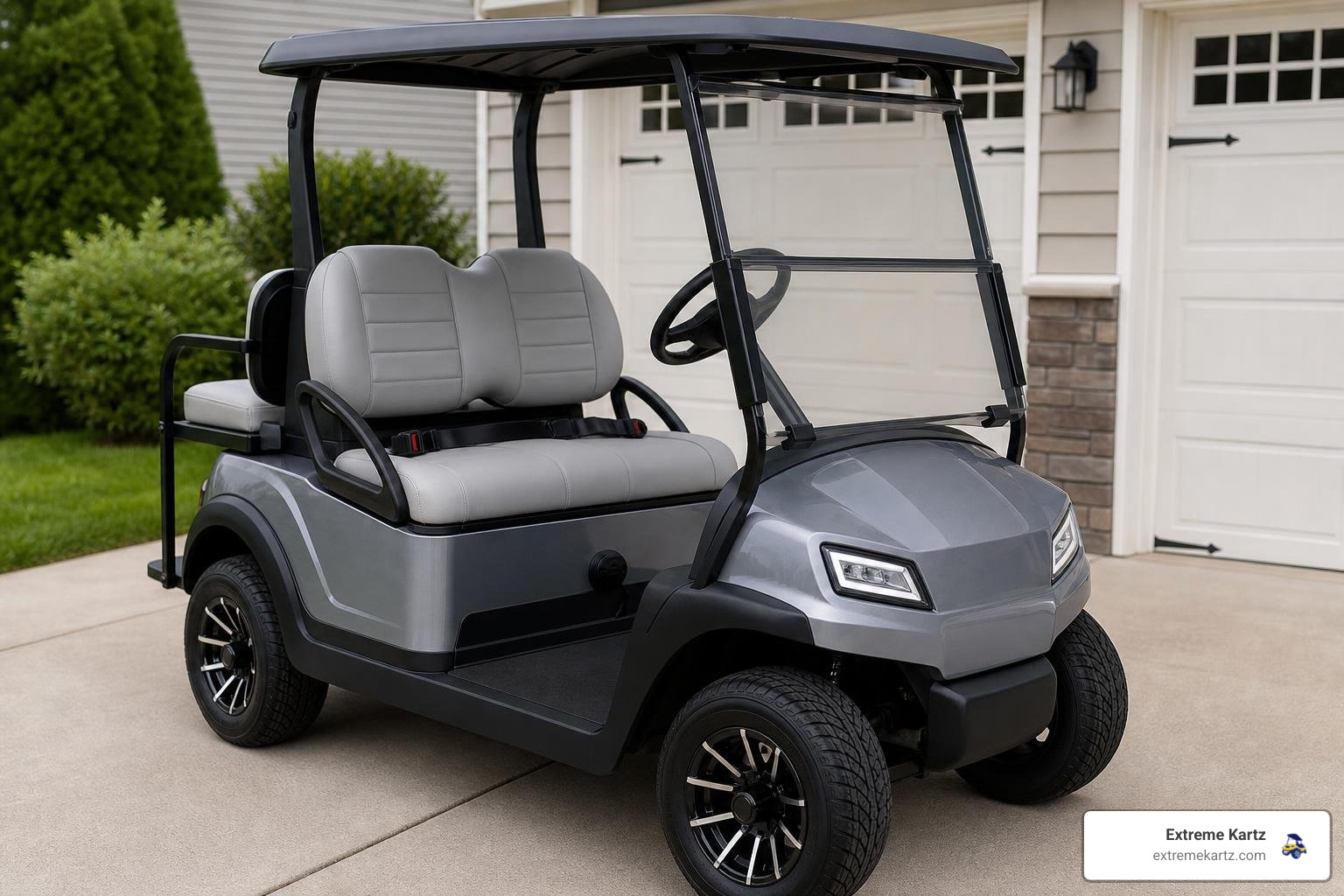
Golf cart seat belts are one of the most practical safety upgrades you can add to your cart — whether you're cruising a neighborhood, crossing a public street, or carrying kids in the back.
Here's a quick overview of what you need to know:
| What You're Looking For | Quick Answer |
|---|---|
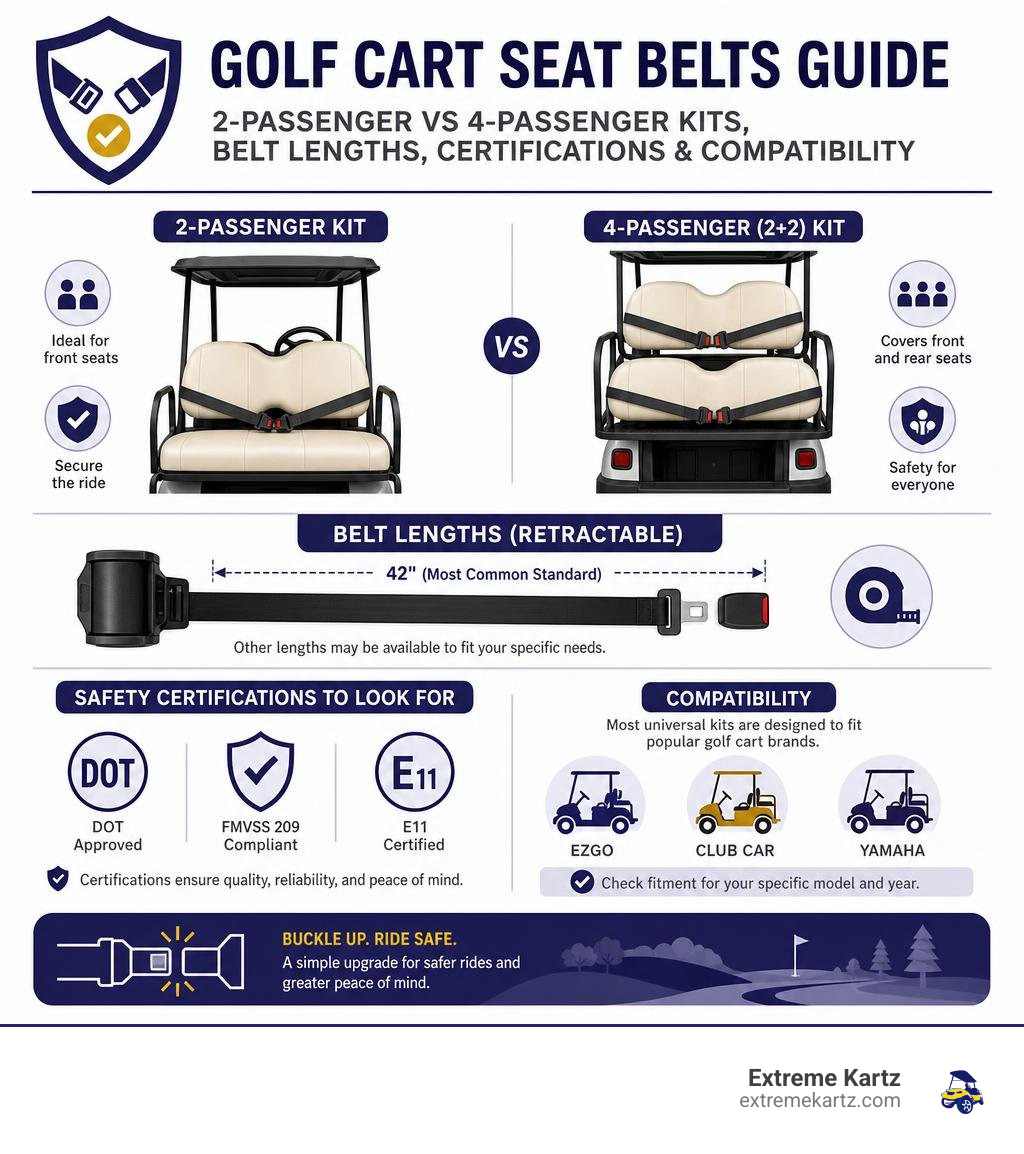
| Best type | Retractable (42" is the most common standard length) |
| Common configurations | 2-passenger kit or 4-passenger (2+2) kit |
| Compatible brands | EZGO, Club Car, Yamaha (most universal kits fit all three) |
| Bracket included? | Not always — check before buying |
| Street-legal requirement | Required in many states for on-road use |
| Price range | $90 (basic 2-pack) to $200+ (4-passenger retractable kit) |
| Safety certifications to look for | DOT approval, FMVSS 209, E11 |
Most golf cart owners assume seat belts are optional — something you add for comfort rather than compliance. But that assumption can lead to real legal exposure, especially if you cross a public road, carry passengers in a rear seat, or transport children.
At even 15 mph, an unbelted passenger can be seriously injured in a rollover or sudden stop. And in many states, operating a golf cart on public roads without seat belts puts you at risk of traffic fines and civil liability if an accident occurs.
I'm Martin Davis, owner of Extreme Kartz, and I've worked closely with manufacturers and technicians to help golf cart owners across all 50 states find the right golf cart seat belts for their specific cart model and use case. In this guide, I'll walk you through everything you need to make a confident, informed decision.
Why You Need Golf Cart Seat Belts
When we think of golf carts, we often picture leisurely drives down perfectly paved golf course fairways. However, as of July 2026, golf carts are increasingly used as primary neighborhood transportation, utility vehicles, and trail cruisers. This transition from the golf course to public asphalt and rugged dirt paths makes installing a high-quality set of golf cart seat belts an absolute necessity.
The primary driver behind installing seat belts is mitigating occupant ejection risks. According to safety studies by the National Highway Traffic Safety Administration (NHTSA), passenger ejection is the leading cause of severe and fatal injuries in low-speed vehicle crashes. Because golf carts feature open-air designs without doors or side pillars, a sudden sharp turn, a quick stop, or navigating uneven, rough terrain can easily cause a passenger to lose balance and fall out of the vehicle.
This risk is particularly high for children and elderly passengers. For example, legislative updates in states like South Carolina strictly mandate that children under the age of 12 must wear fastened seat belts when riding in a golf cart on public streets. Even at a modest speed of 10 to 15 mph, a minor collision or a sudden swerve to avoid an obstacle can throw an unbelted child from the cart, resulting in catastrophic injuries.
Furthermore, adding aftermarket accessories like lift kits, larger wheels, and high-performance motors changes the cart's center of gravity. If you are planning to upgrade your cart's performance, adding seat belts should be your very first step to ensure your passengers remain safely secured. To explore how seat belts fit into your overall cart customization plan, check out our comprehensive Golf Cart Accessories Complete Guide and our detailed Golf Cart Seating Complete Guide.
Key Factors to Consider When Choosing a Kit
Choosing the right golf cart seat belts is not a one-size-fits-all process. To avoid the frustration of ordering incompatible parts, we must evaluate several critical factors before making a purchase.
- Passenger Capacity: Are you outfitting a standard 2-passenger cart, or does your cart have a rear-facing flip seat for a 4-passenger (2+2) configuration?
- Bracket Inclusion: Many "universal" seat belts sold online are just the belt straps and buckles. They do not include the essential steel mounting bracket bar needed to attach the belts to your cart's frame.
- Price vs. Quality: While budget-friendly lap belts can cost as little as $10 to $25, premium, street-legal kits with heavy-duty mounting brackets and retractable mechanisms range from $75 to $190+. Investing in a higher-priced kit ensures durable, automotive-grade materials that will not rust, jam, or fray.
We can break down the primary differences between the two main styles of seat belts in the table below:
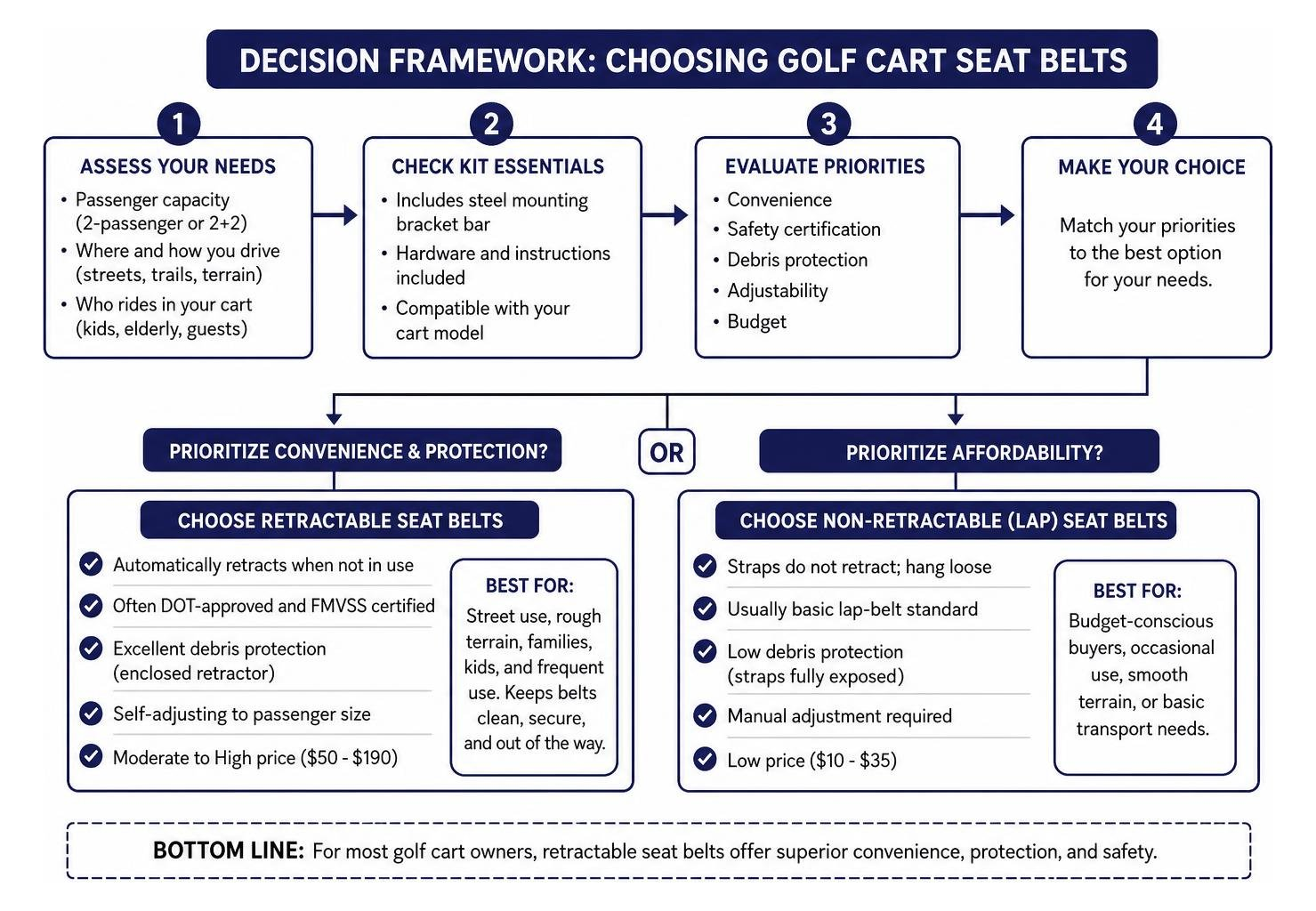
| Feature | Retractable Seat Belts | Non-Retractable (Lap) Seat Belts |
|---|---|---|
| Convenience | High (automatically rolls up when not in use) | Low (straps hang loose, can get dirty or tangled) |
| Safety Certification | Often DOT-approved and FMVSS certified | Usually basic lap-belt standard |
| Debris Protection | Excellent (especially with enclosed retractors) | Low (straps are fully exposed to elements) |
| Adjustability | Self-adjusting to passenger size | Manual adjustment required |
| Price Point | Moderate to High ($50 - $200+) | Low ($10 - $35) |
Retractable vs. Non-Retractable Golf Cart Seat Belts
For most golf cart owners, retractable seat belts are the superior choice. The automatic retracting mechanism keeps the straps neatly rolled up and out of the way when the seats are empty. This prevents the belts from dangling out of the sides of the cart, dragging on the ground, getting caught in the wheels, or becoming covered in mud and dirt.
If you frequently drive your cart in sandy, dusty, or wet outdoor environments (such as near beaches, farm fields, or muddy trails), we highly recommend opting for seat belts with fully enclosed retractors. Enclosed retractors block debris from entering the internal spring mechanism, ensuring the belt retracts smoothly every time.
On the other hand, non-retractable lap belts are highly cost-effective and simple. However, they require manual adjustment for every single passenger, which can become tedious if multiple people use the cart.
If you are looking for a reliable, brand-specific retractable replacement, we recommend choosing a high-quality retractable seat belt kit designed specifically for your cart's make and model. If you prefer a simpler, standard lap belt style, universal 2-point adjustable safety lap belts provide a highly adjustable, straightforward fit.
Sizing and Lengths of Golf Cart Seat Belts
When selecting a seat belt kit, the fully extended length of the belt is incredibly important for passenger comfort. If a belt is too short, it will pinch larger passengers or fail to buckle entirely. Conversely, if it is too long without a proper retractor, it will sag and fail to hold passengers securely.
- 42-Inch Standard: This is the most common length for aftermarket retractable seat belts. It provides ample clearance for the average adult and is highly versatile for front and rear seats.
- 47-Inch to 57-Inch: These medium-length retractable belts are excellent for lifted carts or vehicles with deeper custom seats, offering extra breathing room.
- 60-Inch to 72-Inch: Typically found in standard non-retractable lap belts, these extended lengths are designed to span across wide bench seats or accommodate larger occupants.
Additionally, pay attention to the sleeve length (often 6-inch or 9-inch rigid plastic sleeves) on the buckle side. These sleeves keep the buckle upright and easily accessible between the seat cushions, preventing you from having to fish around for the receiver. To find the perfect balance of length and convenience, look for street-legal 42-inch fully extended seat belts that include the necessary mounting bracket and hardware.
Compatibility and Mounting Bracket Requirements
One of the most common mistakes buyers make is assuming a "universal" seat belt kit will bolt directly onto their cart without any extra hardware. While the seat belt straps themselves are highly compatible across EZGO, Club Car, and Yamaha models, the way they mount to the vehicle varies significantly.
Most standard golf cart frames do not have pre-drilled seat belt mounting holes. To install seat belts safely, you must use a heavy-duty steel mounting bracket (often called a seat belt bar). This bar spans across the rear seat struts of your cart, providing secure, structural anchor points for the seat belt mechanisms.
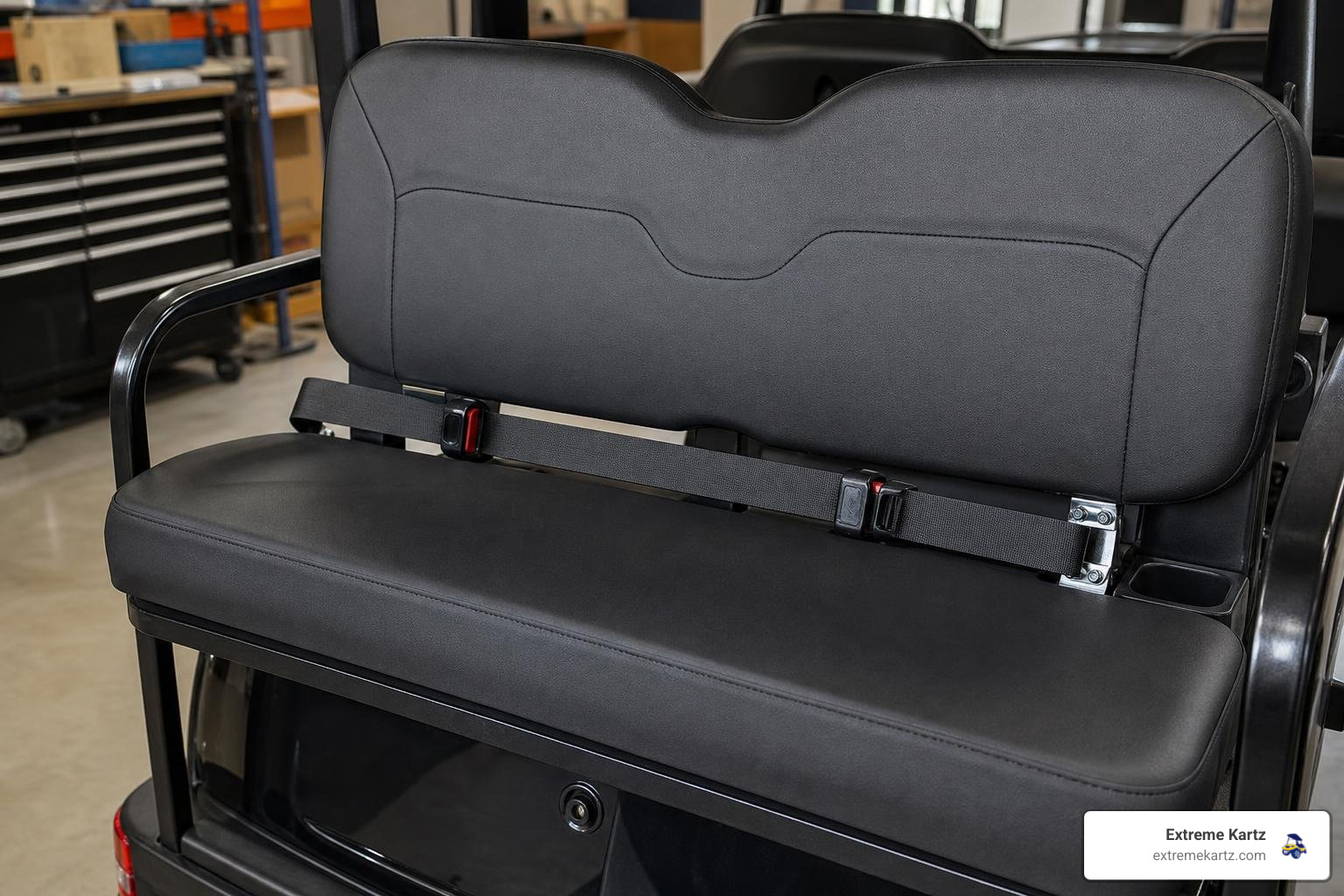
- EZGO Carts: Models like the EZGO TXT often require drilling through the plastic backrest support to securely mount the steel bracket bar to the frame. The EZGO RXV, however, has a different rear strut design and often requires a highly specific bracket kit rather than a standard universal bar.
- Club Car Carts: The Club Car DS can typically accept standard universal brackets. However, newer models like the Club Car Precedent and Club Car Tempo feature unique, triangular canopy struts. To mount seat belts on these models, you must purchase a model-specific adapter bracket (such as the SEAT-2007 mounting kit) to bridge the gap.
- Yamaha Carts: While newer Yamaha Drive and Drive2 models are highly compatible with standard universal brackets, older Yamaha models like the G2 and G9 have completely different frame configurations and are generally incompatible with universal seat belt bars without custom metal fabrication.
If you are upgrading a 4-passenger cart with a rear flip seat, the seat belt bracket must be carefully installed to avoid interfering with the folding mechanism of the rear seat. For a deep dive into how rear seat kits affect your accessory installation, consult our Golf Cart Rear Seat Kit Guide. To find compatible hardware packages, look for certified universal golf cart seat belt kits that are designed to fit major brands like EZGO, Yamaha, and Club Car.
Street-Legal Compliance and Safety Certifications
If your goal is to transition your standard golf cart into a registered Low-Speed Vehicle (LSV) or Neighborhood Electric Vehicle (NEV) for public-road use, seat belts are not just a smart safety choice - they are commonly required as part of the street-legal equipment package.
To support local police, DMV, or inspection requirements, look for seat belt kits that meet recognized automotive safety standards. Key certifications and standards include:
- FMVSS 209: Federal Motor Vehicle Safety Standard No. 209 covers seat belt assembly requirements in the United States, including strength, buckle performance, and material durability.
- DOT Approval: DOT-marked or DOT-compliant belt assemblies are designed to meet applicable U.S. transportation safety expectations.
- E11 Certification: An internationally recognized European approval marking that indicates automotive-grade testing and compliance.
Using uncertified, low-quality belts can create inspection issues and may reduce passenger protection in a sudden stop or collision. Requirements can vary by state, county, and municipality, so confirm your local rules before registering or operating on public roads. To understand the exact legal distinctions between standard carts and LSVs, read our guide on Defining Street Legal Golf Carts Lsvs Nevs And Modified Golf Carts. For maximum safety and compliance, choose certified, street-legal belt kits that match your cart model and seating configuration.
Frequently Asked Questions About Golf Cart Seat Belts
Are seat belts required to make a golf cart street-legal?
Yes. In almost all municipalities and states that allow golf carts on public roads (with speed limits of 35 mph or less), seat belts are a mandatory requirement. Your cart must pass a safety inspection to receive an LSV license plate, and functioning, certified seat belts are a core component of this inspection.
Can I install a universal seat belt kit on a 4-passenger cart?
Yes, but you must ensure you purchase a 4-passenger seat belt kit. These kits include a wider steel mounting bracket (typically around 34.76 inches wide) designed to span the rear struts, and they come packaged with four separate seat belt assemblies (two for the front-facing seats and two for the rear-facing seats).
Do I need to drill holes to install a seat belt bracket?
In many cases, yes. While some golf carts have frames that allow for a direct bolt-on installation, models like the EZGO TXT usually require drilling holes through the plastic seat backrest supports to secure the mounting bracket directly to the steel chassis. Always use grade-5 or grade-8 mounting hardware to ensure structural integrity.
Conclusion
At Extreme Kartz, we believe safety should never be an afterthought. Installing a high-quality set of golf cart seat belts is one of the most effective, straightforward upgrades you can make to protect your family, meet local street-legal regulations, and drive with absolute confidence. All of our seat belt kits ship in 1-2 business days.
Whether you need a model-specific bracket for a Club Car Precedent or a universal 4-passenger retractable kit for your EZGO, we are here to help you get the right fit the first time.
If you have any questions about compatibility, installation, or choosing the right length for your setup, contact our expert support team today. Ready to upgrade your cart? Browse our complete selection of premium upgrades at Extreme Kartz Golf Cart Accessories.

Related Products

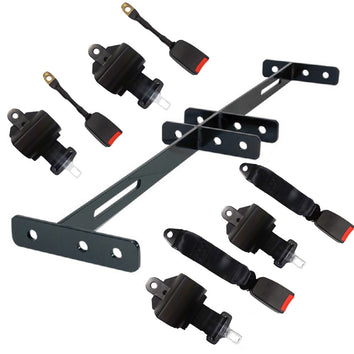
Vendor: Seat Belt Kit, Retractable 4 Pass

Vendor: Lap Belt (Single In Box) w/Hw


Vendor: GTW Retractable Rigid Buckle Seat Belt – Standard 45" (Single)


