


Eco Battery Review: An Honest Buyer’s Guide to Golf Cart Lithium Batteries
If you’ve spent any time researching lithium golf cart batteries, you’ve probably noticed one name keeps coming up everywhere: Eco Battery. It’s not by accident, and it’s not just marketing. We’ve installed these batteries, sold them, fielded the support calls when something went sideways, and watched how they hold up after years of real use on real carts — golf courses, gated communities, hunting leases, and everything in between.
This guide is for golf cart owners seriously considering the jump to lithium and trying to figure out whether Eco Battery is the right fit for their cart, their budget, and how they actually use it. We won’t pretend Eco is perfect for everyone — but we will tell you exactly where it shines, where a couple of competitors edge it out, and how to avoid a bad dealer experience along the way.
By the end, you’ll know what makes Eco’s hardware and BMS different from cheaper alternatives, which battery size fits your use case, how Eco pairs with performance controllers like Navitas, Alltrax, and Teekon, and when another brand might genuinely be the smarter pick.
At a glance
6 Reasons Eco Battery Leads the Pack
Easiest Install
Cart-specific hardware, through-hole mounting
Real Support
Phone answers, plus an active owner community
Reliable BMS
Among the lowest issue rates we’ve seen
Controller Ready
Pairs well with Navitas, Alltrax, Teekon
A Size For Everyone
60Ah to 70V 105Ah covers every use case
Built to Last
OEM contracts back long-term stability
Why Eco Battery Has Become an Industry Leader
Lithium conversions used to be a niche, expensive upgrade reserved for serious off-road builds or fleet operators who could justify the cost. Eco Battery is one of the brands that changed that. They built their bundles specifically around golf cart applications instead of repackaging generic industrial lithium cells, and that single decision is the reason their name shows up in nearly every golf cart Facebook group, every dealer showroom, and every “which lithium battery should I buy” thread you’ll find.
Part of that reputation comes from sheer volume — they’ve sold a lot of batteries, which means a lot of real-world data on how those batteries perform over time. Part of it comes from relationships with OEM golf cart manufacturers who trust Eco enough to spec their batteries into new builds. And part of it, frankly, comes from the basics: they answer the phone, they stand behind their warranty, and their batteries don’t tend to show up in the “my battery just died for no reason” threads nearly as often as some of the cheaper imports do.
None of that means Eco is automatically the right choice for your cart. But it does mean that when you buy Eco, you’re buying into an ecosystem — dealers who know how to install it, a community that can troubleshoot it, and a company that’s likely to still be around when you need a warranty claim five years from now. That ecosystem is worth more than most buyers realize until they’re the one stuck with an orphaned battery brand.
1. The Easiest Lithium Battery to Install
If you’ve ever watched someone fabricate custom battery trays, drill new mounting holes, and rewire a battery compartment to fit a lithium pack that was never designed for that cart, you understand why installation difficulty matters. It’s the difference between a two-hour swap and an all-day project that requires a grinder, a drill press, and a trip to the hardware store.
Eco Battery’s biggest advantage here is that their bundles are built around the actual factory battery trays of popular golf cart models. Instead of giving you a generic rectangular battery and telling you to figure it out, Eco engineers their case dimensions and mounting points to match the cart-specific hardware that’s already sitting in your battery bay.
Cart-Specific Mounting Hardware
Each Eco bundle ships with brackets and hardware sized for specific cart platforms — Club Car, E-Z-GO, Yamaha, and the major OEM lithium-ready chassis. In practice, this means you’re often reusing the existing hold-down points in your battery compartment rather than drilling new ones. We’ve installed these on carts where the entire mounting process took less time than it took to disconnect and remove the old lead-acid batteries.
The Through-Hole Design Advantage
Here’s a detail that doesn’t show up in most reviews but matters a lot once you’re under the seat with a wrench: Eco Battery cases include a through-hole design that lets a mounting bolt pass completely through the battery case and bracket, rather than relying on side clamps or strap-down systems alone. As far as we’ve seen, Eco is the only major brand doing this on their standard bundles.
Why does that matter? A through-bolt mount is more secure on rough terrain, it doesn’t rely on a strap that can loosen over time, and it means the battery isn’t shifting around in the tray when you hit a bump or a curb. For off-road or hilly-terrain owners especially, this is a real durability advantage — not just a convenience feature.
Reduced Fabrication, Real DIY Friendliness
Because the case dimensions and mounting points are designed around common cart layouts, most Eco installs don’t require any cutting, grinding, or fabrication. That’s a big deal if you’re doing this yourself in your garage on a Saturday afternoon. We routinely see owners with basic mechanical skills — the kind of person comfortable changing their own brake pads — complete an Eco Battery install without calling for help.
- Wiring is simplified. Eco’s bundles typically come with pre-terminated cables and connectors sized for direct replacement of your lead-acid bank, so you’re not crimping custom lugs in most cases.
- Weight makes a difference too. A full lithium bundle weighs a fraction of the lead-acid bank it replaces, which means less wrestling heavy batteries in and out of a cramped compartment.
- Installer feedback is consistently positive. Of all the lithium brands we’ve installed, Eco generates the fewest “why doesn’t this fit” calls back to our shop — and that’s coming from someone who fields those calls.
Bottom line: if you’re nervous about the installation side of a golf cart battery upgrade, Eco Battery removes most of the friction. That doesn’t mean zero friction — every cart has its quirks, especially older or modified ones — but compared to generic lithium packs, this is about as plug-and-play as the category gets.
2. Customer Support That Actually Answers the Phone
This sounds like a low bar. It shouldn’t be. But after years in this industry, we can tell you that “can you actually reach the manufacturer when something goes wrong” separates the good lithium brands from the ones that quietly disappear after the sale.
Why Support Matters More With Lithium
Lead-acid batteries are simple, dumb devices — there’s not much to troubleshoot beyond “is it charged.” Lithium batteries have an onboard computer (the BMS) that can throw fault codes, enter protection modes, or behave unexpectedly if it’s paired with the wrong charger settings or an aggressive controller. When that happens, you need someone on the other end of the phone who actually understands the product — not a call center reading from a script.
Eco Battery’s support team consistently answers calls and engages with troubleshooting in a way that, frankly, a lot of their competitors don’t. We’ve called on behalf of customers with odd BMS behavior and gotten real diagnostic guidance the same day. That responsiveness is the difference between a five-minute fix and a battery sitting dead in a cart for two weeks while you wait on an email reply from overseas.
The Dealer Network and Facebook Community
Because Eco Battery has been adopted so widely, there’s a large and active owner community — particularly in golf cart Facebook groups — where current Eco owners answer questions, share install photos, and troubleshoot common issues in real time. If you post a question about an Eco Battery at 9 p.m. on a Sunday, odds are good someone with the exact same setup will respond before your local dealer even opens Monday morning.
The dealer network itself is also broad, which is good for parts availability and warranty service — but it comes with a caveat we’ll cover later: not every dealer that sells Eco Battery actually has experience installing or supporting lithium systems.
What This Looks Like in Real Ownership
- Faster resolution on edge cases. If your battery trips into a protection state after a deep discharge, support can usually walk you through the reset process rather than treating it as a warranty replacement automatically.
- Community-sourced compatibility info. Owners running specific controller upgrades or solar charging setups often share their exact configurations, saving you from being the test case.
- Peace of mind for non-technical owners. If lithium technology is new to you, having a responsive support line and an active community takes a lot of the anxiety out of the switch.
3. One of the Most Reliable Battery Management Systems (BMS)
This is the section we’d argue matters most, and it’s the one most buyers skip past because it sounds technical. It isn’t, once you understand what’s actually going on — and understanding it will save you from making an expensive mistake.
What a BMS Actually Does
Think of the BMS (Battery Management System) as the brain sitting inside the battery case. Its job is to monitor every individual cell inside the pack, balance the charge across them, protect the pack from overcharging, over-discharging, overheating, and short circuits, and communicate with the cart’s charger and controller so everything works together safely.
A battery pack with great cells but a poorly designed BMS is like a car with a great engine and a faulty computer — it might run fine most of the time, but it’s going to do strange things under stress, and when it fails, it tends to fail in ways that are hard to diagnose.
Why Spec Sheets Don’t Tell the Whole Story
Two batteries can have identical amp-hour ratings and voltage specs on paper and behave completely differently in the real world, because the spec sheet doesn’t tell you how the BMS responds when you ask the battery to do something demanding — like climbing a steep hill with two passengers and a cooler, or running an upgraded controller pulling higher amperage than the cart shipped with.
This is where amperage handling becomes the real story. A BMS that’s conservatively tuned will cut power or trip a fault the moment demand spikes past a threshold — even briefly — leaving you stranded mid-hill with a cart that suddenly has no power. A well-tuned BMS allows for realistic surge demands without nuisance trips, while still protecting the pack from genuinely dangerous conditions.
Cheap Lithium — Common Issues
- Nuisance BMS trips under load
- Poor cell balancing over time
- Vague or missing fault reporting
Eco Battery’s BMS
- Among the lowest field-failure rates we’ve seen
- Consistent cell balancing over years of cycles
- Stable under controller upgrade loads
Why Eco’s BMS Stands Out
In our experience across the lithium brands we’ve sold and installed, Eco Battery has one of the lowest rates of BMS-related issues and field failures we’ve encountered. That’s not a marketing claim — it’s based on how often (or rather, how rarely) we get a service call related to BMS trips, balancing issues, or unexplained shutdowns on Eco packs compared to budget alternatives.
The practical upshot for you as a buyer: Eco Battery is less likely to leave you stranded with a tripped BMS during normal use, and more likely to maintain its rated capacity over years of charge cycles. That reliability is the single biggest factor separating a battery you’ll be happy with in year three versus one you’ll be troubleshooting in year one.
4. Excellent Compatibility With Performance Upgrades
If you’re the type of golf cart owner who’s also interested in performance — more speed, better acceleration, smoother throttle response — the battery you choose has a direct impact on whether those upgrades actually work the way they’re supposed to.
Why Battery-Controller Compatibility Matters
Upgraded electronic speed controllers from brands like Navitas, Alltrax, and Teekon are designed to pull significantly more current than a stock controller, especially under acceleration. That higher current draw is exactly the scenario where a weak BMS reveals itself — if the battery’s BMS can’t handle the amperage spikes these controllers demand, you’ll get nuisance shutdowns right when you’re trying to accelerate.
This is where the earlier point about BMS quality comes full circle. A controller upgrade is only as good as the battery’s ability to deliver power to it consistently. We’ve seen owners install a brand-new high-performance controller, pair it with a budget lithium battery, and end up with a cart that’s less reliable than it was on lead-acid — not because the controller was bad, but because the battery’s BMS couldn’t keep up.
Eco Battery and Navitas / Alltrax / Teekon
Eco Battery bundles are commonly paired with Navitas, Alltrax, and Teekon controller upgrades, and in our installation experience, that pairing tends to be stable — the battery delivers the current these controllers ask for without the nuisance trips you can run into with lower-tier lithium packs.
- Navitas controllers are popular for their programmable performance profiles, and they reward a battery that can deliver consistent voltage under load without sag.
- Alltrax controllers are known for their reliability and are often chosen by owners building out off-road or higher-torque setups — exactly the use case where BMS amperage handling matters most.
- Teekon controllers tend to show up in setups focused on smooth, refined throttle response, which depends on the battery supplying clean, stable power rather than fluctuating under demand.
The practical takeaway: if a performance controller upgrade is in your plans — now or down the road — pairing it with a battery that has a strong BMS isn’t optional. It’s the difference between actually getting the performance gains you paid for and ending up chasing intermittent electrical gremlins.
5. A Battery Option for Nearly Every Type of Golf Cart Owner
One thing Eco Battery has done well is build out a catalog that covers most real-world use cases, rather than offering a single one-size-fits-all pack. Here’s how we’d break down who each option is really for.
Quick Reference: Which Battery Fits Your Use Case
| Battery | Best For | Typical Use | Standout Strength |
|---|---|---|---|
| 60Ah | Golf-focused owners | Course play, short trips | Lightweight, efficient, easy install |
| 105Ah | Neighborhood / daily use | Errands, community cruising | Balanced range and reliability |
| 160Ah | Off-road / long-distance | Trails, rural properties | High capacity for tough terrain |
| 70V 105Ah | Performance + range | Off-road with upgraded controllers | Higher voltage for better acceleration |
6. Company Stability Matters More Than Most Buyers Realize
Here’s something that doesn’t get talked about enough when people compare lithium batteries on specs and price alone: what happens if the company you bought from isn’t around in five years?
We’ve already watched a handful of lithium battery brands enter this market with aggressive pricing, gain some traction, and then quietly disappear — leaving their customers with batteries that have no warranty support, no replacement parts, and no one to call when the BMS needs servicing. A lithium battery is a long-term investment, often the most expensive single component you’ll put into your cart, and a warranty is only as good as the company standing behind it.
Why Eco Battery’s Position Looks Stable
- Track record. Eco has been operating long enough, and at enough volume, to demonstrate staying power rather than a flash of early hype.
- OEM relationships. Long-term contracts supplying batteries to golf cart manufacturers create an ongoing revenue base that’s less dependent on direct-to-consumer sales swings alone — and it signals that manufacturers themselves have done their own due diligence on Eco’s reliability.
- Operational maturity. From the outside, the way Eco runs its support, dealer network, and warranty process reflects a company built for the long haul rather than a quick exit.
We can’t promise any company will be around in ten years — nobody honestly can. But of the lithium brands we’ve worked with, Eco Battery is the one we’d put our money on for long-term parts availability and warranty support.
A WORD OF CAUTION: NOT ALL DEALERS ARE EQUAL
Eco Battery’s popularity means a lot of dealers carry it — including some who have never installed a lithium battery before, and some who may not have even handled one in person. Buying from a dealer with zero lithium experience can turn an easy installation into a frustrating one, even with a battery that’s designed to be straightforward.
Before you buy, call the dealer and ask directly: how many Eco Battery installs have you done, and can you walk me through what’s involved for my specific cart? A dealer who can answer confidently is worth far more than a few dollars of price difference.
Situations Where Another Battery Brand May Be Better
We wouldn’t be giving you an honest review if we said Eco Battery wins in every category. It doesn’t — and a good shop should tell you that. Here’s where another brand, particularly Bolt Energy or Bedrock Battery, has a real edge, and where a budget alternative might make sense.
Maximum Power Output
If your priority is squeezing out the absolute maximum power — think serious off-roading or chasing top speed — Eco Battery performs well and is likely good enough for the vast majority of builds. But on paper, Bolt Energy edges ahead on raw amperage: Bolt Energy offers a higher continuous amperage output of 250A, compared to Eco’s specs, along with a higher max amperage output of 520A for 30 seconds for short bursts under heavy load.
For most owners, this difference won’t be noticeable in daily driving. But if you’re building a cart specifically to push performance limits — and you already know you’ll be running aggressive controller settings — it’s worth having this conversation with your dealer before you buy.
Longest Warranty
Eco Battery’s warranty is genuinely strong: 8 years, with proration beginning after year 3. That’s above average for the lithium golf cart battery category, and it reflects real confidence in the product. That said, if warranty length is your single top priority above all else, Bolt Energy currently offers a 10-year warranty, which is the longest we’ve seen in this space.
Two extra years of warranty coverage is meaningful, especially for buyers who plan to keep their cart for a decade or more. If that’s your situation, it’s a legitimate reason to at least compare the two side by side before deciding.
Lowest Budget Option
If saving money upfront is genuinely your top priority — more important than installation ease, BMS reliability, or long-term company stability — and you’re comfortable handling installation quirks yourself, there are lower-cost lithium options worth considering. We carry a couple of brands that fit this profile.
The honest tradeoff is this: budget lithium batteries can work fine for owners who are handy, patient with occasional BMS quirks, and not relying on the cart for anything mission-critical. But you’re trading away the install-friendliness, support responsiveness, and BMS reliability that make Eco Battery worth its price for most buyers. Go in with realistic expectations and you won’t be disappointed.
Our Final Verdict on Eco Battery
Eco Battery earns its popularity. It’s the easiest lithium battery we’ve installed thanks to cart-specific mounting hardware and the through-hole mounting design, the support team actually picks up the phone, the BMS reliability is among the best we’ve seen in the category, and the catalog covers nearly every use case from casual golfing to serious off-roading.
Choose Eco Battery if…
✅ You want a low-hassle lithium upgrade without major fabrication
✅ You’re planning a Navitas, Alltrax, or Teekon controller upgrade
✅ Responsive support and an active community matter to you
✅ You want confidence your warranty will hold up long-term
Consider alternatives if…
🔄 You’re chasing max amperage for extreme builds (Bolt Energy)
🔄 Warranty length is your #1 deciding factor (Bolt Energy: 10 yrs)
🔄 Budget is the top priority and you’re comfortable troubleshooting
Eco Battery is the lithium brand we recommend most often, and for the large majority of golf cart owners, it’s the right call.
Why Buy Eco Battery From Extreme Kartz
Eco Battery’s pricing is set across all authorized dealers, so you won’t find a better sticker price by shopping around — the price is the price wherever you buy it. What changes from dealer to dealer is everything that happens before and after that purchase.
At Extreme Kartz, we’ve installed enough of these batteries to know the small details that make or break an install — the mounting quirks specific to different cart models, which controller pairings work best, and how to spot a BMS issue before it becomes a bigger problem. When you buy from us, you’re not just getting the battery; you’re getting:
- Real product knowledge. We can walk you through exactly which Eco Battery option fits your cart and how you use it — not a generic recommendation.
- Installation guidance. Whether you’re installing it yourself or having it done, we can answer the specific questions that come up during a real install — not just the ones in the manual.
- Post-sale support. If something comes up down the road, you’re talking to people who’ve handled it before, not starting from scratch with a call center.
Since the price is the same everywhere, the only real decision left is who you want in your corner if you ever need help. We’d appreciate the chance to be that for you.
Related Products


Vendor: Eco Battery 48V 105Ah Thru-Hole Bundle - Select your Cart

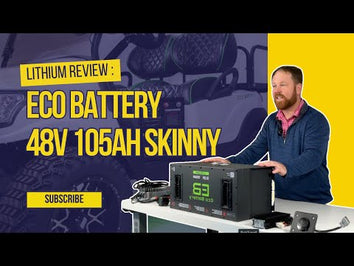
Vendor: Eco Battery 48V 105Ah Skinny Bundle - Select your Cart

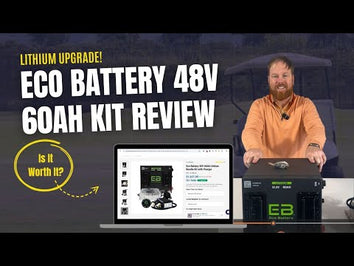
Vendor: Eco Battery 48V 60Ah Lithium Bundle Kit


