


Golf Cart Battery Amps and AH Explained
Why Golf Cart Battery Amp Hours Determine How Far You Can Go
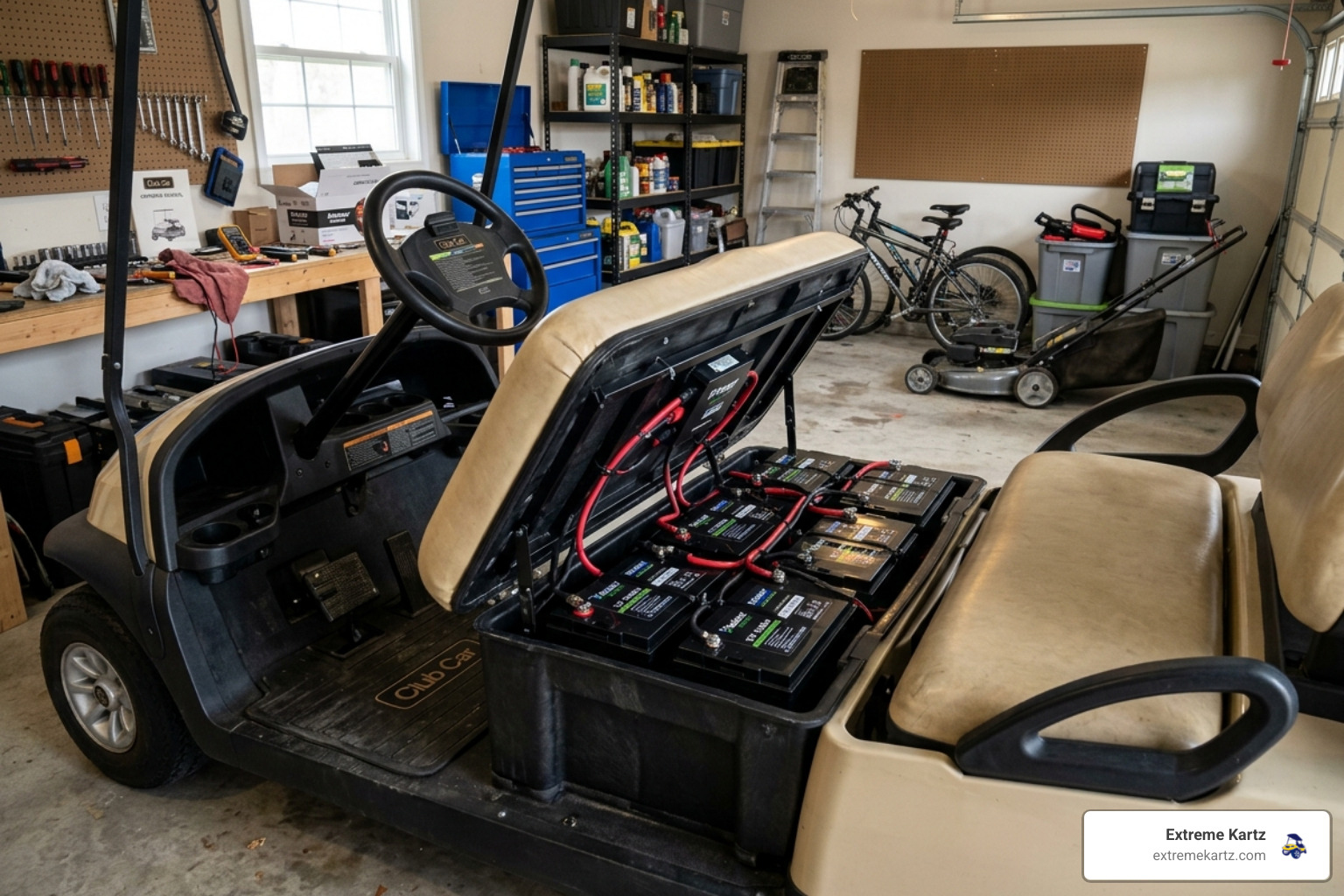
Golf cart battery amp hours (Ah) measure how much energy your battery can store — and that single number has more impact on your cart's range, reliability, and day-to-day performance than almost any other spec.
Here's a quick-reference breakdown before we dive in:
| Ah Rating | Typical Range | Best For |
|---|---|---|
| 60–72 Ah | 20–25 miles | 2-seater, flat terrain, golf use only |
| 90–105 Ah | 30–45 miles | 2–4 seater, mixed terrain, daily use |
| 150–168 Ah | 45–65 miles | Modified carts, hills, extended range |
| 200+ Ah | 65+ miles | Heavy-duty, 6-seater, commercial use |
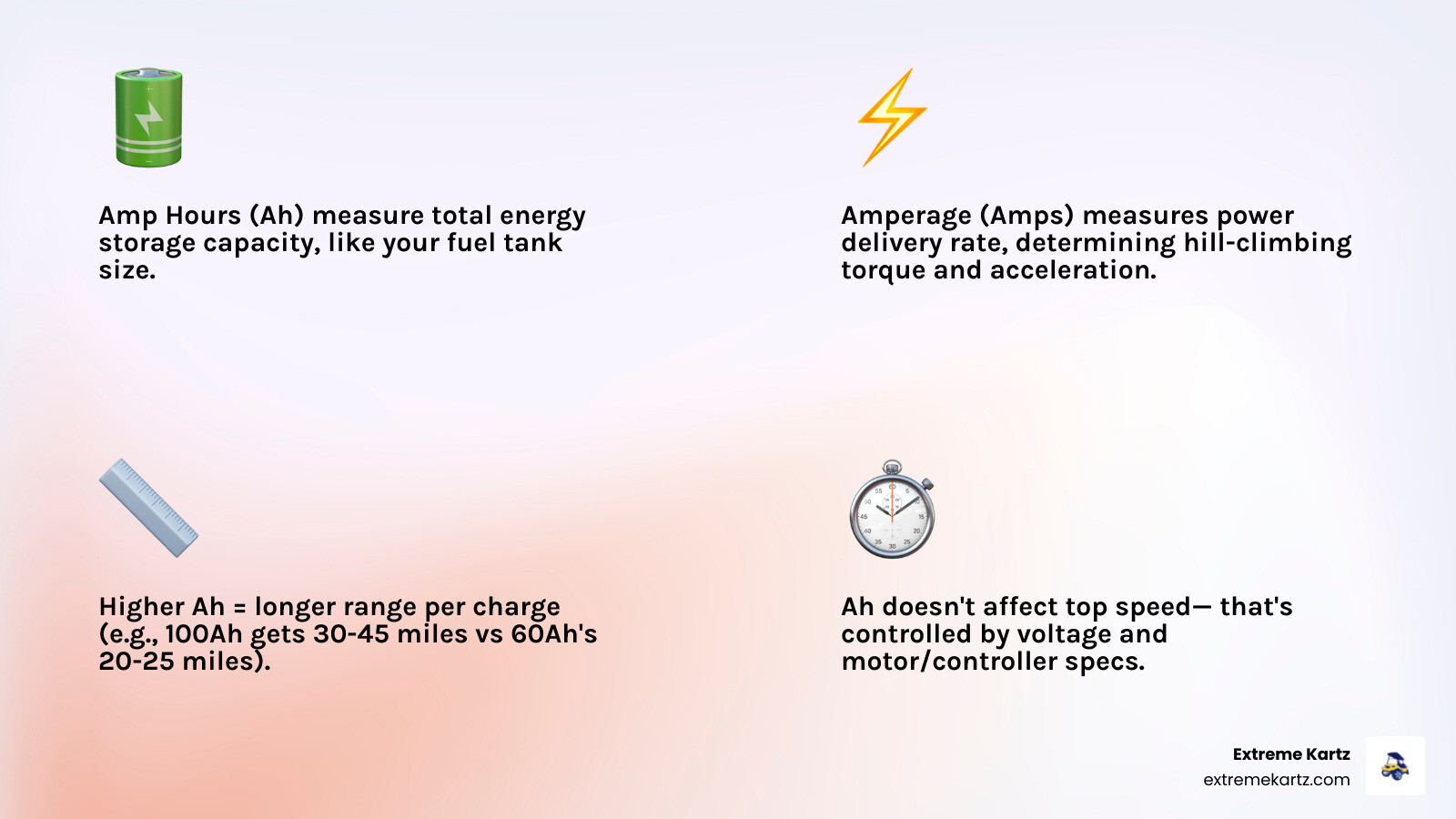
Think of Ah like a fuel tank. A bigger tank means you can go farther before stopping to refuel — or in this case, recharge. It does not tell you how fast you go or how much power your motor puts out. That's a separate spec called amperage, which we'll cover in detail below.
A few things Ah directly affects:
- How many miles you get per charge
- How well your cart handles hills and extra passengers
- Whether your battery's BMS shuts down under heavy load
The right Ah rating depends on your cart's voltage system (36V or 48V), how many passengers you carry, your terrain, and how far you typically drive.
I'm Martin Davis, owner of Extreme Kartz, and I've spent years helping golf cart owners navigate the confusion around golf cart battery amp hours — from basic neighborhood cruisers to heavily modified performance builds. Whether you're replacing a tired lead-acid set or converting to lithium for the first time, getting your Ah sizing right is the foundation of a successful upgrade.
Understanding Golf Cart Battery Amp Hours and Amperage
One of the most common points of confusion we encounter at Extreme Kartz is the difference between "Amp Hours" and "Amperage." While they sound similar, they serve two very different functions in your cart's electrical system.
Capacity (Ah) vs. Power (Amps)
As we mentioned in the intro, golf cart battery amp hours represent capacity. Mathematically, 1 Ah is the ability to provide 1 amp of current for 1 hour. For example, a 100Ah battery can theoretically deliver 10 amps for 10 hours or 100 amps for 1 hour.
Amperage (Amps), on the other hand, is the measure of current flow at any given moment. This is what determines your cart’s "muscle." If you are climbing a steep hill or accelerating quickly, your motor "asks" the battery for a high amount of amps. If your battery can't provide that current, your cart will feel sluggish or, in the case of lithium, the Battery Management System (BMS) might shut the system down entirely to protect the cells.
Continuous vs. Peak Output
When looking at lithium batteries, you’ll see ratings for "Continuous Discharge" and "Peak Discharge."
- Continuous Output: The amount of power the battery can provide indefinitely. A stock 2-seater on flat ground might only need 60A continuous.
- Peak Output: The "burst" of power available for short durations (usually 5–30 seconds). This is critical for getting a lifted cart with big tires moving from a dead stop or conquering a steep driveway.
Understanding the difference between amp hours and amperage is vital because a battery with high capacity (Ah) but low discharge (Amps) will give you great range but terrible performance on hills. Conversely, a high-amp battery with low Ah will be fast but won't get you very far. There are 3 must-knows before buying a lithium battery, and balancing these two specs is at the top of the list.
Comparing Capacity: Lithium vs. Lead-Acid Systems
When comparing golf cart battery amp hours between lead-acid and lithium, it isn't an "apples-to-apples" comparison. This is due to a concept called Depth of Discharge (DOD).
The Usable Energy Gap
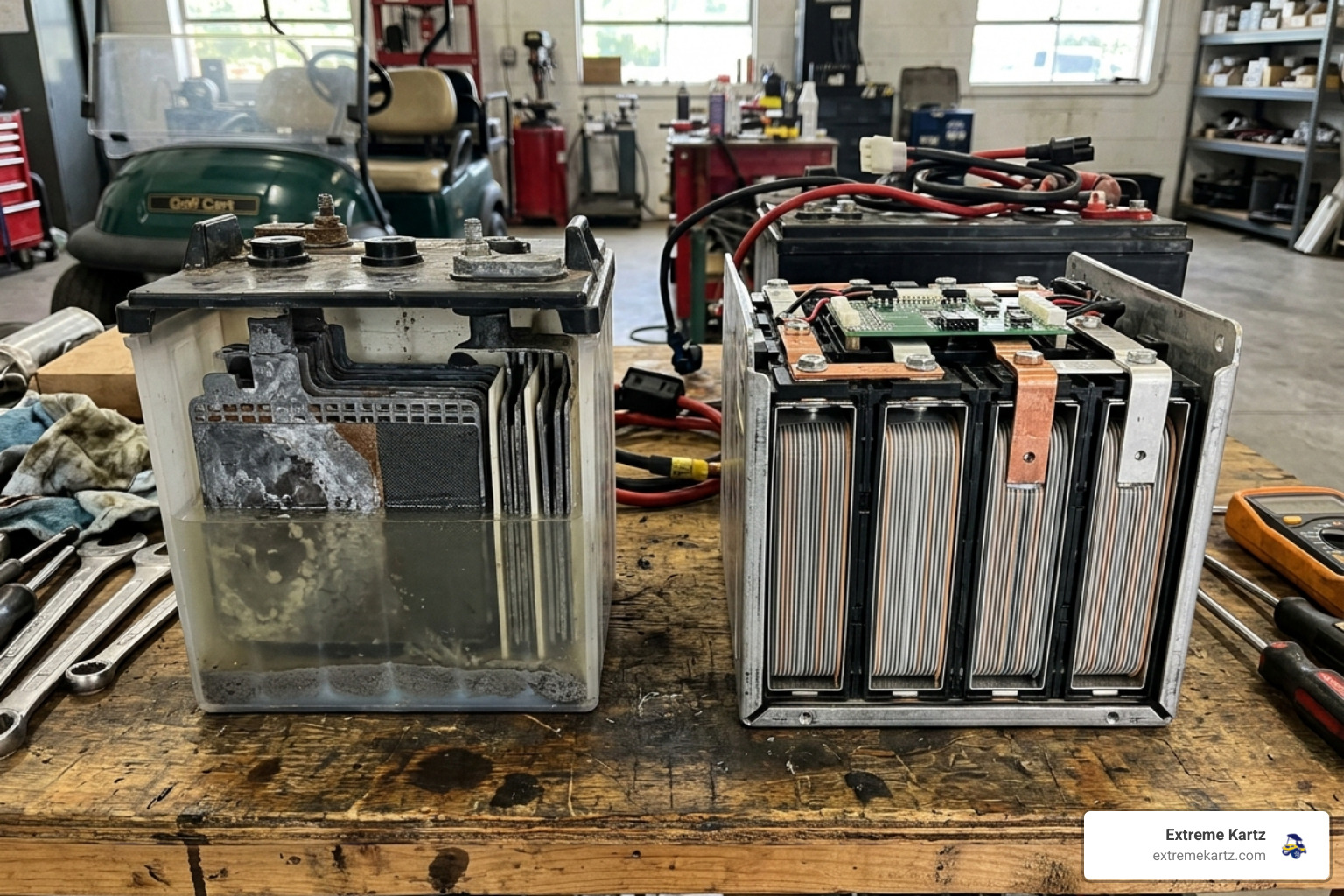
Traditional lead-acid batteries, like the Dyno D105, are typically rated around 225Ah. However, you can only realistically use about 50% of that capacity before the voltage drops so low that the cart slows down significantly ("voltage sag"). Discharging lead-acid batteries beyond 50% also drastically shortens their lifespan.
Lithium (LiFePO4) batteries allow for a much deeper discharge—often up to 85%—without any noticeable loss in power. This is why a 100Ah lithium battery can often out-range a 225Ah lead-acid pack. You are getting more "usable" energy out of a smaller, lighter package.
Weight and Efficiency
A standard set of six 8V lead-acid batteries weighs roughly 390 lbs. A single 48V 105Ah lithium battery weighs about 90 lbs. By shedding 300 lbs, your cart requires fewer amps to move, which effectively increases your range per Ah. When you look at lithium vs lead-acid, the weight reduction alone is a game-changer for handling and braking.
While the initial investment in lithium is higher, the lifespan of a lithium battery (often 10+ years or 3,500–5,000 cycles) far outlasts lead-acid (2–5 years). Knowing how many years a lithium battery lasts helps justify the switch for most of our customers.
How to Calculate Your Golf Cart Battery Amp Hours Requirements
Calculating your needs isn't just about distance; it's about the "load" on the system. At Extreme Kartz, we look at four main factors:
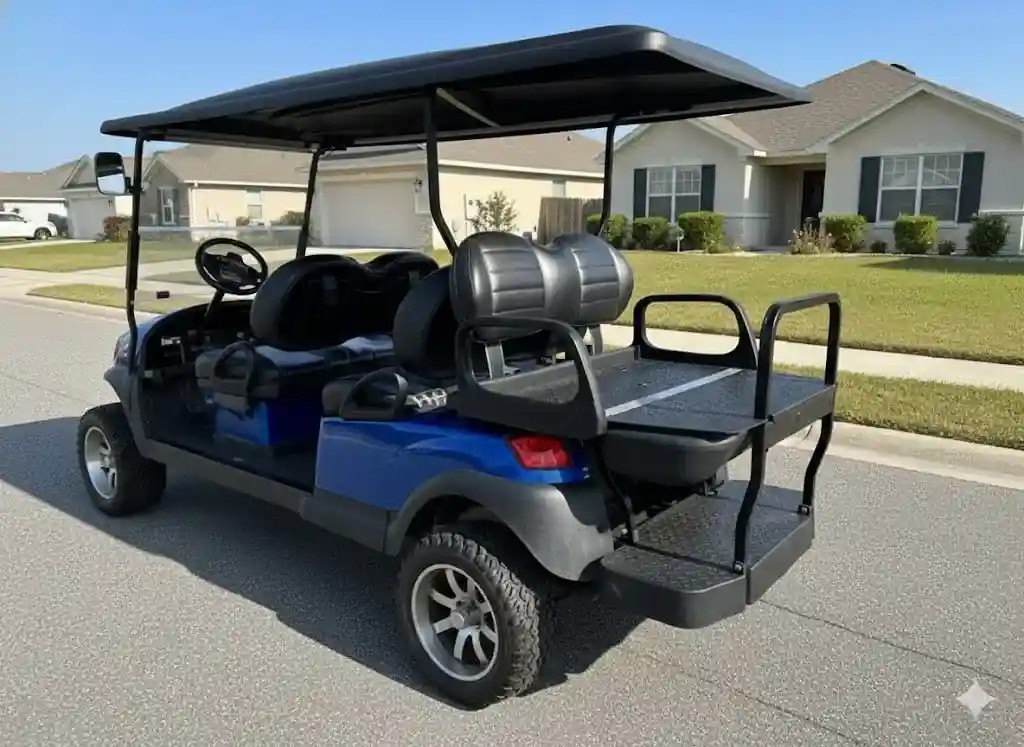
- Vehicle Weight & Passengers: A 6-seater limo cart requires significantly more Ah to cover 10 miles than a standard 2-seater.
- Terrain: Hilly terrain can increase energy consumption by 25% or more compared to flat pavement.
- Tires and Lift Kits: Larger tires (20"+) increase rolling resistance and require more torque (amps) to turn, which drains the "fuel tank" (Ah) faster.
- Speed Controller: High-performance controllers (like Navitas or Alltrax) can draw more current to provide higher speeds, necessitating a higher Ah battery to maintain range.
Picking the proper amp hours for your cart requires being honest about your usage. If you have a "2-seater" but you've added a rear flip seat and frequently carry four adults, you need to size your battery for a 4-passenger load.
Determining Ah for 36V and 48V Systems
Your cart's voltage dictates your battery configuration. Older carts are often 36V, while most modern carts (post-2010) are 48V. 48V and 51V are essentially the same—51.2V is simply the nominal voltage of a "48V" lithium pack.
| System Voltage | Common Lead-Acid Setup | Total Lead-Acid Ah | Recommended Lithium Ah |
|---|---|---|---|
| 36V | 6 x 6V Batteries | 210–225 Ah | 60–105 Ah |
| 48V | 6 x 8V or 8 x 6V | 170–225 Ah | 60–160+ Ah |
When converting to lithium, you have two choices: "Drop-in" batteries (multiple 12V or 48V batteries wired in parallel) or a "Single Pack" solution. We often get asked how many lithium batteries are needed for a 48V cart. The answer depends on the Ah of the individual batteries. If using 30Ah drop-ins, you'll want at least three (90Ah total) for a standard cart, or four to five for a lifted cart to ensure the combined BMS can handle the amp draw.
For more technical details on sizing, check out Vatrer Power's guide on Ah requirements.
Real-World Range and Performance Testing
Manufacturer specs are often recorded under "perfect" conditions—flat ground, one driver, and no wind. In the real world of April 2026, we see different results.
Endurance Stats
Recent testing on 48V systems provides a clearer picture of what to expect:
- 48V 60Ah: Achieved roughly 14–17 miles in neighborhood use.
- 48V 105Ah: Typically delivers 35–45 miles.
- 48V 100Ah (Parallel setup): In high-efficiency tests, some 48V 118Ah configurations have reached over 50 miles, consuming about 110 Wh per mile.
We’ve done extensive hands-on reviews of popular systems, such as the Eco Battery 48V 60Ah, which is the easiest direct replacement for those who don't need massive range. For those who do, the Eco Battery 105Ah Skinny Bundle is a top-tier performer.
Installation also matters for performance. A thru-hole installation ensures the battery is secure and the wiring is optimized for low resistance, which helps maintain efficiency. You can read more about real-world range expectations here.
Factors Affecting Golf Cart Battery Amp Hours Efficiency
- Temperature: Cold weather (below 32°F) can reduce usable capacity by 20–30%.
- Rolling Resistance: Driving on grass, sand, or soft trails requires more energy than asphalt.
- Accessories: Headlights, soundbars, and heaters all pull from your Ah "fuel tank."
- BMS Limits: If you draw too many amps too fast, the BMS may cut power to prevent heat damage, even if you have plenty of Ah left.
To get the most out of your setup, it’s helpful to learn how to maximize your lithium range.
Benefits of Upgrading to High-Capacity Lithium
Upgrading to a higher Ah lithium battery isn't just about distance; it's about the overall health and performance of your cart.
- Consistent Power: Unlike lead-acid, lithium doesn't slow down as the battery gets lower. You get the same "zip" at 20% charge as you do at 100%.
- Faster Charging: Most lithium batteries can be fully charged in 3–5 hours, compared to 8–12 hours for lead-acid.
- Zero Maintenance: No more watering batteries or cleaning acid corrosion off your frame.
- Advanced Monitoring: Modern batteries, like the Eco Battery Gen 3, feature Bluetooth integration so you can see your exact Ah remaining on your phone.
Many customers ask: Will lithium make my cart faster? The answer is usually yes—not because the battery "pushes" more speed, but because the cart is 300 lbs lighter and maintains higher voltage throughout the ride.
Selecting the Best Golf Cart Battery Amp Hours for Performance
If you are running a high-torque setup with a Navitas or Alltrax controller, you cannot skimp on Ah. These controllers demand high amperage, and larger Ah batteries generally have more robust BMS units capable of handling that flow.
We’ve curated a list of the top 5 lithium batteries for 2026 to help you decide. Whether you're looking for the best superlatives of the year or need a battery that specifically works with Silverwolf or Alltrax controllers, choosing the right Ah capacity is the first step toward a high-performance build.
Frequently Asked Questions about Golf Cart Battery Capacity
How many Ah do I need for a 15-mile trip?
For a 15-mile trip on relatively flat ground with two passengers, a 60Ah lithium battery is usually sufficient. However, if your cart is lifted or you have hills, we recommend at least 90–105Ah to provide a safety buffer. You never want to run your battery to 0%.
Can I mix batteries with different Ah ratings in the same cart?
No. Mixing batteries with different Ah ratings (or mixing brands/ages) is a recipe for disaster. The batteries will charge and discharge at different rates, leading to cell imbalance, reduced lifespan, and potential BMS failure. Always replace your batteries as a complete, matching set.
Does a higher Ah rating increase the top speed of my golf cart?
Directly, no. Ah is capacity (range), not power (speed). However, a higher Ah battery often comes with a more powerful BMS that allows for higher peak amp draw, and the weight savings of lithium over lead-acid will naturally allow your motor to reach its top speed more quickly and efficiently.
Conclusion
At Extreme Kartz, we believe that understanding golf cart battery amp hours is the key to a cart that works for you, rather than you working for it. Whether you're looking for a simple neighborhood cruiser or a high-torque off-road machine, the right Ah capacity ensures you'll never be stranded halfway through your journey.
We specialize in system-based solutions, ensuring that your battery, controller, and motor all work in perfect harmony. Our kits ship in 1-2 business days. Don't guess on your fitment or requirements—contact our experts for a personalized lithium conversion recommendation and let us help you build the ultimate golf cart.
Related Products


Vendor: Eco Battery 48V 105Ah Skinny Bundle - Select your Cart


Vendor: Bolt Energy 48V 105Ah THIN Golf Cart Lithium Battery Bundle - Professional or Standard Kit

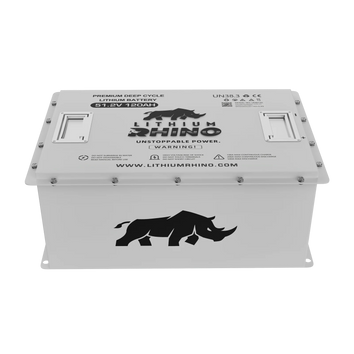
Vendor: Lithium Rhino 48V 120AH Bundle

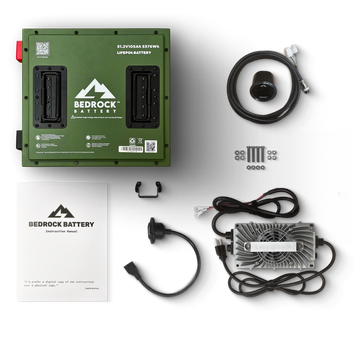
Vendor: Bedrock Battery Compact 48V 105Ah Lithium Conversion Kit


