


The Definitive Guide to Golf Cart Tire PSI
Why Tire Pressure for Golf Cart Tires Matters More Than You Think
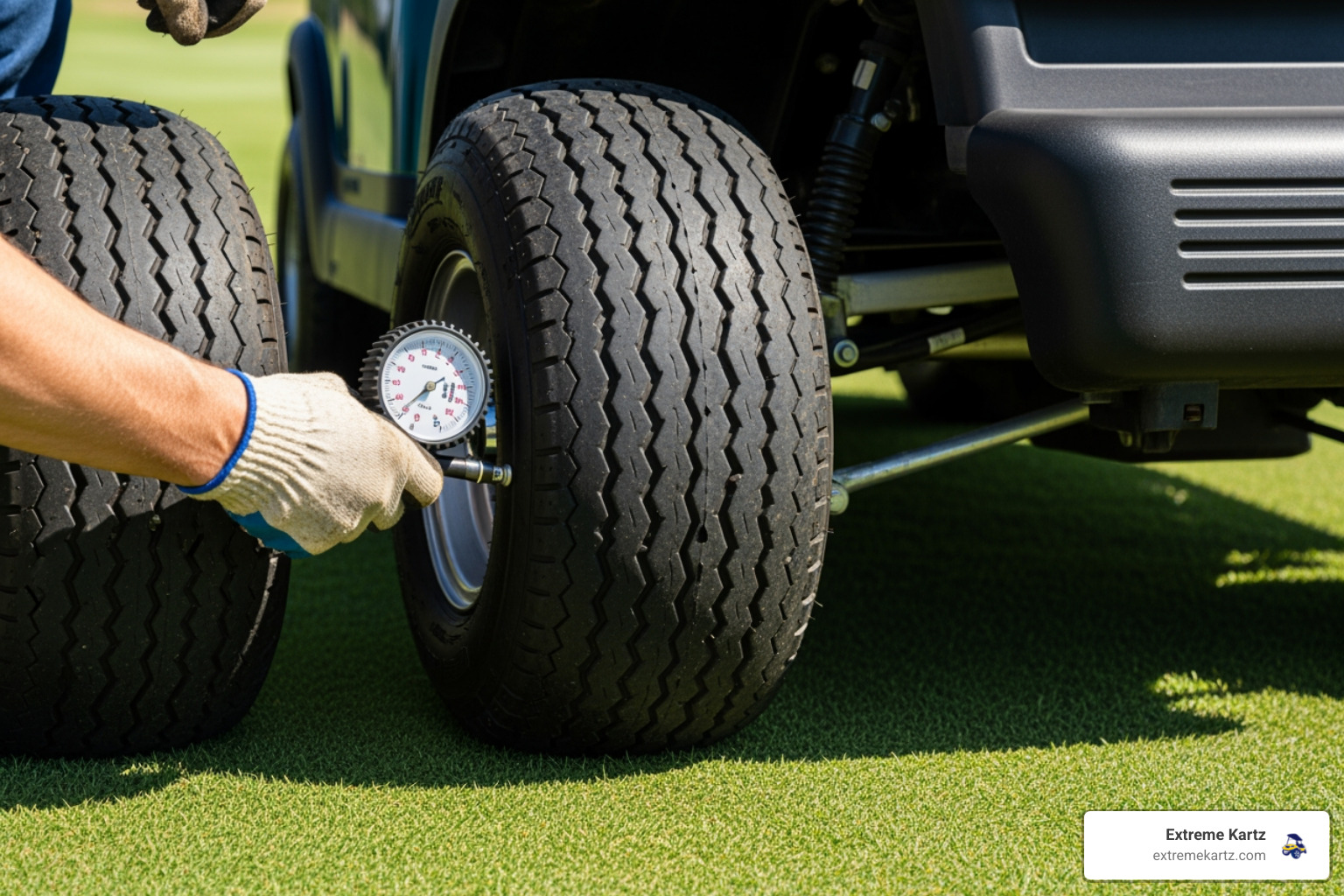
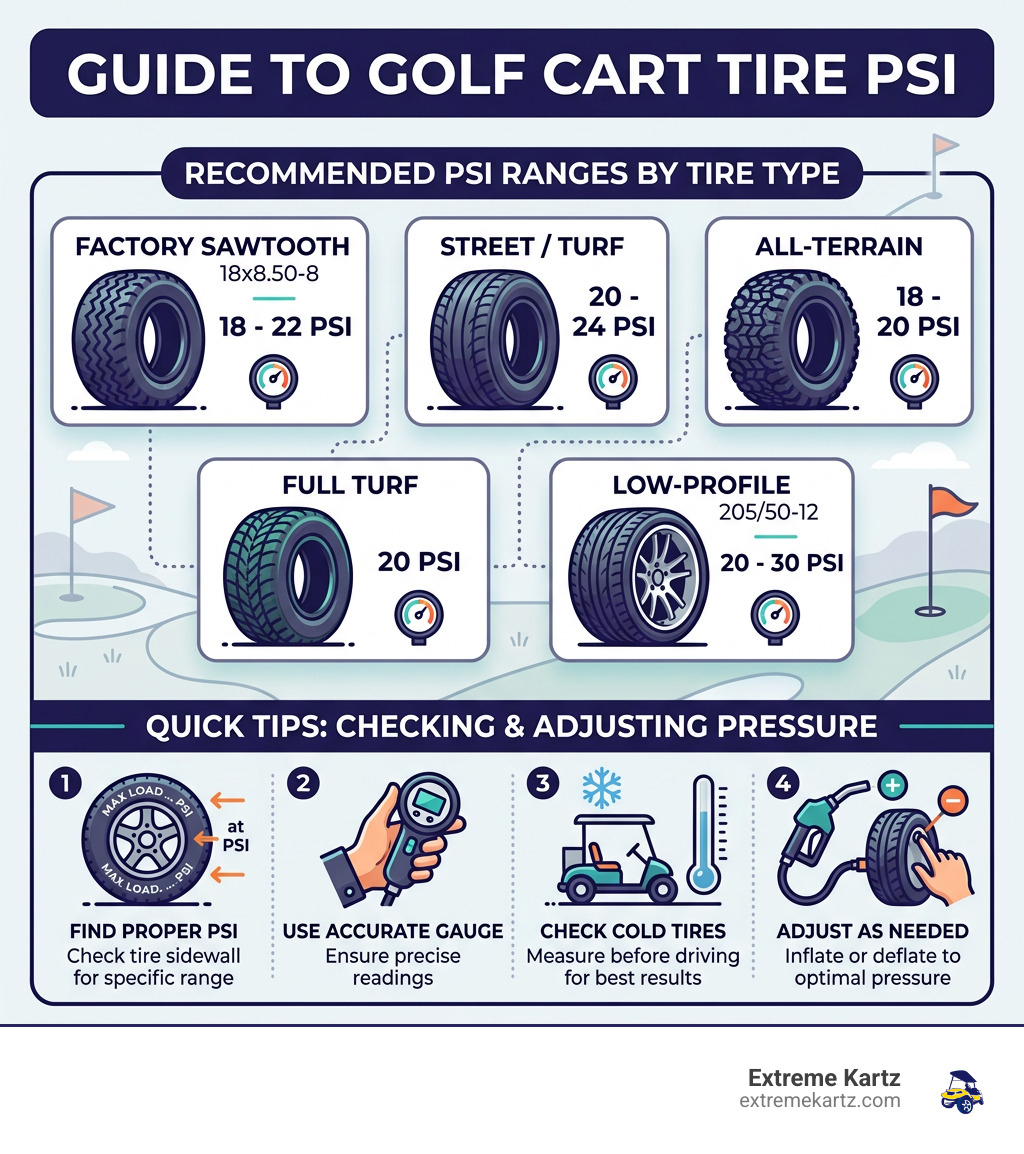
Tire pressure for golf cart tires typically falls between 15 and 25 PSI, with most owners running around 20 PSI as a safe middle ground. Here's a quick reference by tire type:
| Tire Type | Recommended PSI |
|---|---|
| Factory Sawtooth (18x8.50-8) | 18-22 PSI |
| Street / Turf | 20-24 PSI |
| All-Terrain | 18-20 PSI |
| Full Turf | 20 PSI |
| Low-Profile (205/50-12) | 20-30 PSI |
Always check your tire's sidewall and your owner's manual for the exact PSI for your specific setup.
Most golf cart owners spend time thinking about batteries, motors, and accessories -- but tire pressure is one of the simplest things you can maintain, and one of the most overlooked. Run your tires too low and your cart feels sluggish, wears unevenly, and drains your battery faster. Run them too high and you get a rougher ride, reduced traction, and a higher risk of a blowout.
The research is clear: underinflated tires alone can reduce an electric golf cart's range by 10-20% due to increased rolling resistance. That's a real cost -- in battery life, tire wear, and performance -- from something as simple as skipping a monthly pressure check.
Whether you're cruising a fairway, navigating a neighborhood, or hauling gear across rough terrain, getting your PSI right makes every ride smoother, safer, and more efficient.
I'm Martin Davis, owner of Extreme Kartz, and I've spent years helping golf cart owners across the country dial in everything from lithium battery conversions to the basics of tire pressure for golf cart tires -- because every part of the system matters. In this guide, I'll walk you through exactly what you need to know to keep your tires properly inflated for your cart, your terrain, and your conditions.
Understanding Recommended Tire Pressure for Golf Cart Tires
When we talk about PSI (pounds per square inch), we are looking for the "Goldilocks" zone—not too high, not too low, but just right for your specific tires. For the vast majority of carts in the United States, the sweet spot for tire pressure for golf cart tires is between 15 and 25 PSI.
However, "average" doesn't always mean "optimal." Your specific PSI depends on whether you are running standard fleet tires, aggressive off-road treads, or sleek low-profile street tires. While standard tires thrive around 20-22 PSI, specialty tires have different needs. For example, some high-performance or heavy-duty tires can handle up to 35 or 40 PSI, though this is rare for standard golf course use.
Finding the Correct Tire Pressure for Golf Cart Tires
The most reliable place to find your PSI isn't a Google search—it’s the tire itself. Look at the sidewall markings. Every tire manufacturer stamps the "Max Load" and "Max PSI" directly onto the rubber.
Pro Tip: Never inflate your tires to the "Max PSI" listed on the sidewall for daily driving. That number is the absolute limit the tire can handle under a full load. For a comfortable ride, you usually want to stay about 5-10 PSI below that maximum.
Another critical factor is taking cold readings. Air expands when it gets hot. If you’ve been driving around the neighborhood for an hour and then check your pressure, the reading will be artificially high. For the most accurate results, check your tires after the cart has been sitting for at least three hours.
Manufacturer Specifications by Brand
While the tires themselves provide the best data, the cart manufacturers also provide guidelines based on the weight and suspension of the vehicle. If you are running golf cart wheels for Yamaha, EZGO, or Club Car, here are the general factory recommendations:
- Club Car: Typically recommends 18-22 PSI. Club Cars are known for their aluminum frames and specific weight distribution, making this range ideal for a balance of comfort and efficiency.
- Yamaha: Usually suggests 15-22 PSI. Yamaha carts often utilize a different rear suspension setup, and a slightly lower PSI can help absorb bumps more effectively.
- E-Z-GO: Generally falls in the 18-24 PSI range.
- Factory Sawtooth Tires: If you have the standard 18x8.5-8 sawtooth tires that come on 99% of fleet carts, stick to 18-22 PSI.
The Impact of Inflation on Performance and Battery Life
At Extreme Kartz, we focus on performance. We often see customers spend thousands on high-end controllers or lithium battery conversions, only to leave 20% of that performance on the table because of soft tires.
Proper tire pressure for golf cart tires is the "hidden" performance upgrade. Underinflated tires create a larger "contact patch" with the ground. While that sounds like more grip, it actually creates rolling resistance. This forces your motor to work harder and your batteries to drain faster. In an electric cart, this can slash your range by up to 20%. For gas carts, it means lower fuel efficiency and more wear on the drive belt.
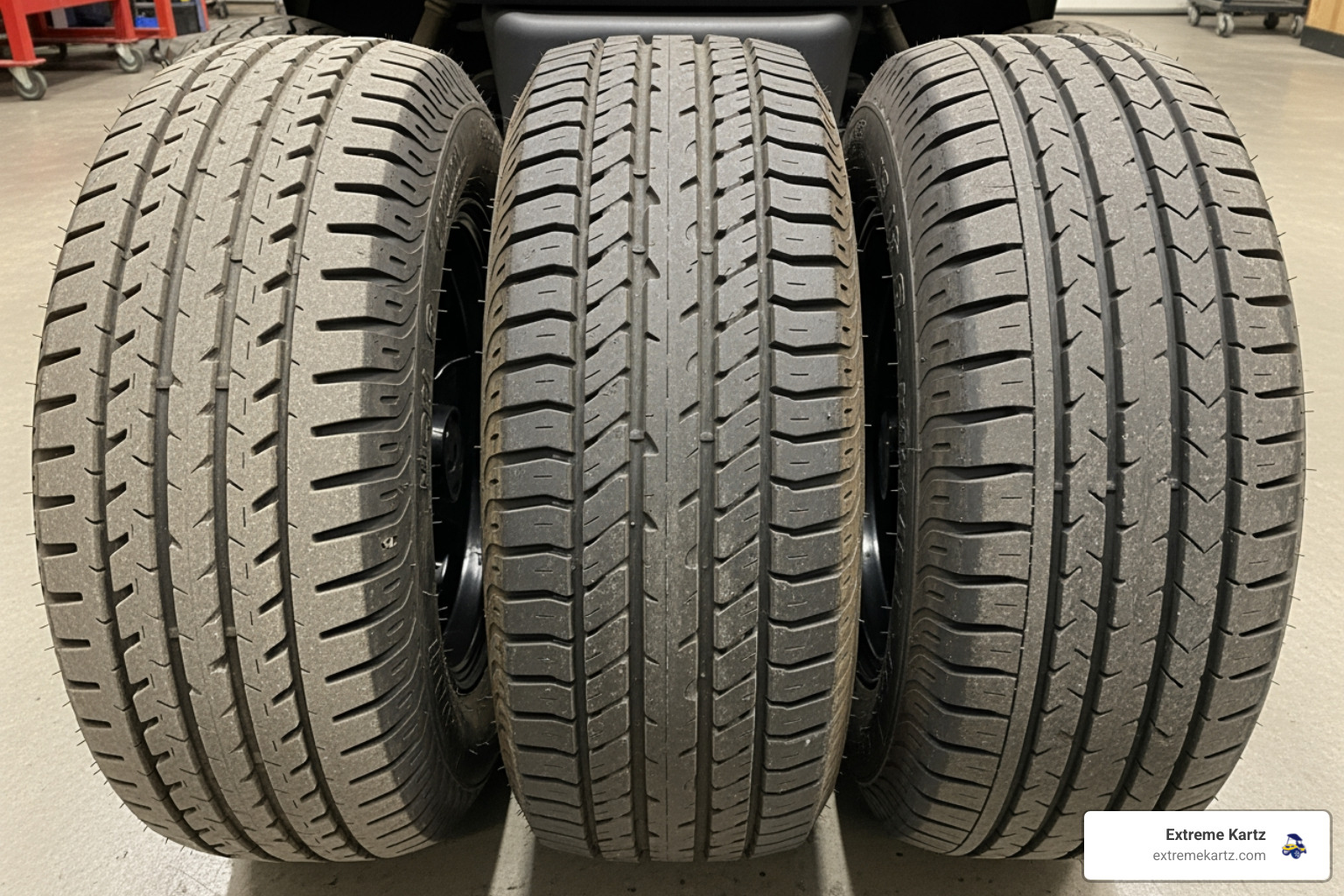
Effects of Underinflated Tires
Driving on underinflated tires is like trying to ride a bicycle through sand—it’s exhausting for the machine.
- Sluggish Handling: The steering will feel "heavy," and the cart won't respond as quickly to turns.
- Sidewall Damage: When a tire is low, the sidewalls flex excessively. Over time, this generates heat and causes the internal structure of the tire to crack.
- Rim Protection: A soft tire offers very little protection against potholes. One bad bump can result in a bent rim, leading to an expensive replacement.
- Increased Friction: More rubber on the road means more heat, which accelerates tread wear on the outer edges of the tire.
Risks of Overinflated Tires
On the flip side, some owners think "more is better" to get a higher top speed. This is a mistake.
- Bumpy Ride: Your tires act as a secondary suspension. If they are rock-hard, you’ll feel every pebble, crack, and blade of grass.
- Reduced Traction: Overinflation causes the tire to "crown," meaning only the center of the tread touches the road. This reduces your grip, which can be dangerous on wet paths or steep hills.
- Center Tread Wear: You’ll find yourself replacing tires sooner because the middle is bald while the edges look brand new.
- Blowout Risk: Exceeding the recommended PSI by more than 5 PSI significantly increases the risk of a blowout, especially on hot summer days.
Step-by-Step Guide to Maintaining Your Tires
Maintaining the correct tire pressure for golf cart tires doesn't require a mechanic's degree. You just need two basic tools: a quality pressure gauge and a portable air compressor or electric pump.
Regular maintenance is key. We recommend checking your pressure at least once a month. If you use your cart daily or live in an area with major temperature swings, every two weeks is even better. This is also a great time to perform a visual inspection for nails, cracks, or uneven wear. To ensure your tires last as long as possible, check out our Golf Cart Tire Rotation Guide.
How to Check and Adjust PSI
Follow these steps for a perfect fill every time:
- Remove the Valve Cap: Unscrew the plastic cap on the valve stem. Don't lose it! These caps keep dirt and moisture out of the valve core.
- Apply the Gauge: Press your pressure gauge firmly onto the valve stem. You might hear a quick "hiss." Read the measurement.
- Inflate: If the PSI is low, attach your compressor. Add air in short bursts (5-10 seconds) and re-check the pressure in between. It’s easy to overshoot on small golf cart tires.
- Deflate: If you’ve added too much air, use the small nib on the back of your gauge (or a screwdriver) to gently press the center pin of the valve stem to release air.
- Secure the Cap: Once you hit your target PSI, screw the cap back on tight.
Troubleshooting Leaks and Pressure Drops
If you find that one tire is consistently lower than the others every time you check, you have a problem.
- Slow Leaks: Usually caused by a small nail or thorn. You can often find these by spraying soapy water on the tread; bubbles will form where air is escaping.
- Valve Core Issues: Sometimes the tiny valve inside the stem gets loose or dirty. Try tightening it with a valve core tool.
- Bead Seating: If you recently installed new Madjax Timberwolf and Raptor series tires, the tire might not be perfectly seated against the rim. A professional shop can reseat the bead for you.
Adjusting PSI for Terrain, Load, and Temperature
One of the most common questions we get at Extreme Kartz is: "Does my PSI stay the same if I'm off-roading?" The answer is no. Your environment and what you’re carrying change the requirements for your tires.
For more information on choosing the right tire for your specific environment, see our guide on golf cart tires for every terrain.
How Temperature Affects Tire Pressure for Golf Cart Tires
Physics dictates that air expands when hot and contracts when cold -- a principle known as Charles's Law. For every 10-degree (Fahrenheit) change in temperature, your tire pressure can change by about 1 PSI.
- Winter: You might wake up to a "flat" looking tire because the cold air has compressed. You’ll likely need to add a few PSI in the autumn.
- Summer: The heat from the pavement and the sun can cause your PSI to spike. If you set your tires to 25 PSI on a cool morning, they might hit 29 or 30 PSI by mid-afternoon, leading to a harsh ride.
Terrain and Load Considerations
- Turf Protection: If you are strictly on a golf course, keeping your PSI around 18-20 ensures you don't leave "ruts" in the sensitive grass.
- Street Efficiency: For neighborhood cruising on pavement, a higher PSI (22-25) reduces rolling resistance and gives you the best battery range.
- All-Terrain Grip: If you are heading into the woods or mud, dropping your pressure to 15-18 PSI allows the tire to "wrap" around obstacles and provides much better traction.
- Sand and Beach: For loose sand, some owners "air down" to as low as 10-12 PSI to create a massive contact patch that allows the cart to "float" on top of the sand rather than digging in. Just remember to air back up before hitting the pavement!
- Heavy Cargo: If you have a rear flip seat and frequently carry two extra adults or heavy gear, increase your rear tire pressure by 2-4 PSI to support the extra weight and prevent the sidewalls from squatting.
Conclusion
Maintaining the correct tire pressure for golf cart tires is the easiest maintenance task you can perform, yet it has a massive impact on your cart's performance, safety, and longevity. Whether you are looking for a smoother ride, more miles out of your lithium battery, or simply want to avoid the headache of a mid-round flat, those few minutes spent with a pressure gauge are well worth it.
At Extreme Kartz, we pride ourselves on being an authoritative educational resource. We don't just sell parts; we provide system-based solutions. Whether you're looking for a golf cart rims tires complete guide or need help with how to properly align your golf cart wheels for a smooth ride, we are here to help you make informed decisions.
Ready to upgrade your ride? Explore our selection of golf cart wheels and tires, including tire-and-wheel packages built for the right fit and the right PSI range. Whether you drive a Club Car, EZGO, or Yamaha, we can help you match your setup to your terrain, load, and performance goals.
If you're unsure which setup is right for your usage goals, reach out to our team. We'll help you find the right parts the first time, preventing incorrect purchases and ensuring your cart performs at its absolute best.
Related Products


Vendor: Set of (4) 15" GTW Bravo Matte Black Wheels with 23x10-R15 Nomad All-Terrain Tires


Vendor: 14" GTW Bravo Wheels with 22x10-14 GTW Timberwolf All-Terrain Tires (Set of 4)

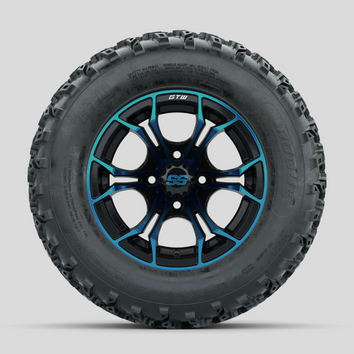
Vendor: GTW Spyder Blue/Black 12 in Wheels with 23x10.00-12 Rogue All Terrain Tires Full Set


