


Yamaha Golf Cart Lift Kits: Compare Options & Terms Demystified
What You Need to Know Before Buying Yamaha Golf Cart Lift Kits
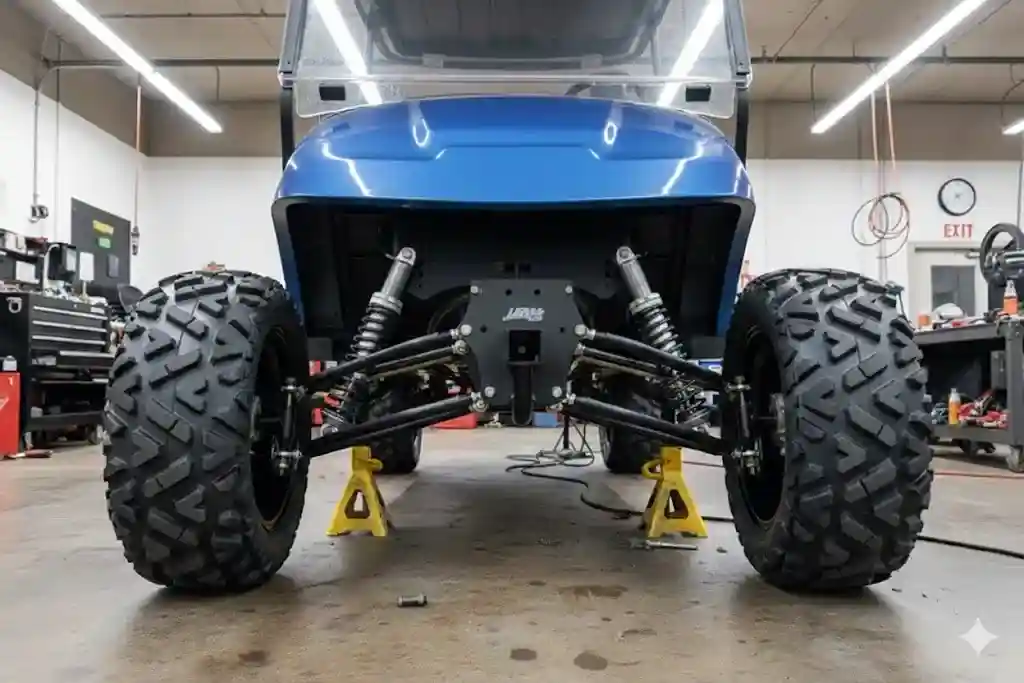
Yamaha golf cart lift kits are one of the most popular upgrades owners make — and for good reason. A lift kit raises your cart's body off the ground, giving you the clearance to run larger tires, handle rougher terrain, and give your ride a much more aggressive look.
But here's where most buyers run into trouble: not all lift kits fit all Yamaha models. The wrong kit for your year or suspension type can mean rubbing tires, failed fitment, or a wasted purchase.
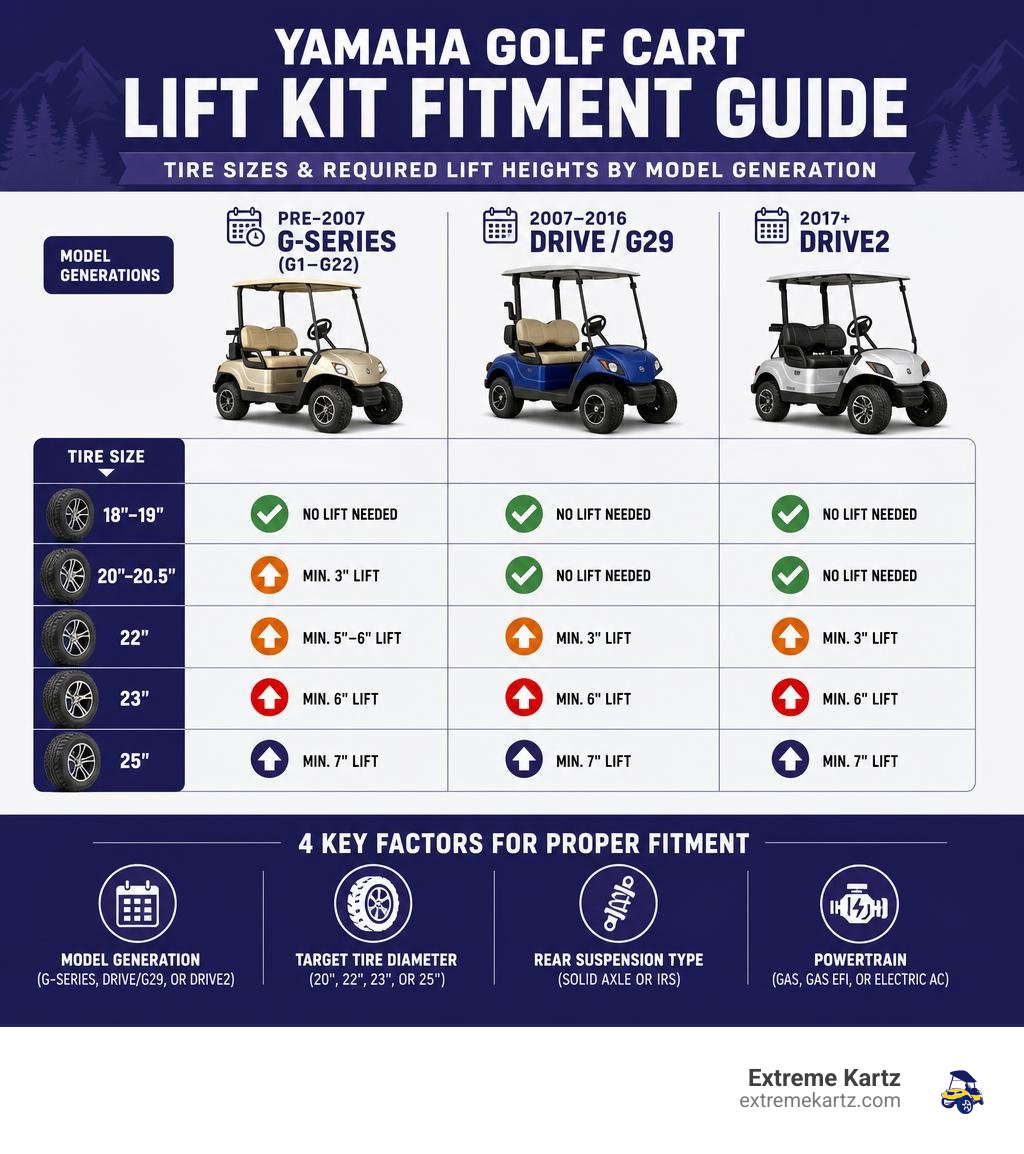
Here's a quick-reference guide to get you oriented:
| Tire Size | Pre-2007 G-Series (G1–G22) | Drive/G29 (2007–2016) | Drive2 (2017+) |
|---|---|---|---|
| 18"–19" | No lift needed | No lift needed | No lift needed |
| 20"–20.5" | Min. 3" lift | No lift needed | No lift needed |
| 22" | Min. 5"–6" lift | Min. 3" lift | Min. 3" lift |
| 23" | Min. 6" lift | Min. 6" lift | Min. 6" lift |
| 25" | Min. 7" lift | Min. 7" lift | Min. 7" lift |
The key variables that determine which lift kit you need are:
- Your Yamaha model generation (G-Series, Drive/G29, or Drive2)
- Your target tire diameter (20", 22", 23", or 25")
- Your rear suspension type (solid/fixed axle or Independent Rear Suspension)
- Your powertrain (gas, gas EFI, or electric AC)
Getting these four things right before you buy will save you time, money, and frustration.
I'm Martin Davis, owner of Extreme Kartz, and helping customers navigate Yamaha golf cart lift kits — from basic spindle lifts to premium long-travel systems — is one of the most common fitment challenges I work through with our team every week. This guide pulls together everything you need to choose the right kit with confidence, no guesswork required.
Explore our related guides:
Comparing the Types of Yamaha Golf Cart Lift Kits
If you are looking to upgrade your Yamaha, you will quickly notice that there isn't just one type of lift kit. Instead, the market is filled with several distinct mechanical designs, each offering different ride characteristics, installation complexities, and price points. Understanding these engineering differences is essential to selecting a system that matches how you plan to use your cart.
We generally group yamaha golf cart lift kits into four primary mechanical categories: spindle lifts, A-arm lifts, block lifts, and long travel suspension systems. Each of these styles addresses the vehicle's suspension geometry in a completely different way. For a deeper look into general golf cart suspension systems, explore our Lifts for Golf Carts Complete Guide.
To help you visualize how these different systems function, let's look at this basic structural comparison:
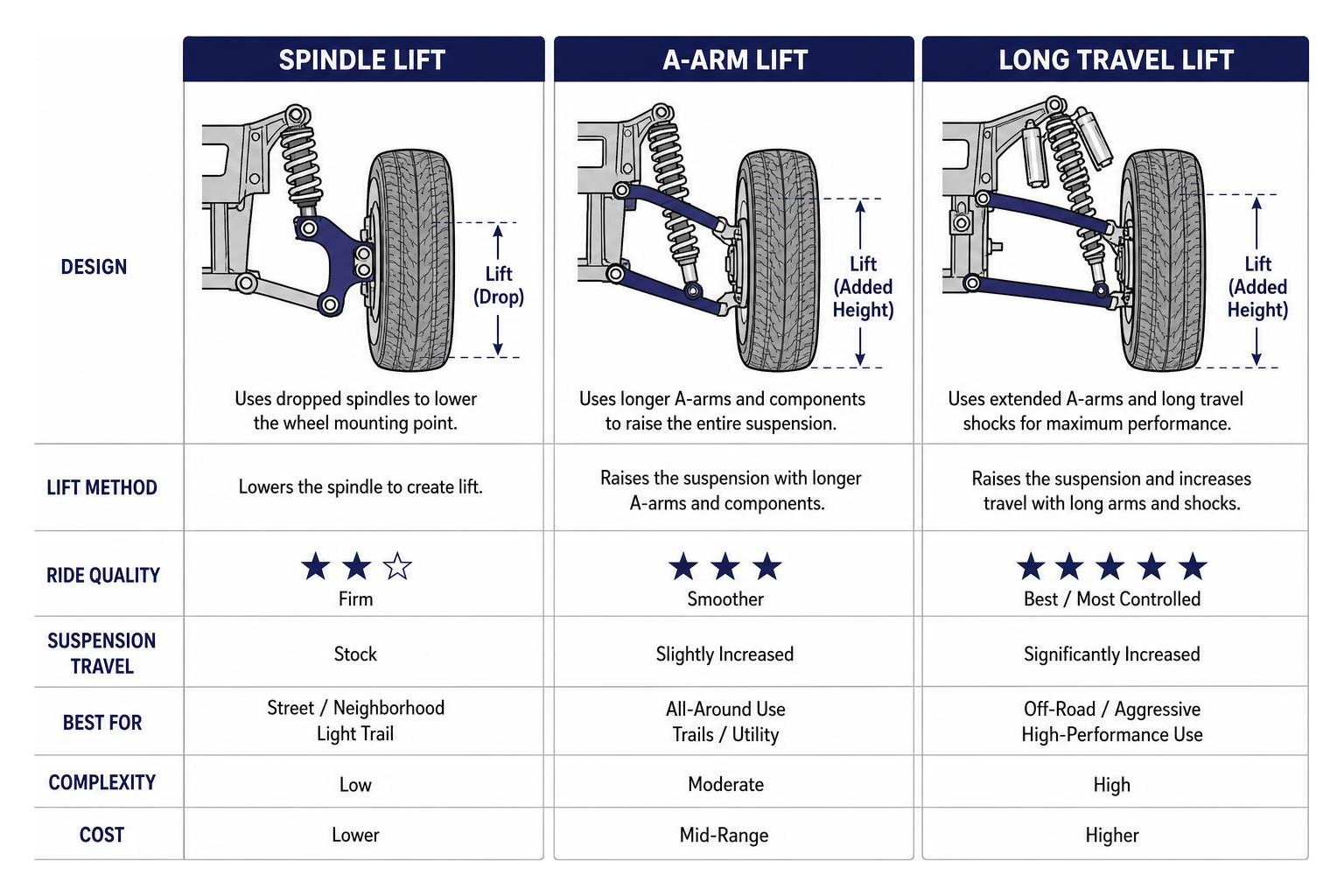
Spindle vs. A-Arm Yamaha Golf Cart Lift Kits
The choice between a spindle lift and an A-arm lift is the most common decision our customers face.
A drop spindle lift kit is often considered the "Goldilocks" option for neighborhood cruisers and light trail riders. Mechanically, these kits replace your factory steering spindles with newly engineered spindles that feature a dropped wheel axle mount.
Because they utilize your factory front suspension geometry, spindle lifts are exceptionally easy to install and highly cost-effective. They do not alter your front spring rates, which means your cart will retain its predictable, factory-like ride quality on paved surfaces. Spindle lifts are excellent for budget-conscious builds where the primary goal is fitting a set of custom 20-inch or 22-inch wheels and tires for neighborhood driving. For a complete breakdown of this specific style, check out our Spindle Lift Kit Guide.
An A-arm lift kit, on the other hand, is a complete front suspension replacement. Instead of keeping the factory setup, an A-arm kit replaces your stock front axle and control arms with a wider, heavy-duty double A-arm assembly.
This design provides several distinct performance advantages:
- Independent Front Suspension: Each wheel can articulate independently over obstacles, greatly improving stability on uneven terrain.
- Wider Track Width: By pushing the wheels slightly outward, A-arm kits widen your cart's footprint, lowering its center of gravity and reducing body roll.
- Adjustable Alignment: Premium A-arm kits, like the MadJax King XD series, utilize turnbuckles and jam nuts, which make aligning your camber and toe-in significantly easier.
If you plan to take your Yamaha off-road, carry heavy loads, or navigate rugged trails, a heavy-duty A-arm lift is well worth the extra investment.
Long Travel and Block Yamaha Golf Cart Lift Kits
For those who want the absolute peak of off-road performance, a long travel lift kit is the ultimate suspension upgrade. Unlike standard kits that simply raise the ride height, a long travel system completely re-engineers your cart's chassis.
These high-end setups feature long, independent control arms paired with adjustable coil-over shocks (often featuring external reservoirs, like those found on premium Jake's Long Travel kits). This design drastically increases suspension travel, allowing your front wheels to walk over deep ruts, rocks, and rough trails with remarkable articulation. Long travel kits also physically extend your cart's wheelbase, which provides unmatched high-speed stability. However, they are highly technical to install and represent the premium end of the price spectrum.
On the opposite end of the complexity scale sits the block lift kit (sometimes called an economy lift). Block lifts are the most basic and budget-friendly option available. They work by placing heavy-duty metal spacer blocks directly between your factory suspension components and the frame.
While they successfully raise the cart's body to clear larger tires, they do not increase suspension travel or widen your track width. They are best suited for flat, paved surfaces where off-road performance is not a priority. To compare these options further, refer to our comprehensive Golf Cart Lift Kit Guide.
Sizing and Fitment: Matching Yamaha Generations to Tire Diameters
One of the most critical aspects of lifting a Yamaha golf cart is understanding how different generations handle tire clearance. Yamaha golf carts have evolved through three major design eras, and each era has its own unique chassis clearances:
- Pre-2007 G-Series (G1 to G22): These classic models have relatively tight wheel wells. They require much larger lift kits to clear the same size tires that newer models can clear with ease.
- Drive / G29 (2007–2016): This generation introduced a much more spacious body and frame design, making it far more forgiving when it comes to tire clearance.
- Drive2 (2017–Present): The modern standard. Like the G29, it features generous wheel wells but introduces more complex rear suspension variations that require precise kit matching.
To prevent tire rubbing and ensure you buy the correct parts the first time, always refer to our structured fitment guide below. For a broader look at modern lift trends, you can also read our Golf Cart Lift Kits Guide 2026.
Sizing Guide for Yamaha Golf Cart Lift Kits and Tires
When planning your build, matching your target tire size to the correct lift height is the single most important step. Let's break down the clearance requirements for the most common tire sizes on the market:
- 20-Inch Tires: If you own a 2007 or newer Drive (G29) or Drive2, you can actually fit up to a 20.5-inch tire on your cart with no lift kit installed (though you may need to make minor inner fender liner adjustments if rubbing occurs during sharp turns). However, if you own an older pre-2007 G-Series cart, you must install a minimum of a 3-inch lift kit to clear 20-inch tires.
- 22-Inch Tires: This is the absolute sweet spot for many custom builds. To run 22-inch tires on a modern Drive or Drive2, you only need a 3-inch or 4-inch lift kit (such as the popular RHOX 4-inch spindle lift). If you are building an older G-Series model (like a G16 or G22), you will need a minimum of a 5-inch or 6-inch lift kit to clear the same 22-inch tires.
- 23-Inch Tires: To run aggressive 23-inch off-road tires, a 6-inch lift kit is recommended for ALL Yamaha models. Whether you have a vintage G9 or a brand-new Drive2, a 6-inch lift provides the necessary clearance to prevent the tires from catching the body panels when the suspension flexes.
- 25-Inch Tires: This is serious monster-cart territory. To run massive 25-inch tires, you will need a minimum of a 7-inch lift kit (or an adjustable long-travel kit set to its maximum height, like the Jake's 4"-8" adjustable system) across all Yamaha models.
Rear Suspension Engineering: Solid Axle vs. Independent Rear Suspension (IRS)
When shopping for a lift kit for a newer Yamaha model, particularly the Drive2 (2017+), you must pay close attention to your rear suspension configuration. Yamaha manufactured these carts with two completely different rear axle designs:
- Solid/Fixed Rear Axle: A traditional setup where both rear wheels are locked to a rigid axle housing.
- Independent Rear Suspension (IRS): A premium automotive-style design where each rear wheel moves independently via its own control arms and CV axles. IRS is standard on modern Yamaha Drive2 PowerTech AC (electric) and Drive2 QuieTech EFI (gas) models.
This distinction is critical because the rear lift brackets included in a lift kit are engineered specifically for one axle type or the other. If you purchase a solid-axle lift kit for an IRS-equipped cart, the rear brackets will not mount to your chassis.
Furthermore, gas EFI (Electronic Fuel Injection) models and electric AC models often require different clearance brackets to avoid contacting delicate engine components or electrical wiring. For instance, when installing a lift on a Gas EFI Drive2 with IRS, manufacturers like RHOX recommend using ratchet straps to secure the hub and axle assemblies during the installation process to prevent the CV joints from over-extending and popping out of their boots.
For electric models, it is vital to switch the cart into TOW mode before starting your work to prevent accidental electrical shorts if a suspension component contacts the motor housing. For a complete guide to lifted cart components, see our Lifted Golf Cart Parts Complete Guide.
Installation Requirements, Tools, and Performance Impacts
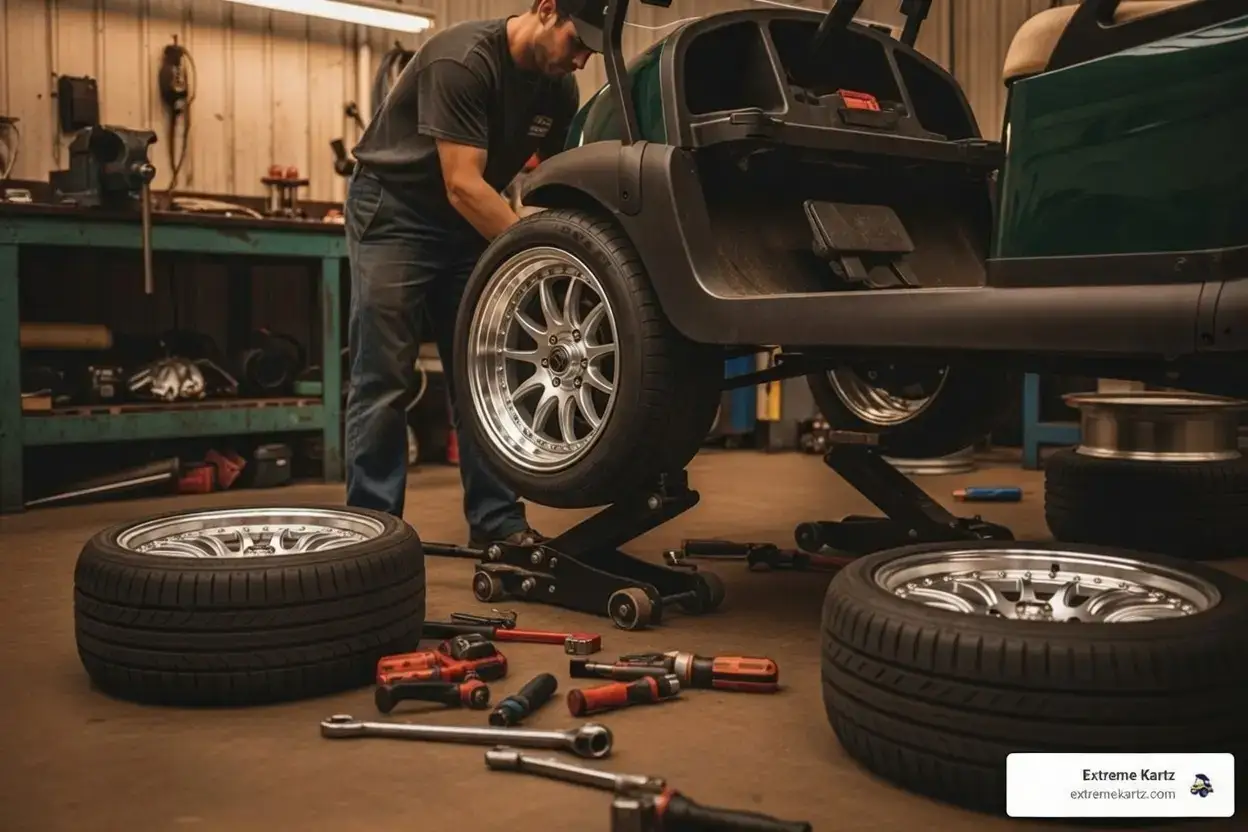
Installing a lift kit is a highly rewarding DIY project that can be completed in a home garage. Most modern kits feature a completely bolt-on design, meaning you won't need to do any cutting, welding, or fabrication.
Required Tools and Skills
To complete the installation safely, you will need basic mechanical skills and the following standard tools:
- A high-quality floor jack and heavy-duty jack stands (never work under a cart supported only by a hydraulic jack)
- A standard socket wrench set (metric and SAE)
- Torque wrench (to ensure all hardware, such as M10 bolts, are torqued to manufacturer specs—typically around 38 ft-lbs)
- General-purpose automotive grease (for greasing the zerk fittings on your new front steering spindles)
- Safety glasses and gloves
Post-Installation Alignment
Once your lift kit is bolted on, your front wheels will be out of alignment. You must perform a basic alignment to prevent rapid tire wear and erratic handling.
To do this, roll the cart forward and backward 20 to 40 feet on a flat surface to let the suspension settle. Then, measure the distance between the front of the front tires and the back of the front tires. You want to adjust your tie rods until you achieve an 1/8-inch toe-in (where the front of the tires point slightly inward). This toe-in will level out perfectly once passengers sit in the cart.
Performance Considerations
Before you mount those massive tires, keep in mind that increasing your tire diameter physically changes your cart's gear ratio. Taller tires will give you a slight bump in top-end speed, but they will decrease your low-end torque.
If you live in a hilly area or plan to carry heavy loads, upgrading to 22-inch or 23-inch tires may cause your cart to struggle on inclines. To offset this torque loss, you may want to consider upgrading your motor controller or clutch system. For G29 owners, we have detailed these performance dynamics in our guide to Yamaha G29 Performance Upgrades.
Frequently Asked Questions About Yamaha Lift Kits
What is the largest tire size I can fit on a stock Yamaha Drive2 without a lift kit?
On a stock Yamaha Drive or Drive2, you can safely run up to a 20.5-inch overall diameter tire without installing a lift kit. This is a fantastic option for owners who want to upgrade to stylish low-profile street wheels or mild turf tires without raising the cart's center of gravity.
However, if you choose to run a 20.5-inch tire on a stock suspension, keep an eye on your inner fender liners. Under full passenger loads or during sharp, high-speed turns, you may experience minor tire rubbing against the plastic bodywork.
Will installing a lift kit on my Yamaha golf cart decrease its torque or battery range?
The lift kit itself does not affect your cart's performance, but the larger tires you install with it certainly will. Taller tires have a larger rolling circumference, which requires more energy from your motor to turn. This increased rolling resistance and motor strain can lead to a noticeable reduction in hill-climbing torque and a slight decrease in overall battery range on electric models.
If you want to run large tires without sacrificing range or power, upgrading your power source is the single best solution. Transitioning from heavy, traditional lead-acid batteries to a high-performance lithium system from trusted brands like Bolt Energy, Eco Battery, Lithium Rhino, and Bedrock Battery will instantly shed hundreds of pounds of dead weight from your cart. This weight reduction, combined with lithium's consistent voltage output, completely restores the torque and range lost to larger tires.
Can I use my stock wheels with a lifted Yamaha golf cart?
In almost all cases, no, you cannot use stock wheels with a lifted Yamaha golf cart.
Standard factory wheels do not have enough "offset" (the measurement of how far the wheel centerline sits relative to the mounting hub). When you install a lift kit—especially a spindle lift or an A-arm lift—the new suspension components sit much closer to the wheel wells. If you attempt to mount a stock wheel, the tire's sidewall will rub directly against the new steering spindles or shock absorbers.
To run a lifted setup safely, you must pair your lift kit with aftermarket wheels that feature an offset (typically a minimum of a 1-inch offset on a 10-inch or larger wheel). This offset pushes the wheel outward, widening your stance and providing the necessary clearance for your new suspension components.
Conclusion
Lifting your Yamaha golf cart is one of the most impactful upgrades you can make, instantly transforming both its capability and its visual presence. Whether you are seeking a simple, budget-friendly 3-inch spindle lift for neighborhood cruising or a heavy-duty, trail-ready 6-inch A-arm suspension system, the key to a successful build lies in matching your specific model generation, rear suspension configuration, and desired tire size.
At Extreme Kartz, we are committed to helping you build a cohesive, high-performance system rather than just selling individual parts. All of our high-quality lift kits ship in 1-2 business days, so you can get started on your upgrade without delay. If you are planning a complete aesthetic overhaul, you can also pair your new suspension with one of our premium custom Golf Cart Body Kits for Yamaha.
To ensure perfect fitment and prevent the headache of ordering mismatched parts, we highly recommend reviewing the manufacturer's specific installation instructions for your chosen kit before ordering through Extreme Kartz.
Ready to elevate your ride? Explore our complete selection of premium suspension systems, heavy-duty parts, and matched wheel-and-tire packages by visiting our Shop Yamaha Parts & Accessories page. If you have any questions about compatibility or alignment for your specific Yamaha model, our expert team is always here to guide you to the perfect fit!
Related Products


Vendor: RHOX BMF A-Arm Lift Kit, 6" Yamaha G22


Vendor: MadJax Yamaha Drive2 Gas 4” Independent Rear Lift Kit (Years 2017-Up)

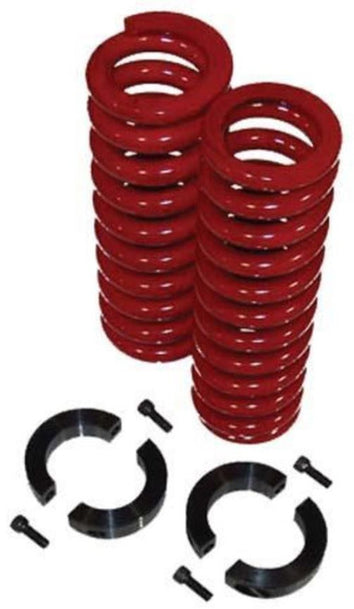
Vendor: Hd Spring Kit, Yamaha G14-G29 (Pair)


