


Epoch vs Bedrock Battery Review: Which 48V Golf Cart Lithium Kit Is the Better Buy?

If you've searched “Epoch batteries” this week, you already know the drill. Every result is either the manufacturer's own page, an AI-written list that reads like a spec sheet wearing adjectives, or a dealer talking up whatever's in their warehouse.
So here's ours, up front: Extreme Kartz doesn't sell Epoch (anymore). We do sell Bedrock Battery. You should know that before you read another word — and you should hold everything below to a higher standard because of it.
Which is why we did this the only way that's fair. Same size pack, same job, manufacturer-published numbers only, side by side. We're comparing the 48V 105Ah kit from each brand, because that's where these decisions usually come down to. No range estimates. No peak-amp horsepower games. No number we can't point at a source for.
Epoch wins some of this outright, and we say exactly where. Bedrock wins more of it — and the places it wins are the ones that show up years after the sale.
📌 At a glance
Epoch and Bedrock both build 48V 105Ah LiFePO₄ drop-in kits with about 5.38 kWh of usable energy, both IP67-rated, both offered in a heated version. Epoch leads on warranty length (11 years vs 10) and bundles the 48V-to-12V converter that's a $70 add-on with Bedrock. Bedrock leads on continuous discharge (250A vs 200A), years of full repair-or-replace coverage (5 vs 3), a warranty that transfers to the next owner, and price — from $2,099 vs $2,299, and still $130 less out the door even with the converter added. Cycle-life ratings are the same for both brands: 3,500–6,000.
Epoch vs Bedrock at a glance

|

|
|
|---|---|---|
| Kit price (as of 07/2026) | From $2,299 | From $2,099 |
| Warranty term | 11 years | 10 years |
| Years of full repair/replace | 3 | 5 |
| Warranty transferable | No — original purchaser only | Yes — one transfer within 3 years ($100) |
| Continuous discharge | 200A | 250A |
| Cycle life (rated) | 3,500–6,000 | 3,500–6,000 |
| Usable energy | ~5.38 kWh | ~5.38 kWh |
| Weight | 99 lb | 95.9 lb (Compact) / 98.1 lb (Slim) |
| Waterproof rating | IP67 | IP67 |
| Military Grade Certified | Not published | Yes — certified across 10+ tests |
| Cart-specific kit & brackets | Yes | Yes — configured to your cart at checkout |
| Dash-mounted power button | Yes | No |
Every figure above comes from the manufacturers' own published spec pages and kit listings, checked July–August 2026.
Even after adding Bedrock's optional $70 converter, Bedrock's out-the-door total is still $130 less.
How we compared these two — and what we left out.
Both brands publish short-burst peak amp numbers. We've left them out on purpose: they're measured over different time windows, so putting them in one row would be comparing two different tests. Continuous is the number your cart actually lives in.
You'll also notice no mileage estimates. Both brands publish them; both rest on assumptions we can't verify. We'd rather show you nothing than a number that isn't real.
Warranty: 11 years non-transferable vs 10 years transferable
Epoch's golf cart battery warranty runs 11 years, but only years 1–3 are repair-or-replace; years 4–5 are covered at 40% off MSRP and the remaining years at 25% off. It's non-transferable, with registration required within 90 days. Bedrock's runs 10 years with years 1–5 full replacement or repair and years 6–10 prorated, and it transfers once to a new owner within 3 years for a $100 fee.

|

|
|
|---|---|---|
| Term | 11 years | 10 years |
| Years of full repair/replace | 3 | 5 |
| After that | Yrs 4–5: 40% off MSRP Yrs 6–11: 25% off MSRP |
Yrs 6–10: prorated |
| Transferable | No | Yes — once, within 3 years, $100 |
| Registration | Within 90 days | Within 90 days |
How long are you actually fully covered?
“11 years” and “10 years” sound like a one-year difference. They aren't measuring the same thing. Epoch's first three years are repair-or-replace. Bedrock's first five are. After year 3, an Epoch claim means buying a replacement at a discount — 40% off MSRP in years 4–5, then 25% off for the rest of the term.
So look at the years you're most likely to actually need it: in years 4 and 5, a Bedrock failure is a replacement; an Epoch failure is a bill for 60% of MSRP. Past year 5 the two converge into discount territory — and Epoch's term does run a year longer at the tail end.
Is Epoch's warranty transferable?
No — and this is the row almost everybody skips. Epoch's 11 years covers you, the original purchaser; sell the cart and the coverage dies with the sale. Bedrock's 10 years can be transferred once to a new owner, within 3 years of the original purchase, for a $100 fee. The clock keeps running from the original purchase date — it does not reset — but the remaining coverage goes with the cart, which on a three-year-old listing is a line the other cart can't print.
A shorter warranty you can hand to a buyer is worth more than a longer one that dies in your driveway.
Register it the day it arrives — either brand
Both brands require registration within 90 days — and Epoch's warranty page adds that if you miss the window, “the warranty period will begin from the battery's original manufacturing date,” meaning shelf time eats your coverage. Whichever you buy: register it the day the pallet lands. It's the single most common way people lose coverage they already paid for, on any brand.
Continuous discharge: 250A vs 200A — what it actually buys you
Bedrock's 48V 105Ah publishes 250A continuous discharge; Epoch's publishes 200A. Continuous discharge is the current a pack delivers sustained — not for two seconds, but for the whole hill. On a stock cart you're unlikely to reach either ceiling. The 250A pack matters when you load the cart, lift it, or upgrade the controller later.
Here's where we'll be straighter with you than most comparisons bother to be.
If your cart is stock and lives on flat neighborhood streets, you will probably never feel the difference between 200A and 250A. Anyone who tells you a bigger continuous number will make a stock cart quicker is selling you something. Your controller sets the speed ceiling, not your battery.
So why is it on the chart at all? Three reasons, and all of them are about the cart you'll own in three years rather than the one in your driveway today.
It's easier on the pack itself. Think of the continuous rating like an engine's redline. Ask 180 amps of a pack rated for 250 and it's cruising; ask the same 180 of a pack rated for 200 and it's living near redline. The less time a battery and its BMS spend at their ceiling, the less stress on the cells and the electronics — so a higher continuous rating isn't just power you might use someday. It's margin the pack benefits from on every single hill, and over the years, margin is longevity.
It's insurance against the cart stopping dead. When you genuinely overdraw a pack — six adults, a long grade, oversized tires — it isn't the motor that gives up. The BMS protects itself and cuts out, and the cart simply stops. The higher the continuous rating, the further away that ceiling sits.
It's what keeps your options open. This is our own standing advice to customers who ask about speed: if you think you might add a controller, a lift, and big tires later, size the battery for it now — 105Ah or more, 250A continuous or more — so the upgrade drops straight in without a second battery purchase. An underspec pack quietly caps whatever you bolt on afterward. A 600A controller behind a 200A battery is a 200A cart.
Bedrock is at that 250A number today, at the lower price. Epoch isn't.
Cycle life: the same for both — 3,500–6,000
A cycle is one full charge and discharge, and on this spec there's nothing to argue about: both brands' packs are rated for 3,500–6,000 cycles. Epoch prints its figure as “3,500+” and Bedrock as the full range — same band, same chemistry, same story.
Neither figure is an independent lab result — each is its manufacturer's design target, measured under bench conditions no golf cart actually lives in. So here's the honest read, from the company selling one of these two packs: treat the ratings as the same. At a full cycle a day, 3,500 cycles is nine-plus years of daily driving before rated capacity fade — on either brand — and if someone's pitch hinges on a cycle number, they're selling you something.
The place the long-run money actually lives is the section above this one: not how many cycles a pack is rated for, but who pays if it fails in year 4.
Price and what's in the box
As of July 2026, the Bedrock 48V 105Ah kit starts at $2,099 and the Epoch at $2,299 — about $200 apart.
But do the out-the-door math properly, because there's a real asterisk.
The 12V converter question
Epoch bundles a 48V→12V converter in the kit. With Bedrock it's an optional add-on — $70 as of July 2026. If you run headlights, a stereo, a fan, or a USB port, you need one either way. So price it honestly: $2,169 out the door for Bedrock against $2,299 for Epoch. Bedrock still comes in $130 less with the converter in the cart. The bundle narrows the gap; it doesn't close it.
And you may not need the $70 at all. Many newer carts already have a factory 12V converter — if your headlights work today, you likely have one. If your cart is bone stock with no 12V accessories, you don't need one either, and the full $200 stays in your pocket.
One more thing we'll say because we've said it on camera: in our view Bedrock's is the best 12V converter kit in the business — it ships with complimentary extra connectors that make the reducer hookup cleaner and save you the mid-install hardware-store run that stalls half of these conversions.
What each kit includes
- Epoch: battery, 15A charger, 48V→12V converter, Bluetooth battery gauge, dash-mounted power button, cart-specific mounting brackets.
- Bedrock: battery, 15A onboard charger, state-of-charge meter (your choice of round LCD or touchscreen), cart-specific bracket and hardware, charge-port adapter, AC port plug. Heated version available for +$99.
Worth knowing on both: a lithium conversion replaces the batteries and the charger, meter, and charge port. You can't reuse your lead-acid charger, and you can't part-swap between brands.
And read those two lists as the ease-of-install comparison, because that's what they are. “Easy to install” is a claim; what's actually in the box is a fact. Every part of the conversion that ships in the kit — configured to your exact cart — is a step you don't improvise in the garage: the cart-specific bracket, the charge-port adapter, the AC port plug, and (if you add the converter kit) the extra 12V connectors that save the mid-install hardware-store run. Bedrock's kit ships more of the install; Epoch counters with the converter and a dash-mounted power button in the box. Count the parts yourself — that's the objective version of “which is easier.”
Will it fit your cart?
The conversion that goes sideways is almost never the one where the specs were wrong. It's the one where the pack was technically correct and physically wouldn't sit in the tray.
That's what Bedrock's two builds are for, and between them they cover the major platforms:
- Compact — Club Car Precedent '09+ / Onward / Tempo · Club Car Precedent '04–'08 · Club Car DS (A-Frame) · EZGO RXV (Plastic Tray) · Yamaha Drive '07–'10 · Yamaha Drive '11+ / Drive2 · Universal
- Slim — EZGO TXT · EZGO RXV (Metal Tray) · Yamaha G19–G22 · ICON / Advanced EV · Kandi / Coleman Star EV · Polaris Ranger EV · Universal
You configure the kit to your cart before it ships, and a cart-specific charge-port adapter comes in the box. You also pick your meter — round LCD or touchscreen. Small thing. You'll look at it every day.
Cart by cart: which kit makes for the easier install?
Both brands sell cart-specific kits — so we went one level deeper and compared what each kit actually provides for each cart. The parts columns reflect each maker's current kit configurations; the edge call in the last column is ours, from putting these kits into real carts — and we've called it a toss-up wherever it genuinely is one. Yamaha Drive goes to Epoch.
| Cart | Epoch kit provides | Bedrock kit provides | The edge goes to… |
|---|---|---|---|
| Club Car Precedent '09+ / Onward | Precedent bracket + Precedent charge receptacle | Precedent tools + Precedent charge-receptacle adapter | Toss-up |
| Club Car Precedent '04–'08 | Does not fit | Precedent battery shape + Precedent '04–'08 tools | Bedrock |
| Club Car DS | DS battery shape | DS battery shape + DS drill-less bracket | Bedrock |
| Yamaha Drive / Drive2 | Yamaha bracket | Generic bracket | Epoch |
| EZGO TXT | Generic battery shape + TXT bracket + TXT receptacle | TXT battery shape + TXT bracket + TXT ring terminal + TXT receptacle adapter | Bedrock |
| EZGO RXV (plastic tray) | Generic battery shape + RXV bracket + RXV receptacle | Compact battery shape + RXV hardware + RXV receptacle adapter + RXV ring terminal | Toss-up |
| EZGO RXV (metal tray) | Generic battery shape + RXV bracket + RXV receptacle | RXV battery shape + RXV metal-tray bracket + RXV receptacle + RXV ring terminal | Bedrock |
| ICON / Advanced EV | Generic | Generic | Toss-up |
Tally: Bedrock takes the edge on 4 of 8 platforms, Epoch takes Yamaha Drive, and 3 are toss-ups. “Generic” means the kit fits, but with universal rather than cart-specific parts.
Straight answer: don't guess, and don't trust a photo. Club Car DS comes in A-frame and H-frame; EZGO RXV comes with a plastic or a metal tray. Those change which kit you need. Send us your make, model, and year — we'll confirm it in writing before you order. Costs nothing, takes a minute.
Lock it from your phone
The Bedrock Connect app will lock or unlock the battery's power from your phone. Somebody gets under the seat, and the cart still doesn't drive.
If your cart lives at a course, a campground, a marina, or in a rental fleet, that isn't a gimmick — it's the difference between an attempted theft and a theft. Epoch doesn't publish an equivalent.
Cold weather and charging
Neither battery will charge below 32°F. LiFePO₄ packs block charging under freezing to protect the cells — the cart still drives, it just won't take a charge until things warm up.
Both brands offer a heated version for cold climates; on Bedrock's kits that's a $99 upgrade. If you're storing a cart through a northern winter, that's the option to look at.
Where Epoch wins
We'll give the column that isn't ours to sell its own fair hearing.
The warranty term is longer — 11 years to Bedrock's 10. At the tail end of ownership, Epoch's coverage is still running a year after Bedrock's has expired. Read the structure section above before you weigh it, but the outer number is genuinely Epoch's.
The dash-mounted power button is Epoch's. Epoch's kit includes one; Bedrock's doesn't. It's a small convenience — but it's real, it's in the box, and it goes in Epoch's column.
On a Yamaha Drive or Drive2, Epoch's kit is the more cart-specific one — its Yamaha bracket against Bedrock's generic bracket. That's straight from our own cart-by-cart table above, and it's Epoch's row fair and square.
Charging speed isn't a Bedrock win, either. On the standard 15A charger, a full Bedrock charge runs about 5.5 hours — the slower end of this class. If your cart charges overnight, you'll never notice; if you like topping up between rounds, it's worth knowing.
And several things are simply a tie, which is worth saying out loud. Usable energy is the same (~5.38 kWh). Both are LiFePO₄. Both are IP67. Both offer a heated version. Both include a charger and a gauge. Weight is within a few pounds. Cycle-life ratings are the same (3,500–6,000). Anyone telling you one of these packs is in a different class than the other on the published specs above is selling you something. Internal components and build quality are a different conversation — we take that up below.
Where Bedrock wins
- Five years of full repair-or-replace, not three — and the warranty transfers, so the coverage becomes part of what you're selling instead of dying with your ownership.
- 250A continuous vs 200A — headroom for a loaded or lifted cart, less time at redline for the pack itself, and the number that keeps a future controller upgrade from being capped.
- The install that ships more complete — the kit is configured to your cart at checkout, with a patent-pending cart-specific bracket, charge-port adapter, AC port plug, your choice of meter, and — with the converter kit — complimentary extra 12V connectors, behind what Bedrock publishes as “the most comprehensive install guide available.” What's in the box is the objective measure of an easy install, and Bedrock's box ships with more of the job done — cart by cart, the edge lands Bedrock's way on 4 of 8 major platforms, with 3 toss-ups and Yamaha Drive going to Epoch.
- A published test pedigree — MIL-STD-810H certification across 10+ tests, and a steel case certified against salt, fog, sand, dust, and corrosion, straight from Bedrock's own product pages. Details below.
- Anti-theft lock from your phone — no published Epoch equivalent.
- $200 less — with the spec sheet and the price tag pointing the same direction, and still $130 less out the door after adding the $70 converter Epoch bundles.
- Compact and Slim builds configured to your cart, plus your choice of meter — and if 105Ah isn't your number, the family also runs 36V, 48V in 65Ah and 150Ah, and 72V.
Straight answer: “if it's cheaper, what did they leave out?”
Cheap usually shows up somewhere on a spec sheet. Go find it here. Continuous discharge: Bedrock's is higher. Cycle rating: the same — 3,500–6,000 for both. Usable energy: identical. Chemistry: identical. Waterproof rating: identical. Warranty: one year shorter, but transferable — and with two more years of full replacement.
The one place the money genuinely shows up is the warranty term — a year longer on Epoch's side. That's the trade, in writing.
Beyond the spec sheet: build, testing, and the company behind it
A promise kept, then a lane change we'll label honestly. Everything above this line came from the two manufacturers' published spec pages. This section runs on two different kinds of source: claims Bedrock publishes about its own build and testing — quoted, with where they live — and our own assessment as people who work on these carts every day, clearly marked as exactly that. Hold each to its own standard.
What Bedrock publishes about its build
| Feature | What it buys you | Bedrock's published claim |
|---|---|---|
| Military-grade testing | Built to survive vibration, shock, heat, and duress — certified, not a tagline | “Certified across 10+ MIL-STD-810H tests” — stated on the 48V 105Ah kit's own product page |
| Lowest issue rate | Fewer problems, more years of quiet ownership | “Our smart BMS has an industry leading <0.3% error rate (measured over 5yrs)… Expect less issues than with almost any other brand.” |
| Coastal-climate proofing | Durability at the beach, at the shore, and out west | “Proprietary steel case with rust resistant components… certified to protect against salt, fog, sand, dust, and corrosion” |
| DIY-first install | Convert the cart yourself, without guesswork | “Confidently handle the installation yourself with the most comprehensive install guide available.” |
| Cart-specific brackets | The pack sits right in your tray — fewer modifications | Custom brackets “tailored to individual cart models,” patent-pending design — configured for 12+ unique carts across the Compact and Slim builds |
| Converter kit extras | Cleaner 12V hookup, no mid-install hardware run | Complimentary extra connectors included in every 12V converter kit |
Quotes pulled from bedrockbattery.com — the homepage and the 48V 105Ah kit product page — August 2026. These are the manufacturer's claims about its own product, quoted so you can weigh them yourself.
Our assessment — take it as exactly that
Now the part no spec sheet will tell you. Neither company publishes its design arrangements, so what follows is Extreme Kartz's own read of the industry — informed opinion, clearly labeled, not a cited fact.
Epoch is a marine and RV lithium company first, and by all accounts a good one — marine is where its engineering attention and its reputation live. Its golf-cart battery, as we read the industry, isn't designed in-house the way its marine line is: a third party designs it, which puts an extra middle-man between the engineers and your battery tray — and, we'd argue, an extra margin in the price. Bedrock's packs come from a team that does golf carts and nothing else, with a certified lithium technician on staff and hands-on experience across more than twenty lithium battery brands.
The after-sale side reads similarly to us: owner reviews of Epoch's customer service run hot and cold — some report quick, helpful support, others report going unanswered. That's not a scandal; it's average. But when an install stalls at the charge-port bypass on a Saturday afternoon, average is exactly what you don't want on the other end of the phone.
Put this section together with the spec sheet above and you have the pitch we actually sell Bedrock on: the only US brand starting at $2,099 that shows up with best-or-top marks in every category on this page.
How to decide in about 90 seconds
Question 1 — Is there any chance you sell this cart?
Yes → Bedrock. The transferable warranty is money back at resale. That one's decided.
Question 2 — Is your cart lifted, loaded, or on hills — or might it be?
Yes → Bedrock. 250A is the headroom you'll want, and the number that keeps a later controller upgrade from being capped.
Question 3 — Do you run 12V accessories, and does your cart lack a factory converter?
Yes → add the $70 converter to the Bedrock kit and compare the totals honestly: $2,169 against $2,299 as of July 2026 — Bedrock, by $130.
No → the $200 is just $200 you keep. Bedrock.
“No” to all three, and the 11-year number is the one that calms you down? Buy the Epoch. Genuinely. Enjoy it.
If your tray is unusual or you're not sure what you've got — talk to a human before you buy either one. That's a fitment check, not a checkout button.
The pack is only half the job
Conversions almost never fail because of the battery. They fail at:
- the charge-port bypass — the #1 “my cart won't move after the install” cause, and every make has its own version;
- the 12V reducer wiring — the #1 “my lights and stereo are dead” cause;
- the interlock wire, and on Club Car DS (all 48V) and Precedent 2013-and-older, the OBC bypass.
Buy from someone who'll pick up the phone when you're standing over the cart with a wire in your hand.
Ready to spec your Bedrock kit?
Shop Bedrock Battery 48V 105Ah Kits
Not sure it'll fit? Send us your make, model, and year — we'll confirm the right kit before you spend a dollar. Free, and no pitch on the other end.
Still want to see the whole field? Browse every lithium kit we carry.
Still doing homework? Which Lithium Battery is Good, Better, Best? · Top 5 Lithium Batteries for Golf Carts in 2026 · How long a lithium golf cart battery actually lasts
Epoch vs Bedrock: frequently asked questions
Is Bedrock Battery as good as Epoch?
On published specs for their 48V 105Ah kits, Bedrock leads on continuous discharge (250A vs 200A), price (from $2,099 vs $2,299), and years of full repair-or-replace warranty coverage (5 vs 3) — and its 10-year warranty is transferable. Cycle-life ratings are the same for both brands — 3,500–6,000. Epoch leads on total warranty length (11 years vs 10) and bundles a 12V converter that's a $70 add-on with Bedrock — though even with the converter added, Bedrock's out-the-door total is $130 lower. Both are IP67-rated LiFePO₄ drop-in conversions for the same carts, and both offer heated versions.
How long is Epoch's golf cart battery warranty really?
The term is 11 years, but only years 1–3 are repair-or-replace. Years 4–5 are covered at 40% off MSRP and the remaining years at 25% off — so after year 3, a claim means buying a replacement at a discount rather than getting one. Bedrock's term is 10 years with years 1–5 full replacement or repair, then prorated coverage in years 6–10.
Is Epoch's golf cart battery warranty transferable?
No — Epoch's 11-year warranty covers the original purchaser only, with registration required within 90 days. Bedrock's 10-year warranty allows one transfer to a new owner within 3 years of the original purchase for a $100 fee, with the coverage clock still running from the original purchase date.
Is the Bedrock 48V 105Ah kit really military grade?
Bedrock publishes MIL-STD-810H certification across 10+ tests for the kit — the claim appears on the 48V 105Ah product page itself (checked August 2026) — along with a proprietary steel case certified against salt, fog, sand, dust, and corrosion. MIL-STD-810H is a U.S. military environmental test standard covering stresses like vibration, shock, and temperature extremes; certification means the pack passed those test procedures, not that it's a military product.
Which is easier to install — Epoch or Bedrock?
Both are drop-in 48V conversions with cart-specific mounting brackets, so neither requires fabrication on a supported cart. The objective difference is what ships in the box: Bedrock kits are configured to your exact cart at checkout and include the cart-specific bracket and hardware, a charge-port adapter, an AC port plug, your choice of meter, and complimentary extra 12V connectors in the converter kit, plus what Bedrock publishes as “the most comprehensive install guide available.” Epoch's kit includes the 12V converter and a dash-mounted power button. Cart by cart, our install comparison gives Bedrock the edge on Club Car Precedent '04–'08, Club Car DS, EZGO TXT, and EZGO RXV (metal tray); Yamaha Drive goes to Epoch; Precedent '09+/Onward, RXV (plastic tray), and ICON/Advanced EV are toss-ups. Either way, the failure points are the same — the charge-port bypass, the 12V reducer wiring, and the interlock/OBC wiring — so buy from someone who answers the phone mid-install.
Will a lithium battery make my cart faster?
Not on its own. Your controller and motor set the speed ceiling — a battery swap alone won't raise it, though shedding ~300 lb of lead can be worth a mile per hour or so. If speed is the goal, the path is a controller or AC upgrade — and that's exactly when a 250A-continuous pack stops being headroom and starts being the thing that lets the upgrade work.
Related Products

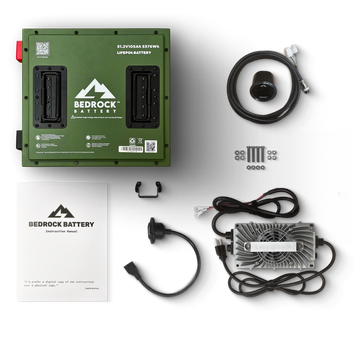
Vendor: Bedrock Battery Compact 48V 105Ah Lithium Conversion Kit

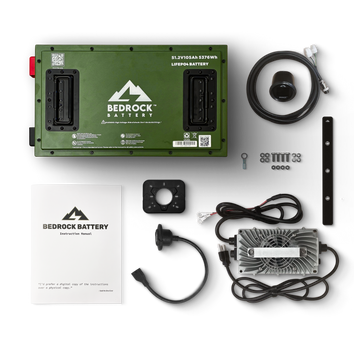
Vendor: Bedrock Battery Slim 48V 105Ah Lithium Conversion Kit


