


How to Tune Your Yamaha Golf Cart for Peak Performance
Why Yamaha G29 Performance Upgrades Are Worth Your Attention

Yamaha G29 performance can be significantly improved through a combination of motor, controller, gear, and battery upgrades — whether your cart is gas or electric.
Here's a quick summary of the most effective upgrades:
| Upgrade Type | Best For | Expected Gain |
|---|---|---|
| High-speed DC motor | Electric G29 (YDRE) | 25–35% more performance |
| Navitas or Alltrax controller | Electric G29 | Higher top speed, better torque |
| Governor adjustment | Gas G29 (YDRA) | Up to 20–21 MPH stock |
| High-speed gear set (8:1) | Gas G29 | Meaningful top speed increase |
| Larger tires (22–23") | Gas or electric | +4–5 MPH over stock |
| Lithium battery conversion | Electric G29 | Better range, consistent voltage |
The Yamaha Drive (G29) is one of the most popular personal golf carts on the market — and for good reason. It's reliable, well-built, and responds well to upgrades. But stock performance leaves room to grow, and most owners eventually want more speed, more torque, or both.
The good news: there's a clear, proven path to get there.
This guide walks you through every major performance upgrade for the G29 — from electric motor and controller swaps to gas tuning strategies, suspension improvements, and battery conversions.
I'm Martin Davis, owner of Extreme Kartz, and I've spent years helping golf cart owners navigate Yamaha G29 performance upgrades with accurate fitment guidance and real-world parts experience. Whether you're new to cart tuning or ready to go deep on specs, this guide is built around what actually works.
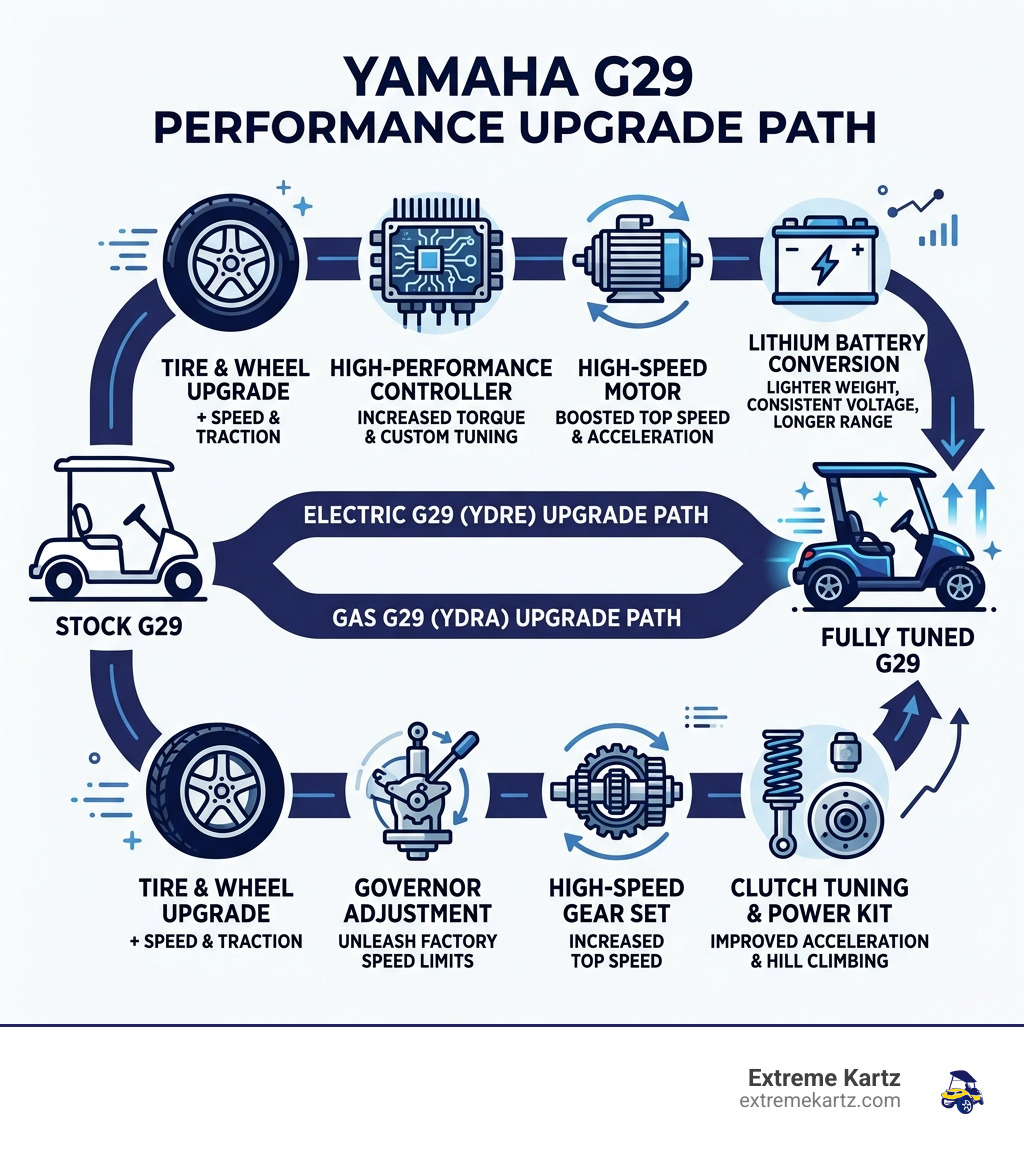
Optimizing Yamaha G29 Performance for Speed and Torque
When we talk about Yamaha G29 performance, the first thing we have to do is identify exactly what is sitting in your garage. The Yamaha G29, often referred to as "The Drive," was produced between 2007 and 2016. It comes in two primary flavors: the YDRE (Electric) and the YDRA (Gas).
While they share a chassis and many body components, the way we extract power from them is fundamentally different. For the electric models, we focus on the flow of electrons—increasing amperage and motor efficiency. For the gas models, we focus on mechanical advantages—adjusting the governor, upgrading clutches, and changing gear ratios.
At Extreme Kartz, we believe in system-based solutions. Swapping a single part can help, but matching a high-speed motor with a compatible controller and heavy-duty cables ensures that you don't create a bottleneck in your system. This holistic approach prevents premature component failure and provides the most reliable "seat-of-the-pants" power increase.
Before diving into modifications, it is always a good idea to check the baseline specifications from the Yamaha Golf Car Official Site. Most stock G29s are limited to about 12–15 MPH. Our goal is to safely push that into the 20–25 MPH range (or higher) depending on your local regulations and intended use. For a deeper dive into the basics, check out our Yamaha Golf Cart Speed Guide.
Upgrading Electric Yamaha G29 Performance with High-Speed Motors
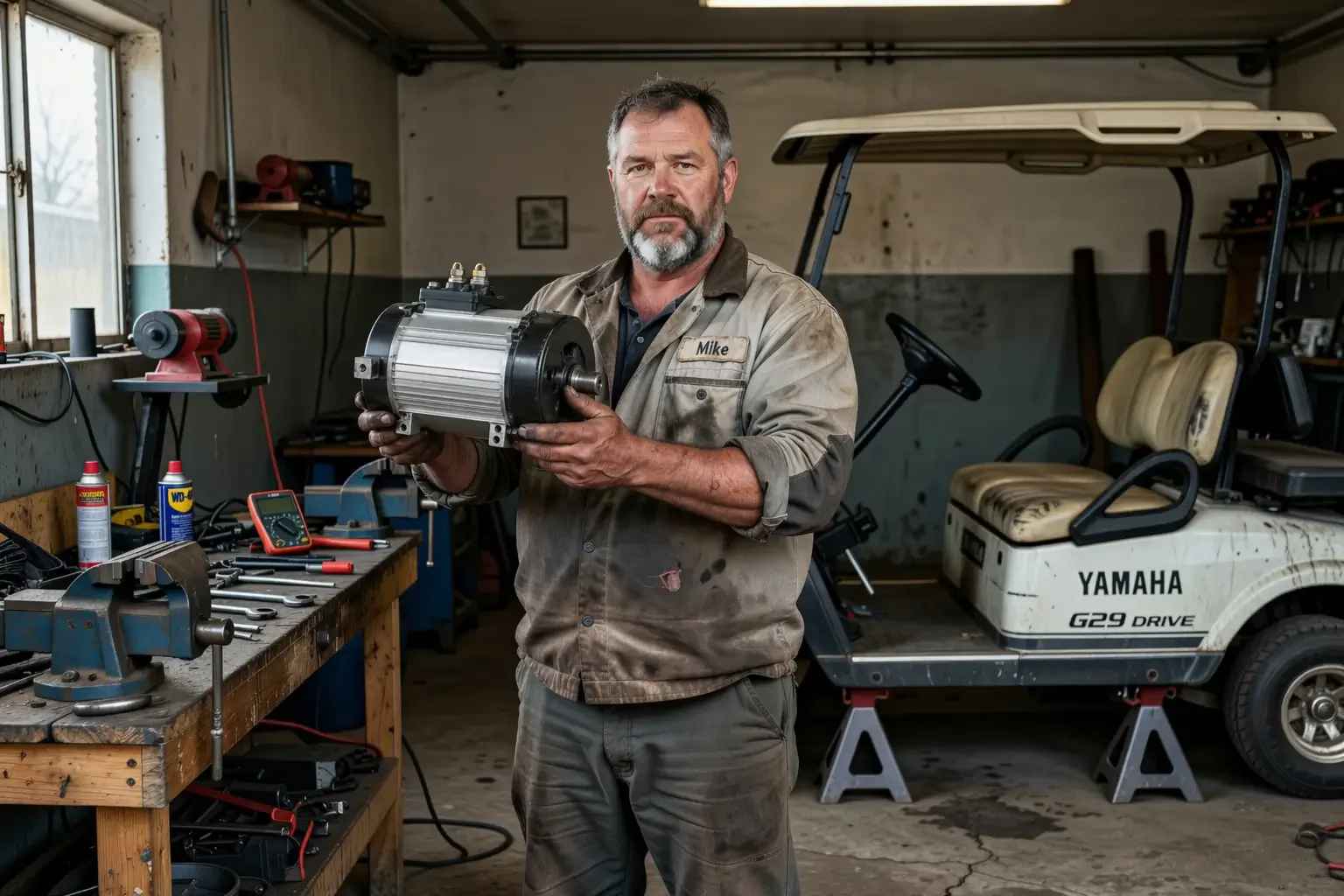
If you own an electric YDRE, the motor is the heart of your machine. The stock Hitachi motor is fine for a round of golf, but it isn't designed for high-speed neighborhood cruising or climbing steep hills with four passengers.
When looking at aftermarket DC motors, we often recommend options that feature a 19-tooth internal spline, which is the standard mount for the Yamaha Dana H12 transaxle. High-quality replacement motors, such as those born from partnerships with industry leaders like Nidec, can offer a 25–35% performance increase even on a factory setup.
We also see incredible results with Admiral motors. Independent testing has shown that these motors often provide more torque than other leading aftermarket brands. By utilizing more copper and steel in the internal windings, these motors offer higher thermal capabilities, meaning they can handle more power without overheating.
However, a motor is only as good as the energy it receives. If you're looking for the ultimate leap in technology, you might consider moving away from DC entirely. AC Motors: Why All the Hype explains why AC conversion kits are becoming the gold standard for those who want maximum efficiency and maintenance-free operation.
Advanced Controller Configurations
If the motor is the heart, the controller is the brain. The stock controller on a Yamaha G29 is programmed with very conservative limits to protect the battery and motor. By upgrading to a high-performance programmable controller, you unlock the full potential of your powertrain.
Brands like Navitas and Alltrax are the leaders in this space. We typically see two main tiers for the G29:
- 400-Amp Controllers: Perfect for street use and moderate hills. It provides a noticeable boost in torque and top speed without requiring a total overhaul of your battery system.
- 600-Amp Controllers: Designed for high-torque applications, such as lifted carts with large tires or carts used in very hilly terrain.
The beauty of these modern controllers is their programmability. You can use a smartphone app or a laptop to adjust "on-the-fly" settings. This allows you to prioritize longer range for a long day of driving or maximum top speed for a quick trip. You can also fine-tune regenerative braking, which helps slow the cart down while feeding a bit of energy back into the batteries.
To understand how these units work their magic, take a look at our guide on Golf Cart Speed Controllers: A Basic Understanding. Choosing the right amperage is critical; a 600-amp controller paired with thin, stock 6-gauge wires is a recipe for a meltdown. We always recommend upgrading to 4-gauge or 2-gauge cables when installing high-amp controllers.
Gas-Powered Yamaha G29 Tuning Strategies
Tuning a gas-powered Yamaha G29 (YDRA) is a different beast entirely. You aren't dealing with software; you're dealing with physics and mechanical limits. The G29 uses a reliable 357cc four-stroke engine, but it is heavily restricted by a mechanical governor to keep speeds low for safety on the golf course.
The most common "entry-level" modification is a governor adjustment. By accessing the governor arm near the transaxle (often hidden behind a plastic access panel), you can adjust the tension to allow the engine to reach higher RPMs before the throttle is pulled back. Some owners use the "zip-tie method" to bypass the governor entirely, which can push a stock cart to 20–21 MPH. However, be careful—over-revving a stock engine for long periods can lead to internal damage.
For those who want more than just a quick tweak, we look at gearing and clutches. The stock gear ratio is typically 12:1. Swapping this for an 8:1 high-speed gear set can provide a significant boost in top speed. While a 6:1 ratio exists, we generally find it too drastic for anything other than perfectly flat pavement, as it kills your climbing torque.
| Component | Stock Setup | High-Speed Upgrade | Impact |
|---|---|---|---|
| Gear Ratio | 12:1 | 8:1 | Higher Top Speed |
| Clutch Spring | Standard | High Torque / Power Spring | Better Hill Climbing |
| Drive Belt | Standard | Heavy Duty / Severe Duty | Less Slip, Better Grip |
Mechanical Speed Enhancements
Beyond the governor, the CVT (Continuously Variable Transmission) system is where we find hidden performance. The G29 uses a primary and secondary clutch system connected by a drive belt. Over time, belts stretch and clutches wear down, leading to "slippage" and lost speed.
Installing a Power Spring kit or a High Torque clutch spring can dramatically change how the cart accelerates. A "Power Spring" helps the clutch stay in a lower gear longer, providing better torque for taking off or climbing hills. This is especially important if you have added weight, like a rear seat kit or a cargo bed.
Don't overlook the basics, either. A clean, high-flow air filter and a fresh spark plug ensure the engine is breathing and firing correctly. While these won't turn your cart into a race car, they ensure that your other modifications—like gear changes—actually reach their full potential. Also, consider the comfort of your ride; while not a "speed" part, Yamaha Golf Cart Floor Mats keep your interior clean while you're out testing your new performance limits.
Suspension and Handling for High-Performance Carts
When you increase Yamaha G29 performance, you must also consider how the cart handles that extra speed. A cart doing 25 MPH feels very different from one doing 12 MPH, especially if the suspension is worn out.
The G29 was the first in the industry to feature a true Independent Rear Suspension (IRS) on certain models, which provides a much smoother ride. However, if you plan on adding larger tires, you will likely need a lift kit. A 3-inch or 6-inch lift kit not only gives the cart a rugged look but also allows for 22-inch or 23-inch tires.
Larger tires provide a "mechanical" speed boost. Because the circumference is larger, the cart travels further with every rotation of the axle. On a gas G29, moving from 18-inch tires to 23-inch tires can add 4–5 MPH to your top speed without touching the engine.
However, lifting a cart raises the center of gravity. To maintain stability, we recommend wider tires and perhaps wheel spacers to increase the cart's footprint. For more on choosing the right rubber, see Golf Cart Tires for Every Terrain. And if you're hitting those higher speeds, a quality windshield is a must to keep the wind out of your eyes—check out Yamaha Golf Cart Windshields for the best fitment options.
Improving Yamaha G29 Performance with Lithium Battery Conversions
For electric G29 owners, the single most transformative upgrade you can make is a lithium battery conversion. Traditional lead-acid batteries are incredibly heavy—a standard 48V pack can weigh upwards of 350 lbs. Lithium batteries can cut that weight by 70% or more.
Weight reduction is a massive factor in Yamaha G29 performance. Less weight means the motor doesn't have to work as hard to accelerate, which translates to better torque and a slightly higher top speed. Furthermore, lithium batteries don't suffer from "voltage sag." When you hit a hill with lead-acid batteries, the voltage drops, and the cart slows down. Lithium maintains a consistent voltage until the battery is nearly empty, giving you full power throughout your entire ride.
Many owners ask, "Will Lithium Batteries Make My Golf Cart Faster?" The answer is usually yes, but mostly because of the weight savings and the lack of voltage drop under load. When paired with a 600-amp controller, a lithium pack allows for massive current discharge that lead-acid batteries simply can't match.
Aesthetic and Functional Performance Accessories
While "performance" usually refers to speed and torque, functional accessories improve the overall "performance" of the cart as a vehicle. If you are building a high-speed neighborhood cruiser, you need the support systems to match.
- Light Kits: If you're going faster, you need to see further. Upgrading to an LED light kit provides better illumination with less draw on your battery system.
- Dashes and Storage: An automotive-style dash adds a premium feel and provides a place to mount gauges—like a digital speedometer or battery volt meter—which are essential for monitoring your tuned G29.
- Rear Seat Kits: Most performance builds include a rear seat. Adding two extra passengers adds roughly 300–400 lbs. This is why we emphasize torque upgrades (like high-amp controllers or power springs) alongside speed upgrades.
It is also worth noting a common point of confusion in the "G29" world. If you are searching for reviews online, you might come across the Logitech G29 Review: Note on Model Names. The Logitech G29 is a popular racing wheel for video games. While we love a good racing sim, make sure you are looking at golf cart-specific parts when shopping with us!
Finally, no performance build is complete without some tunes. Yamaha Golf Cart Radios are a great way to round out your custom build, ensuring your cart sounds as good as it performs.
Frequently Asked Questions about Yamaha G29 Upgrades
What is the top speed of a modified Yamaha G29?
A stock Yamaha G29 typically tops out at 15 MPH. With a governor adjustment (gas) or a basic controller tweak (electric), you can hit 19–21 MPH. With a high-speed motor, 600-amp controller, and larger tires, it is common to see speeds between 25 and 30 MPH. Some extreme builds go even faster, but safety and braking become major concerns at those levels.
Can I install a high-speed motor with stock batteries?
Yes, you can, but you won't get the "peak" performance. Stock lead-acid batteries can only provide so much amperage at once. While the motor will be more efficient and likely faster, you'll see the biggest gains when you also upgrade your controller and eventually move to lithium batteries.
Do lift kits affect the torque of my Yamaha Drive?
Indirectly, yes. A lift kit allows for larger tires. Larger tires increase your top speed but require more torque to get moving from a complete stop. If you lift your cart and add 23-inch tires without upgrading your motor or controller, you might find the cart feels "sluggish" on take-off or when climbing hills. This is why we recommend "system-based" upgrades—if you go big on tires, go big on the controller, too.
Conclusion
Tuning your Yamaha G29 performance is a rewarding journey that turns a standard fleet cart into a personalized, high-performance machine. Whether you are looking to zip through your gated community at 25 MPH or need the torque to haul your family up a steep trail, the parts and technology exist to make it happen.
At Extreme Kartz, we pride ourselves on fitment accuracy. We know that a 2012 YDRE needs a different setup than a 2017 Drive2, and we're here to make sure you get the right parts the first time. Don't guess when it comes to high-amperage electronics or internal engine gears.
If you are ready to start your build, you can Shop Yamaha G29 Parts and Accessories directly on our site. All kits ship in 1-2 business days. If you're still unsure which motor-controller combo is right for your specific terrain, give us a call. We're golf cart enthusiasts first and retailers second, and we love helping our customers build the ultimate Drive.
For more tips on getting the most out of your cart, check out our Six Proven Tips to Boost Your Golf Cart Performance. Let's get that Yamaha performing at its peak!
Related Products

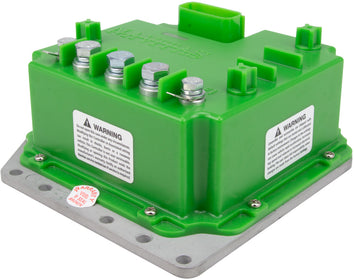
Vendor: Yamaha Navitas Controller Kit - 600 amp or 440 amp - Drive2 / Drive / G19 / G22


Vendor: Yamaha Drive/Drive2 Navitas AC Conversion Kit - CAN enabled


Vendor: Alltrax XCT 400AMP Programmable Controller for Yam Drive

Vendor: Alltrax 48V 500A Yamaha Drive YDRE Controller


