


Beginner's Guide to Golf Cart Lift Kits
What a Lift Kit for a Golf Cart Actually Does (And Whether You Need One)
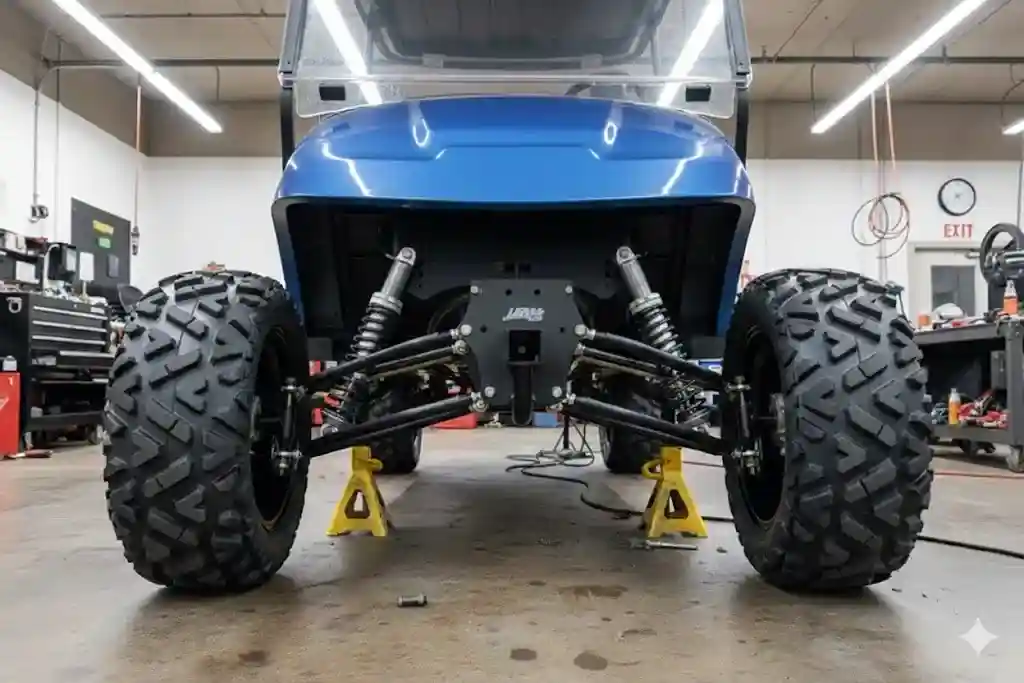
A lift kit for a golf cart raises your cart's suspension to create more ground clearance, allow for larger tires, and improve your cart's ability to handle real-world terrain — from neighborhood streets with speed bumps to rough off-road trails. All of our kits ship in 1-2 business days, so you can get started on your upgrade right away.
Here's a quick look at what lift kits offer and what to expect:
| Feature | What It Means for You |
|---|---|
| Ground clearance | Clear obstacles, roots, and uneven terrain without scraping |
| Larger tires | Fit tires from 20" up to 26"+ depending on lift height |
| Better aesthetics | Aggressive, custom stance that stands out |
| Improved ride | Smoother absorption of bumps on roads and trails |
| Model-specific fitment | Kits are designed for Club Car, EZGO, Yamaha, and more |
Most golf carts are built for smooth fairways and flat paths. But most owners use their carts in the real world — navigating potholes, grass, gravel, and uneven ground. A lift kit is the most direct way to close that gap.
Lift heights typically range from 2 inches (a subtle level-up for neighborhood use) all the way to 8 inches or more for serious off-road builds. The right choice depends on your cart model, how you use it, and what tires you want to run.
I'm Martin Davis, owner of Extreme Kartz, and I've spent years helping golf cart owners find the right lift kit for a golf cart that matches their actual use case — not just their wishlist. This guide covers everything you need to make a confident, compatible purchase.
Understanding the Main Types of Lift Kit for Golf Cart Options
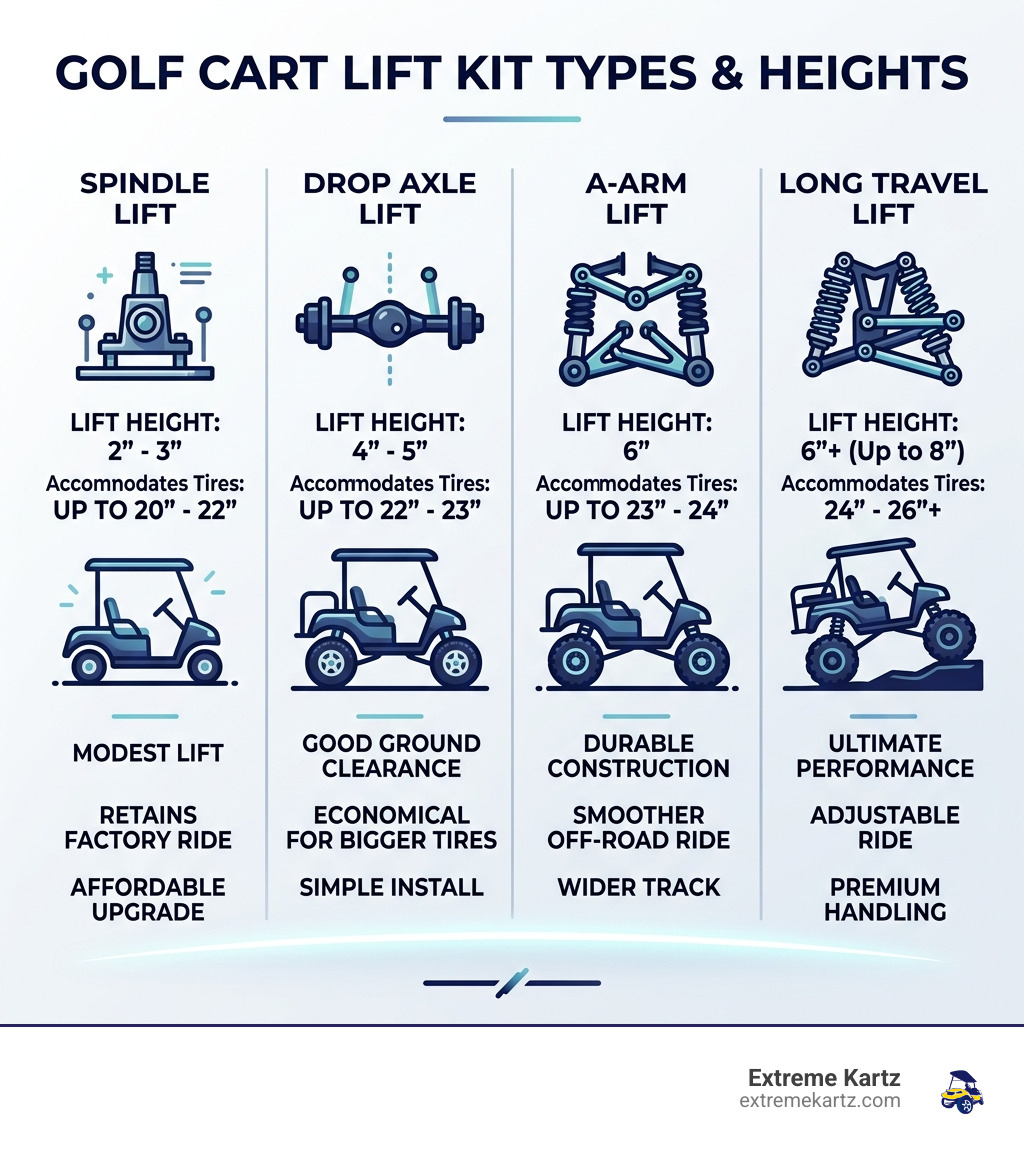
Choosing the right lift kit for golf cart upgrades starts with understanding the mechanical design. Not all lifts are created equal; some are designed for simple height, while others completely re-engineer your front suspension for maximum performance. At Extreme Kartz, we focus on system-based solutions that ensure your cart remains stable and safe after the modification.
Spindle and Drop Axle Lift Kit for Golf Cart Basics
If you are looking for an economy-focused option that provides a boost without breaking the bank, spindle and drop axle kits are the standard.
- Spindle Lift Kits: These are incredibly popular because they are generally affordable and easy to install. A Spindle Lift Kit replaces your factory spindles with longer ones, which pushes the wheel down and raises the body. They maintain your factory steering geometry and are perfect for neighborhood cruising. Most 3-inch applications utilize this design.
- Drop Axle Lift Kits: Common on older EZGO models like the Marathon, these kits replace the entire front axle with a "dropped" design. This provides more ground clearance than a spindle kit and is a robust choice for light off-roading.
Both of these options are typically "bolt-on," meaning you won't need to cut or weld your frame. You can browse our full range of these designs in the Extreme Kartz Lift Kit Collection.
A-Arm and Long Travel Lift Kit for Golf Cart Performance
For those who want more than just height, we move into high-performance suspension systems.
- A-Arm Lift Kits: These kits replace the entire front suspension with a Double A-Arm design. This allows for independent front suspension, meaning if one wheel hits a rock, it doesn't tilt the entire axle. They often feature adjustable camber and toe, ensuring your tires wear evenly. Many of these utilize DOM (Drawn Over Mandrel) tubing—the same high-strength material used in race car roll cages.
- Long Travel Lift Kits: This is the "Big Dawg" of the industry. Brands like Jake's offer kits that are adjustable from 4 to 8 inches (or even 6 to 10 inches). These kits feature independent front suspension and extended reservoir shocks, allowing your cart to "walk" over extreme terrain like a rock crawler. They also lengthen the wheelbase, which significantly improves stability. For a deep dive into these taller setups, check out our 6 Inch Lift Kit Complete Guide.
Choosing the Right Lift Height and Tire Compatibility
The most common question we hear is: "How high do I need to go to fit these tires?" It’s a critical question because over-lifting can make a cart unstable, while under-lifting leads to tires rubbing against the wheel wells.
Neighborhood Stance vs. Extreme Terrain
Your terrain dictates your height.
- 1-2 Inch (Low Pro/Leveling): Perfect for leveling out a "saggy" front end or giving a subtle custom stance for neighborhood driving. These usually accommodate 20-inch tires.
- 3-4 Inch: The "Goldilocks" height. It provides enough clearance for 20 to 22-inch tires without making the cart feel top-heavy. This is ideal for gravel paths and campgrounds. See our 4 Inch Lift Kit Guide for more.
- 5-6 Inch: The industry standard for off-roading. This height allows for 23-inch all-terrain tires, which are necessary for navigating mud, sand, or rocky trails.
- 8+ Inch: Reserved for extreme builds and "monsters." These can accommodate tires up to 26 inches tall but require a high-quality long-travel system to maintain safety.
Tire and Wheel Sizing for Your Lift Kit for Golf Cart
When you lift a cart, you can't always stick with factory wheels. Most lift kits require offset wheels (where the mounting point is deeper in the wheel) to push the tire outward. This prevents the tire from rubbing against the new suspension components or the frame during tight turns.
If you don't want to buy new wheels, you may need wheel spacers to achieve that necessary clearance. Generally, a 4-inch lift pairs perfectly with 12-inch rims, while a 6-inch lift is the sweet spot for 14-inch rims and 23-inch tires. For a full breakdown of what fits what, read our Lifted Golf Cart Parts Complete Guide.
Model-Specific Fitment and Compatibility Considerations
One of the biggest mistakes we see beginners make is ordering a kit based on the brand (like "EZGO") without checking the specific year or steering configuration. Manufacturers often changed designs mid-year, which can lead to a kit that simply won't bolt up.
Club Car, EZGO, and Yamaha Requirements
- Club Car DS: There is a major "fitment break" in mid-2004 (2004.5). Models made before this date have different suspension mounting points than those made after.
- EZGO TXT: You must check your steering column. Older models have a 3-bolt pattern where the column meets the floorboard, while newer ones (post-2001) have a 4-bolt pattern. If you're working on an older model, our 95 EZGO Golf Cart Lift Kit Guide is a must-read.
- EZGO RXV: These carts often require a "carrier-style" lift, especially the electric models from 2015-2021, which may need specific rear brackets.
- Yamaha: The G-series (G14-G19), often called the "Ultima" series, generally uses the same kit for both gas and electric models, but you must verify the model code to ensure the spindles match.
Common Mistakes to Avoid During Purchase
- Ignoring Gas vs. Electric: While many front kits are universal, rear lift brackets often differ between gas and electric models due to engine or battery tray placement.
- Skipping Spindle Checks: Some high-end long travel kits require you to reuse your factory spindles. If you already have an aftermarket spindle lift installed and threw away your old parts, you'll need to source OEM spindles before the new kit will work.
- Ductile Iron vs. Gray Iron: Always look for ductile iron components. They are roughly three times stronger than standard gray iron, which is vital for a part holding your wheels on at 20 mph.
Installation, Maintenance, and Performance Impacts
Installing a lift kit for golf cart use is a rewarding DIY project, but it requires attention to detail. Most kits are designed to be "bolt-on," but "bolt-on" doesn't mean "maintenance-free."
Professional vs. DIY Installation
Most owners with a set of jack stands, a socket set, and a Saturday afternoon can install a spindle or drop-axle kit. However, A-arm and long travel kits are more complex. They involve more moving parts and require a precise front-end alignment (caster, camber, and toe) once finished.
We always recommend using Grade 8 hardware. Suspension components are under immense stress, and standard bolts can shear under pressure. If you aren't comfortable adjusting a synchronized steering box or aligning independent suspension, seeking professional help is a smart safety move.
Post-Installation Maintenance and Accessories
Once your kit is on, the job isn't done.
- Lubrication: Most high-quality kits (like those from RHOX or MadJax) feature grease fittings. You should grease these every few months to prevent squeaks and premature wear on urethane bushings.
- Heavy-Duty Leaf Springs: When you lift a cart, you often add larger tires and maybe a rear seat for more passengers. The factory single-leaf springs usually can't handle the extra weight and will sag. Upgrading to heavy-duty leaf springs ensures your cart stays level.
- Shocks: Consider heavy-duty shocks to manage the new center of gravity. A lifted cart is naturally more prone to "body roll," and better shocks help keep the ride stable.
Frequently Asked Questions
How much does a golf cart lift kit cost?
The price varies wildly based on performance.
- Economy Spindle Kits: These typically range from $300 to $500.
- Premium A-Arm Kits: Expect to pay between $400 and $700.
- Long Travel Systems: These are a significant investment, often ranging from $1,300 to $1,600+, but they offer a ride quality that basic kits cannot match.
Will a lift kit affect my golf cart's speed?
Yes, but indirectly. By allowing for larger diameter tires, you are essentially changing the "final drive gear" of your cart. A larger tire covers more ground in one rotation, which can increase your top-end speed by 2–4 mph. However, this comes at the cost of torque. If you have a hilly yard, you might find the cart struggles to climb with big tires unless you also upgrade your controller or motor.
Do I need wheel spacers with a lift kit?
Not always, but they are a great tool. If your tires are rubbing against the frame or suspension during sharp turns, wheel spacers can push the wheels out to clear the obstruction. They also increase the track width of the cart, which provides a more stable feel and helps counteract the higher center of gravity.
Conclusion
At Extreme Kartz, we believe that a lift kit for golf cart modification should be about more than just looking cool—it should be about performance, safety, and durability. Whether you’re looking for a simple 3-inch boost for your Club Car Precedent or a monster 8-inch adjustable system for an EZGO TXT, the key is fitment accuracy. All of our kits ship in 1-2 business days to get you on the road faster.
We pride ourselves on being a system-based provider. We don't just want to sell you a box of parts; we want to make sure those parts work with your specific year, model, and intended use. If you’re ever unsure about compatibility, our team is here to help you navigate the technical details so you can build the cart of your dreams with confidence.
Ready to start your build? Explore our Golf Cart Lift Kit Selection Guide and find the perfect match for your ride today.
Related Products


Vendor: RHOX BMF A-Arm Lift Kit, 6" Yamaha G22


Vendor: Club Car DS (1982-2003) SGC 6" Heavy Duty Double A-Arm Lift Kit

Vendor: RHOX BMF 6" A-Arm Lift Kit, Club Car Tempo, Onward w/o Factory Lift, Precedent 2004-2025


Vendor: LKTX06 - SGC Lift Kit - 6" Drop Axle kit for EZGO TXT/PDS (2001.5-2008) Gas


