


Golf Cart Light Kit Buyer’s Guide
Golf Cart Light Kit: Types of Light Kits and Where to Start
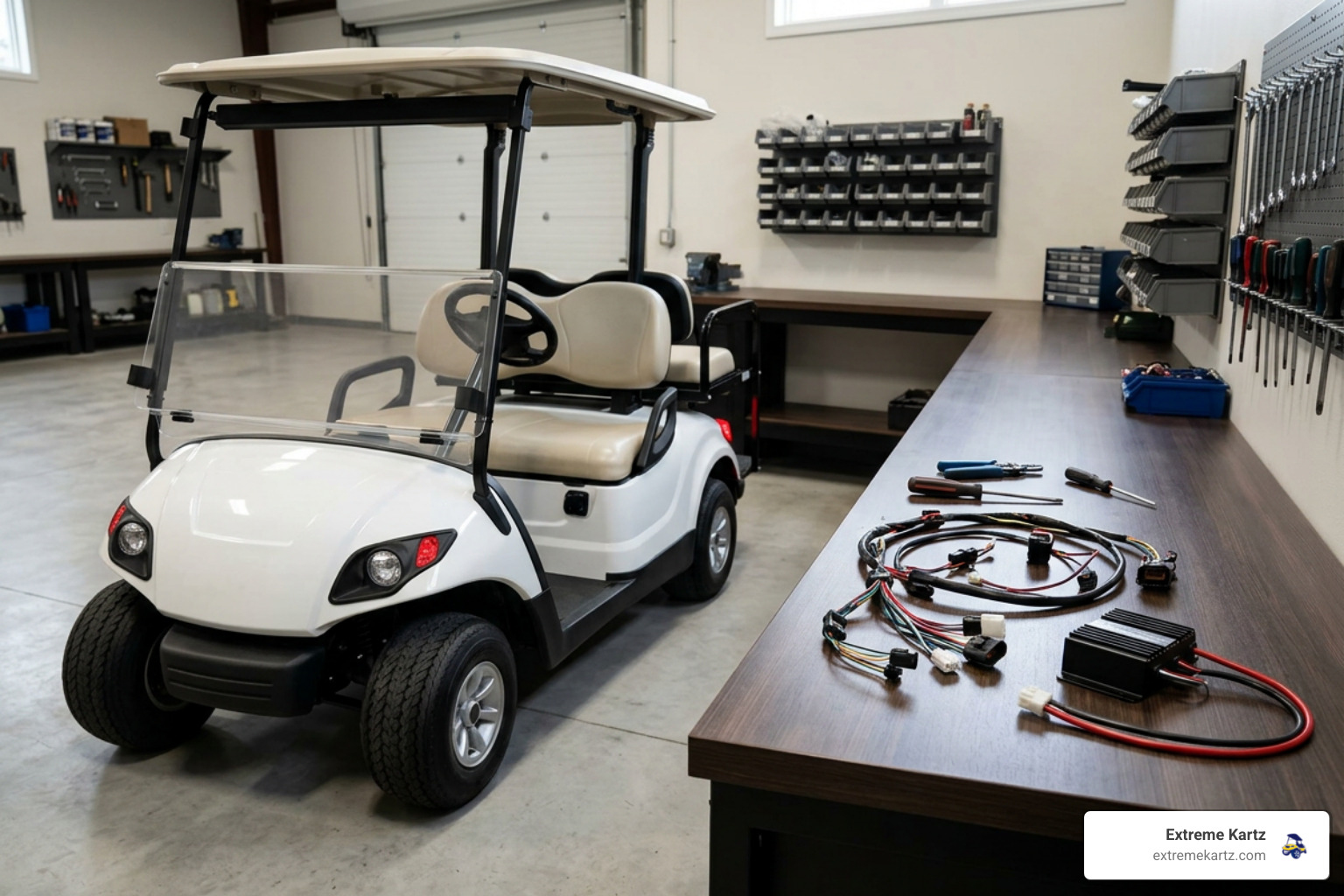
I'm Martin Davis, owner of Extreme Kartz. If you're shopping for a golf cart light kit, start with how you actually use the cart: private property, neighborhood cruising, or a street build that needs more signaling equipment.
| Use case | What to look for |
|---|---|
| Night driving on private property | Headlights and taillights that fit your exact cart body. |
| Neighborhood or community roads | A fuller kit with brake lights, turn signals, and horn components where local rules require them. |
| Electric cart lighting | A properly rated DC-DC voltage reducer so 12V lights work safely on a 36V, 48V, or 72V pack. |
| Visual accent lighting | Cut-to-fit LED strips routed under the cart or along the top. |
Need help choosing before you buy? Browse our golf cart light kits, then contact Extreme Kartz with your cart make, model, serial number, and battery voltage so we can point you toward the right fit.
Understanding local ordinances is crucial before choosing a kit. For public-road use, there are two common tracks: the federal LSV / FMVSS 500 baseline and a lighter local golf-cart-permit track. The federal LSV path generally involves headlamps, stop lamps, front and rear turn signals, taillamps, reflectors, a parking brake, mirrors, windshield, seat belts, and a 17-digit VIN. You can review the federal baseline through NHTSA, and you can also read our guide to Defining Street Legal Golf Carts, LSVs, NEVs, and Modified Golf Carts.
Requirements vary by state and by local ordinance, and some states require DOT-stamped components. Always confirm with your county DMV before buying parts for a street build. A light kit can help you add required lighting and signaling components, but it does not guarantee legal compliance by itself.
Standard Headlight & Taillight vs Full Street Legal Golf Cart Light Kit
A basic light kit typically includes twin front headlights and rear taillights. These setups provide front illumination for unlit paths, campsites, or private property while making the rear of the cart easier to see.
A full street-oriented golf cart light kit, by contrast, expands functionality into an automotive-style lighting harness. In addition to primary headlamps and tail lamps, street-oriented systems may incorporate:
- Turn Signal Assemblies: Steering-column controls with turn indicators and hazard flashers.
- Brake Light Switches: Pedal-mounted switches so rear lamps brighten when braking.
- Horn Assembly: A horn wired into the steering-column switch or a dedicated button.
- Reflectors and Side Markers: Added visibility for side-profile awareness at intersections.
If you ride around neighborhood streets, those signaling components help surrounding drivers understand your next move after sundown. Depending on your cart, options include the RHOX Self-Canceling Plug and Play Turn Signal Kit, Turn Signal Assy w/ Flasher & Horn Button, Club Car Tempo, Precedent Time Delay Brake Light Kit, and Brake Switch Kit, E-Z-Go TXT.
LED vs Halogen Technology in Your Golf Cart Light Kit
Historically, standard halogen bulbs were the primary option for golf cart headlights. While halogen remains an accessible traditional technology, modern LED lighting has become the preferred choice across many golf cart applications because it uses less power, handles vibration well, and produces clean forward visibility.
LED light kits offer three practical advantages:
- Lower Power Consumption: LED bulbs draw less amperage than halogen elements, helping preserve battery runtime on electric carts.
- Long Service Life: LEDs are solid-state components without fragile filaments, so they tolerate chassis vibration and rougher surfaces well.
- Bright, Clean Output: Quality LED headlights provide strong forward visibility without requiring a large accessory load.
For platform-specific options, start with Club Car light kits, EZGO light kits, or Yamaha light kits. For Club Car-specific detail, see our Club Car Golf Cart Lights Guide.
Electrical Power Requirements and Voltage Reducer Integration
Integrating aftermarket lighting into a golf cart requires careful attention to system voltage. Standard golf cart lights and accessories run on 12V direct current. Electric carts, however, commonly use higher-voltage battery banks, so a DC-DC reducer bridges that gap.
If you encounter electrical system issues during setup, consult our guide on How to Troubleshoot Common Golf Cart Electrical Issues for diagnostic help.
Powering Electric vs Gas Carts
Gas-powered golf carts use a standard 12V starter battery charged by an onboard starter-generator. Installing a golf cart light kit on a gas cart is usually straightforward: positive and negative supply leads connect to the 12V battery with appropriate inline protection.
Electric golf carts feature higher-voltage battery banks configured in series:
- 36-Volt systems
- 48-Volt systems
- 72-Volt systems (typically lithium packs)
On older lead-acid packs, tapping two 6V batteries for 12V worked, though it wore the tapped batteries unevenly. The bigger issue today is lithium: a lithium pack is a sealed unit with no accessible mid-string tap point. Swap to lithium without a reducer and every 12V accessory goes dead. This is the single most common cause of "my lights quit after a lithium swap" that we see.
For many electric-cart buyers, the companion part to consider is the 24/36/48Vdc to 12Vdc 20A DC/DC Converter if your kit does not already include a reducer. Other reducer options include the Eco Battery 12V Converter for 36V Batteries for compatible 36V systems and the Bolt 50-AMP DC/DC 36/72 Volt HD Voltage Reducer as a 72V option. Eco products are excluded from all promotional codes.
One important exception: the Madjax Ultimate Light Kit Plus kits have a voltage reducer built in and run on 12-48V, so you do not need a separate converter with them. You need a standalone reducer when your kit does not include one, when you are powering accent strips or other 12V accessories on their own, or when you have a 72V pack — the built-in reducers in these kits do not cover 72V.
Choosing the Right Voltage Reducer
To protect high-voltage battery packs, electric carts require a high-quality battery voltage reducer, also called a step-down converter. A voltage reducer draws from the pack and converts output down to a regulated 12V supply for lights and accessories.
When selecting a voltage reducer, consider:
- Input Voltage Range: A 72V pack needs a reducer rated for 84V maximum input, because a fully charged 72V lithium pack reads about 84 volts. For 36V use a 36V-specific or universal unit; for 48V use a 36V/48V rated or universal unit.
- Amperage Capacity: A headlight and taillight kit draws roughly 3-5 amps, so a 20-amp reducer is plenty for a lights-only build. Add audio or other accessories and you may need 30 amps or more. Total your 12V loads and add 20% headroom.
- Switched vs. Unswitched Power: Choose a reducer with a key-switch activation wire when available. This helps the converter shut off when the key is turned off, reducing parasitic battery draw.
- Fuse Protection: Install an inline fuse on the positive input lead, within 12 inches of the pack positive terminal, and follow the instructions supplied with your kit.
Selecting Color Configurations and Cut-to-Fit LED Strips
Beyond standard headlights, many cart owners add accent lighting to customize the cart's look. Keep this simple: the LED strip options we carry are cut-to-fit products, not per-seat sizing kits.
Single-Color vs Multi-Color Configurations
Accent lighting systems fall into two main hardware categories: single-color setups and multi-color controllable systems.
| Feature | Single-color LED strips | Multi-color RGB / RGBW strips |
|---|---|---|
| Color variety | One static color such as blue, red, green, or white. | Multiple selectable colors depending on controller and strip design. |
| Control interface | Simple inline switch. | Wireless remote or Bluetooth app depending on the kit. |
| Best use | Clean, simple accent lighting. | Custom under-cart or top lighting with selectable color effects. |
| Wiring | Basic positive and negative leads. | Controller-based wiring with multi-conductor leads. |
For Extreme Kartz shoppers, the two relevant strip options are the LED Light Strip, RGB 12 VDC, 20' Length w/ Bluetooth Controller and the INNOVA LED Light Strip w/ Bluetooth. The RGB 12VDC strip is 20 feet long, can be cut and routed to fit, and can be used under the cart or along an 80" top. You can also browse universal LED light kits and parts for related lighting components.
Route strips where they will not interfere with suspension travel, steering linkages, pedal movement, or removable access panels. Clean mounting surfaces before applying adhesive backing, and secure wiring so connectors stay protected from road spray.
Good, Better, Best: Choosing the Right Golf Cart Light Kit
The right tier depends on your cart platform and how much signaling equipment you need. If you only need forward visibility, headlights may be enough. If you want a cleaner complete upgrade, a full kit is usually the better starting point. If you are building toward road use, an all-in-one kit with signaling components is the most complete choice.
| Tier | What it includes | Good fit for |
|---|---|---|
| Good | Headlights only. | Replacing worn headlights or adding basic front illumination. |
| Better | Front and rear lights with harness. | Owners who want a cleaner complete lighting upgrade for their exact body style. |
| Best | All-in-one lighting with turn signals, brake light function, and a built-in voltage reducer. Horn and hazard components vary by kit — check the product page for your cart. | Neighborhood and street-oriented builds where local rules require more signaling equipment. |
Our default pick is the Club Car Precedent Madjax Ultimate Plus LED Light Kit for compatible Club Car Precedent carts because it gives shoppers a complete all-in-one path instead of piecing together the core lighting and signaling components separately, and its built-in voltage reducer helps simplify the electrical setup on compatible 12-48V carts.
Not on a Precedent? Use the platform list as your fallback: TXT, T48 LED Ultimate Light Kit Plus (2014-Up), Express S4 LED Ultimate Light Kit Plus (15-up), LED Light Kit Standard Front/Rear Lights with Harness TXT 96-13, LED Factory Style Light Kit, E-Z-Go TXT 14+, GTW LED Light Kit, Premium Harness, EZGO RXV (08-15), and RHOX LED Light Kit w/ RGBW LED Running Lights, Yamaha Drive2, which has RGBW accents with seven standard colors.
Already running a MadJax basic light kit and just want signaling? The Ultimate upgrade kit for Precedent, RXV and Drive/G29 adds an automotive-style turn signal switch, steering column cover, brake switch, and horn to a kit you already own — it does not include lights.
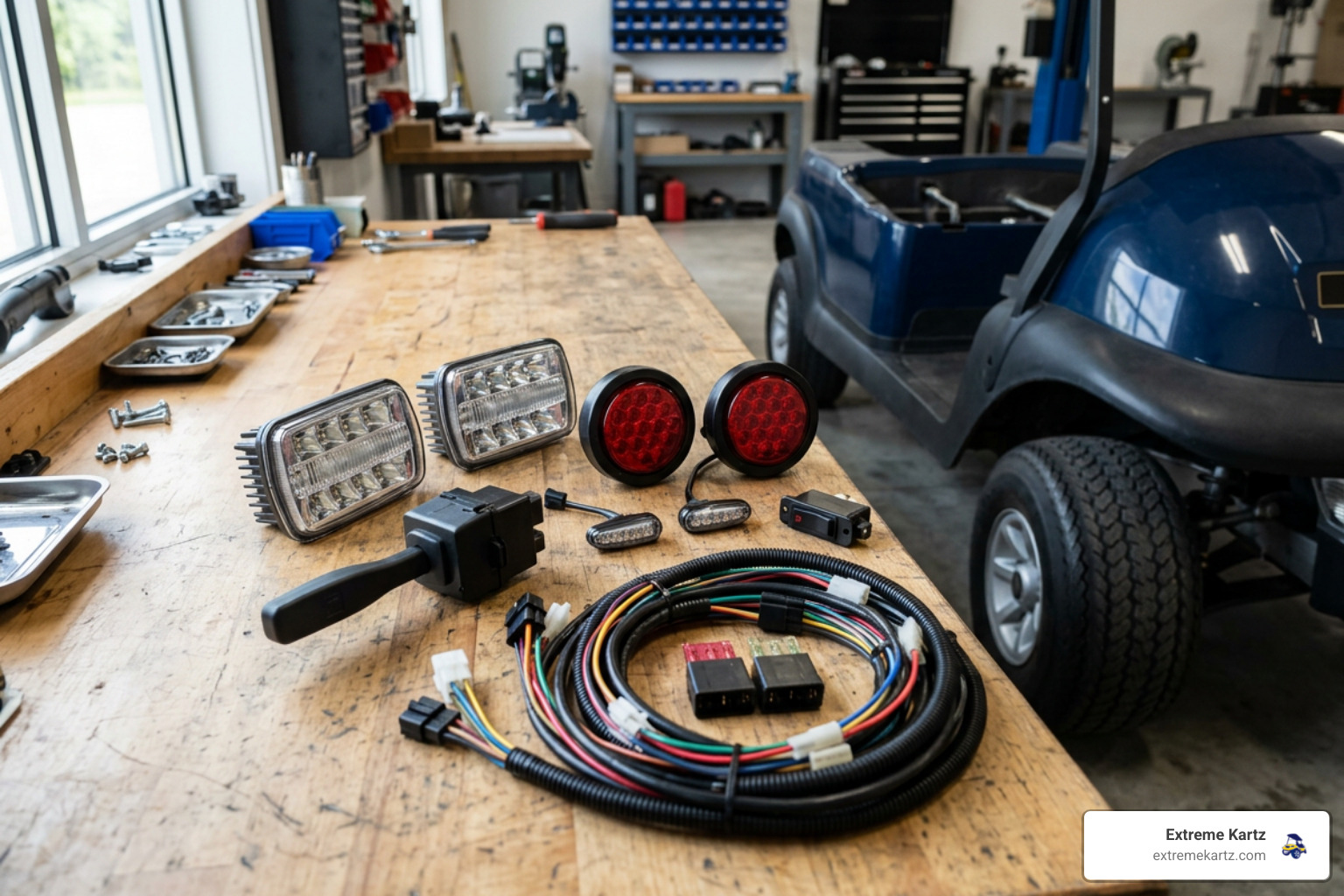
For headlights-only needs, consider LED Factory Style Headlights with Bezels, Yamaha Drive, LED Clear Factory Style Headlights with Bezels, E-Z-Go RXV, or LED Adjustable Headlights with Bezels, E-Z-Go TXT.
Mid-article fitment check: before ordering, compare your serial number and body style against the product page, or contact Extreme Kartz with your cart details. You can start from the full light kits collection if you are still narrowing down your platform.
Vehicle Fitment, Controllers, and Installation Best Practices
Ensuring your golf cart light kit fits properly requires verifying your cart's manufacturer, body model, and model year before purchasing cut-out light housings or replacement cowl panels.
Identifying Golf Cart Make, Model, and Year
Major golf cart manufacturers redesign body cowls across generations. A light kit contoured for a Club Car Precedent will not fit a Club Car DS cowl, just as an EZGO TXT kit will not match an EZGO RXV or Yamaha Drive2 body profile.
To identify your vehicle details accurately:
- Club Car: Find the serial plate in the passenger-side glove box area, or stamped into the driver-side frame rail. Read the serial rather than judging by the body — panels get swapped. If your Precedent is near the 2008 model-year cutover, confirm the year with us before ordering, because the body cowl headlight cutout changed.
- EZGO: Check the serial number together with the model number, usually on the manufacturer label inside the passenger-side glove pocket or on the frame rail under the seat. Use both details to distinguish TXT, RXV, and other platforms before buying.
- Yamaha: Locate the serial number first, then use body appearance as a secondary clue. Common serial locations include near the steering column base, under the seat near the battery compartment, or inside the rear wheel well area.
Controller Options and Common Installation Mistakes
Modern accessory lighting controllers offer flexible user management:
- Handheld RF Remotes: Compact physical key fobs offering push-button color selection and pattern toggles.
- Bluetooth Smartphone Apps: Wireless app connectivity providing color selection, brightness adjustments, zone controls, and lighting effects.
To ensure long-term electrical reliability, avoid these common installation errors:
- Skipping the Voltage Reducer: Do not tap mid-pack on a lithium cart, and do not power 12V accessories directly from a high-voltage battery bank.
- No Inline Fuse Near Pack Positive: Install an inline fuse on the positive input lead, within 12 inches of the pack positive terminal, and follow the instructions supplied with your kit.
- Cutting Into the Factory Harness: Use a plug-and-play kit whenever the right one is available for your cart platform.
- Buying by Looks Alone: Decode the serial number and model information before ordering, because body panels can be swapped.
- Leaving Connectors Unsealed: Use weather-resistant connections and protect wiring from road spray, vibration, and moving components.
Frequently Asked Questions About Golf Cart Lighting
Do I need a voltage reducer for my electric golf cart?
Yes. Electric golf carts operate on 36V, 48V, or 72V battery banks, while standard lights run on 12V. A voltage reducer steps the pack voltage down to a stable 12V supply for lights and accessories. Lithium carts especially need the correct reducer because the pack has no accessible mid-string tap point.
What is the default golf cart light kit pick?
For compatible Club Car Precedent carts, our default pick is the Club Car Precedent Madjax Ultimate Plus LED Light Kit. If you do not have a Precedent, choose by platform instead: Club Car, EZGO, Yamaha, and other body styles use different housings and harnesses.
What is the difference between RGB and RGBW light kits?
RGB light kits combine red, green, and blue diodes for color effects. RGBW adds a dedicated white diode for cleaner white accent lighting.
Can a light kit make my golf cart street legal?
A light kit can provide important lighting and signaling components, but it does not make a cart street legal by itself. State and local rules vary, and some builds follow the LSV / FMVSS 500 path while others follow a local golf-cart-permit path. Confirm with your county DMV before buying parts for a street build.
Conclusion
Upgrading your cart with a high-performance golf cart light kit improves nighttime safety, expands driving usability around your community, and elevates overall vehicle style. Whether you require a basic light setup for private-property driving or a fuller package with turn signals, brake lights, and horn components, choosing parts matched to your electrical system is the key to a reliable installation.
Always verify your cart's make, model, year, serial information, and battery bank configuration before purchasing electrical components. Remember to install a properly rated voltage reducer on electric models to shield your lighting system and keep 12V accessories working correctly.
For personalized guidance on selecting compatible lighting harnesses, voltage converters, and performance accessories tailored to your vehicle, explore our complete selection of Premium Golf Cart Accessories. Please reach out to our expert team at Extreme Kartz with your vehicle fitment inquiries or model specifications so we can recommend the exact system configuration for your build.
Specifications are accurate as of publication — confirm current details and pricing on the product page for your cart before ordering.
Related Products

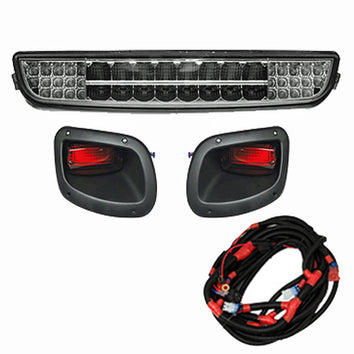
Vendor: GTW Led Light Bar Kit, w/Premium Harness, TXT (1996-2014)

Vendor: DoubleTake Phoenix Street Legal LED Light Kit

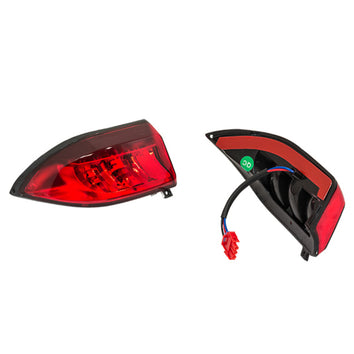
Vendor: Club Car Precedent Madjax Ultimate Plus LED Light Kit


Vendor: INNOVA LED Light Strip w/ Bluetooth


