


A Practical Guide to Identify Your Club Car Year and Model
Why Knowing What Year and Model Is My Club Car Matters Before You Buy Parts
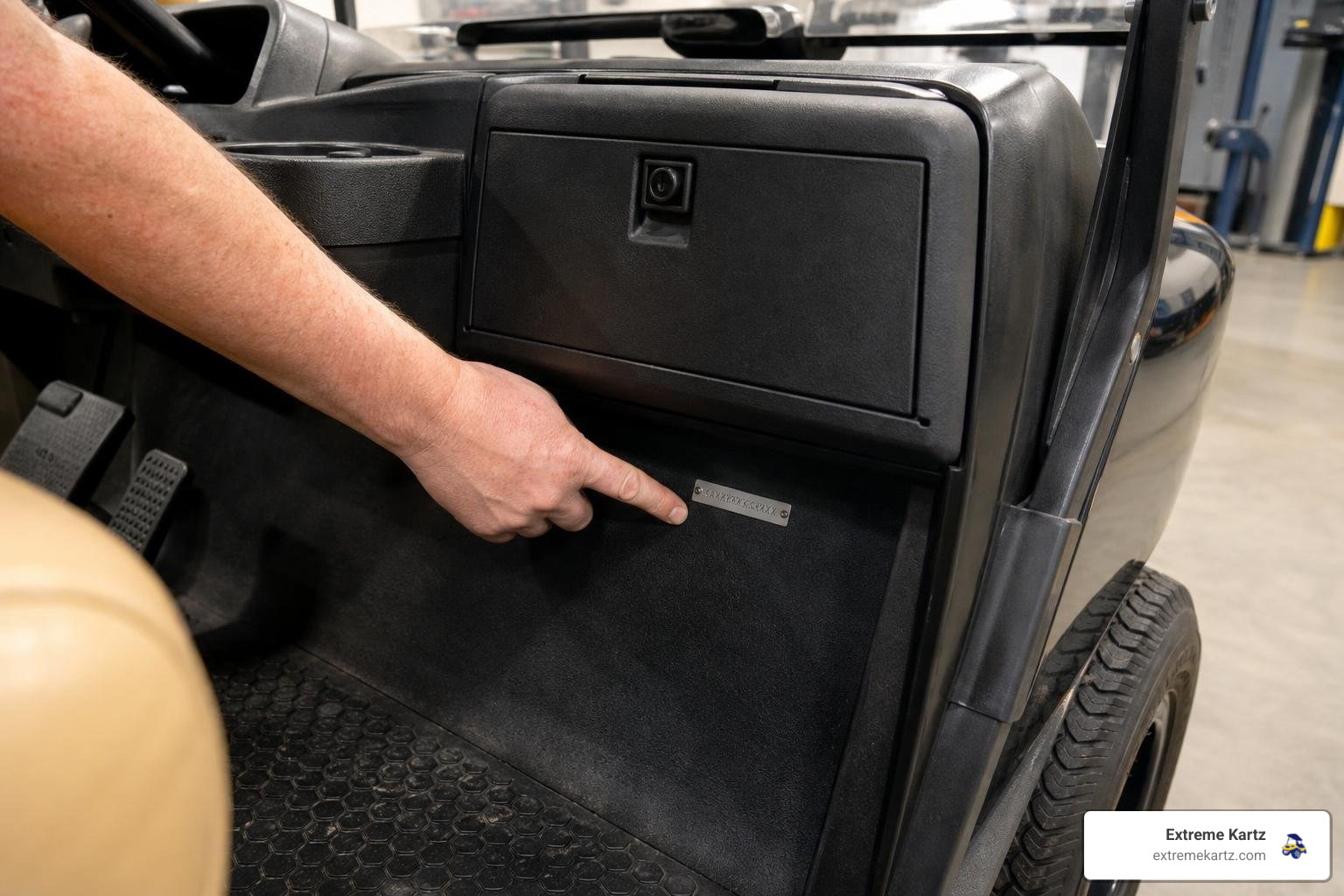
If you've ever wondered what year and model is my Club Car, the answer is hiding in a short string of letters and numbers on your cart right now — and it takes less than a minute to find.
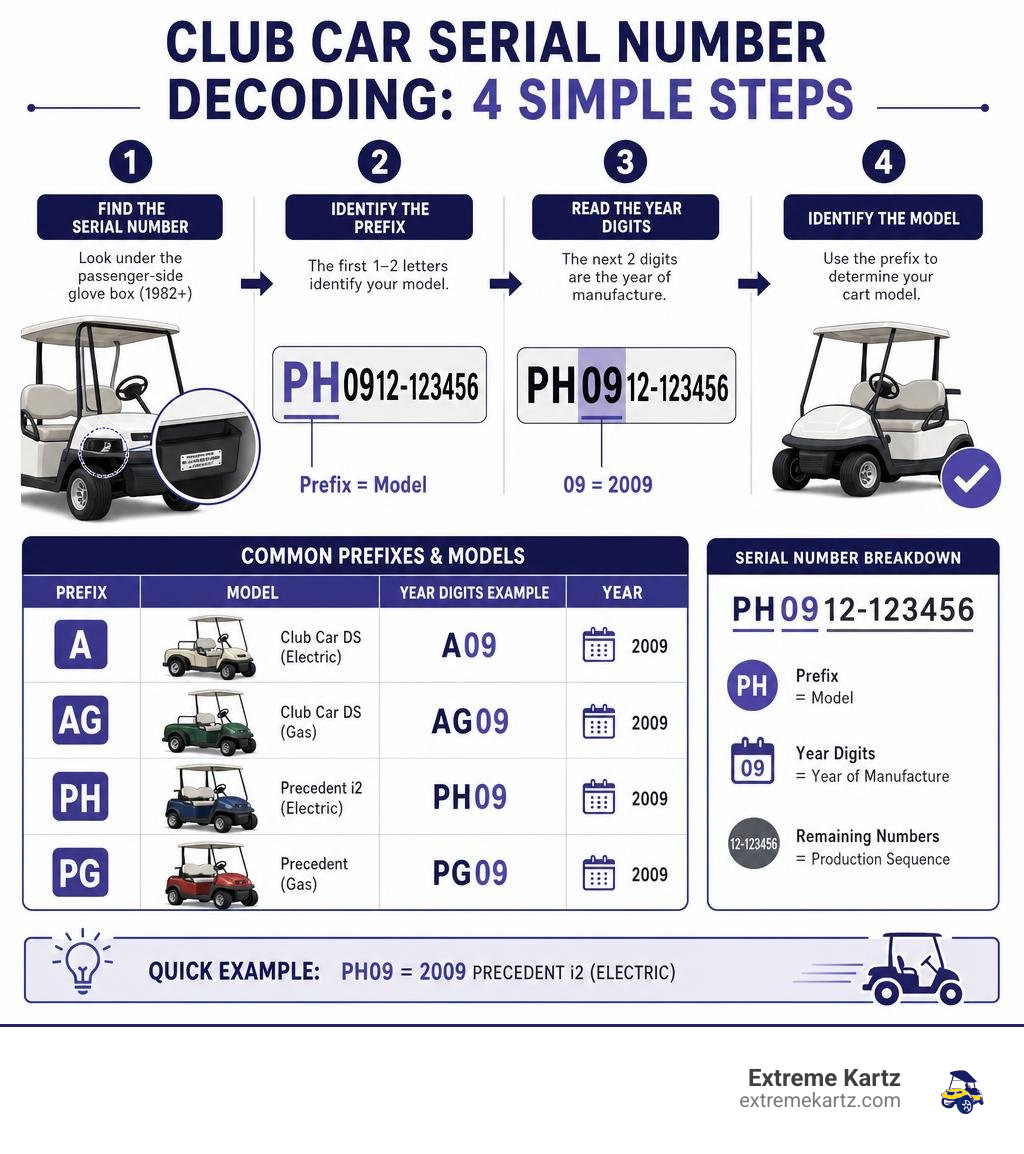
Here's the quick answer:
- Find the serial number — look under the passenger-side glove box on models made after 1981.
- Read the first 1–2 letters — these identify your model (e.g., "A" = DS, "PH" = Precedent i2).
- Read the next 2 digits — these are your manufacturing year (e.g., "09" = 2009).
Example: A serial number starting with PH09 = a 2009 Club Car Precedent i2.
| Serial Prefix | Model | Year Digits Example | Year |
|---|---|---|---|
| A | Club Car DS (Electric) | A09 | 2009 |
| AG | Club Car DS (Gas) | AG09 | 2009 |
| PH | Precedent i2 (Electric) | PH09 | 2009 |
| PG | Precedent (Gas) | PG09 | 2009 |
Standard Club Cars do not have a 17-digit VIN like a car or truck. They use a manufacturer-specific serial number instead. Only street-legal Low Speed Vehicles (LSVs) carry a true VIN.
Getting this wrong is costly. A 2008 Club Car DS and a 2008 Club Car Precedent are the same age — but they use completely different parts, controllers, and accessories. Ordering without confirming your exact model is one of the most common mistakes cart owners make.
I'm Martin Davis, owner of Extreme Kartz, and helping customers figure out what year and model is my Club Car is one of the first things we walk people through before recommending any upgrade or replacement part. In the sections below, I'll show you exactly how to find your serial number, decode it, and identify your cart visually if the plate is missing.
Locating Your Club Car Serial Number
Finding the serial number on your Club Car is usually a straightforward task, but the exact location depends on when your cart rolled off the assembly line. Because Club Car has been building top-tier light utility and personal vehicles for over 65 years, they have shifted the location of these serial tags a few times to improve accessibility.
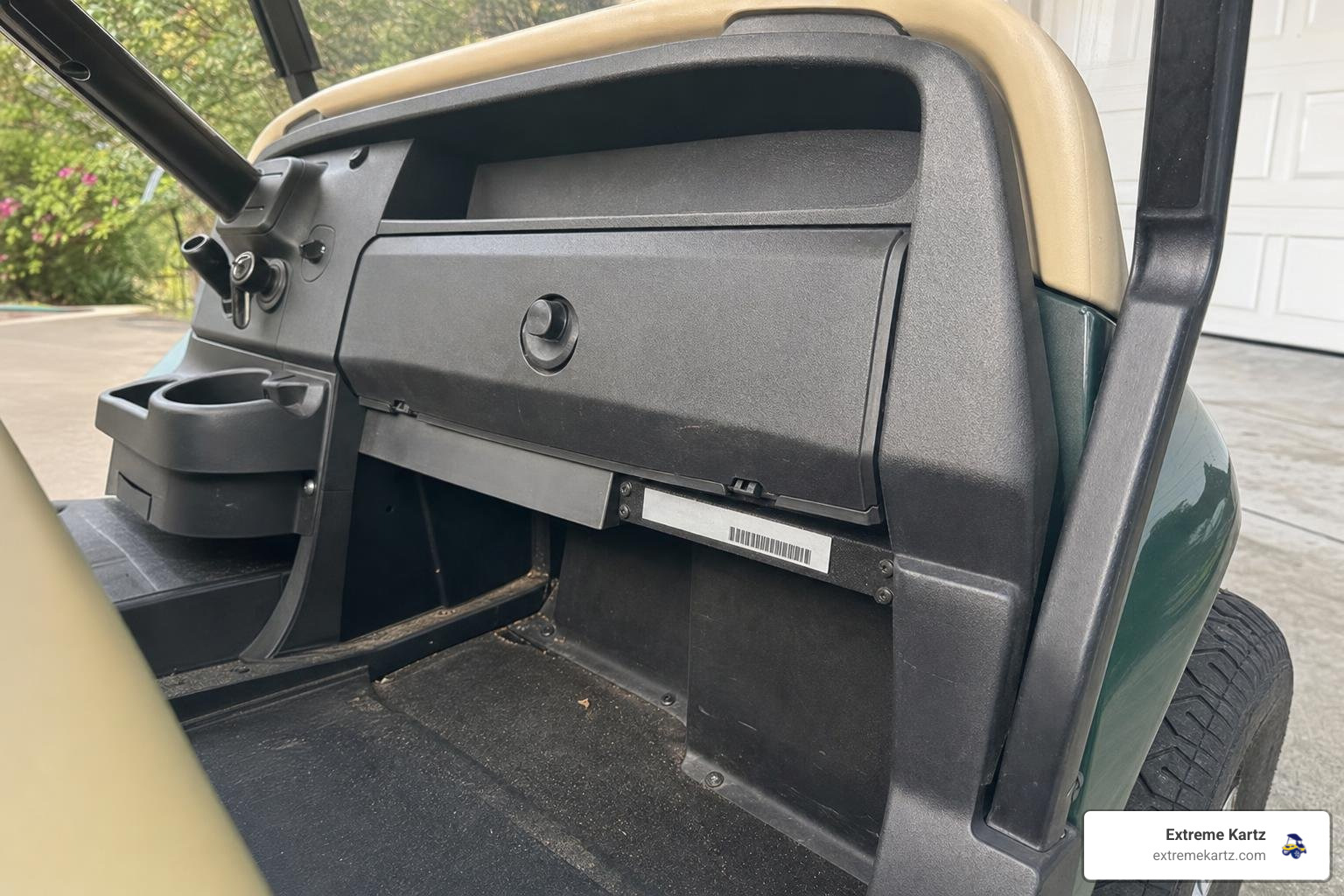
For almost all modern Club Car golf carts manufactured from 1981 to the present, you can find the serial number in one of three primary areas:
- Under the Passenger-Side Glove Box: This is the absolute standard location. If you look just beneath the glove compartment opening on the passenger side, you should see a printed barcode decal or a small metal plate.
- On the Kick Panel: On some DS and early Precedent models, the serial number sticker is located on the kick panel directly below the glove compartment or cup holder area.
- Behind the Accelerator Pedal: In certain production runs, the manufacturer placed the serial sticker on the inner frame rail just above or behind the accelerator pedal assembly.
If you are inspecting a modern cart, running your hand along the plastic trim under the glove box is often the fastest way to feel for the sticker's edge if dirt or dust is covering it. If you have recently installed a new windshield or dash trim, make sure these accessories aren't blocking your view of this area. For more tips on how accessories interact with your front dash setup, you can check out our Club Car Golf Cart Windshield Guide.
Finding the Serial Number on Vintage Pre-1981 Models
If you are working on a classic, vintage Club Car manufactured between 1975 and 1980, the location is completely different. During this era, Club Car had not yet standardized the passenger-side dashboard sticker.
To find the serial number on a pre-1981 model, you will need to lift the main seat bottom. Look closely at the aluminum I-beam frame section on the driver's side, right next to the battery compartment. The serial number on these older models is typically stamped directly into the aluminum frame or printed on a small metal tag riveted to the frame rail. Because these carts have spent decades in the wild, you may need a flashlight and a soft wire brush to clean away dirt, corrosion, or old paint to make the characters legible. For a deeper look at vintage locations, you can reference the What Year is my Club Car ® Golf Cart? guide.
How to Decode Your Club Car Serial Number
Once you have located your serial number, the next step is reading it. Club Car uses a highly deterministic, structured 12-character format that makes decoding incredibly simple once you know what each segment represents.
Unlike other golf cart brands that use confusing mid-year production codes, Club Car builds the manufacturing year and the exact week of production right into the serial number.
Let's break down a standard 12-character Club Car serial number using the example PH0901-123456:
| Characters | Segment | Meaning in Example (PH0901-123456) |
|---|---|---|
| PH (1st & 2nd) | Model Prefix | Identifies the model type and drivetrain (Precedent i2 Electric) |
| 09 (3rd & 4th) | Model Year | Identifies the year of manufacture (2009) |
| 01 (5th & 6th) | Production Week | Identifies the week of the year it was built (1st week of January) |
| - (7th) | Separator | Hyphen dividing the identification code from the sequence |
| 123456 (8th–12th) | Sequential Number | The unique factory production sequence number for your specific cart |
This simple pattern allows you to instantly know the age and model of your vehicle. If your prefix is different, you can cross-reference it using the official Golf Cart and UTV Serial Number Prefix | Club Car directory. Knowing these details is a crucial first step before planning any significant upgrades, which we outline in our Club Car Performance Upgrades Guide.
Decoding the Prefix: What Year and Model Is My Club Car?
The first one or two letters of your serial number are the most critical characters for determining parts compatibility. These letters tell us exactly what model family your cart belongs to and what type of motor or engine system it uses.
For example, if you are looking to install a high-performance speed controller, knowing whether your Precedent has an IQ system or an Excel system is the difference between a plug-and-play installation and a fried electrical harness. We explain these controller differences in detail in our Club Car Precedent Controller Guide.
Here is a quick-reference lookup list of the most common Club Car serial prefixes you will encounter:
- AA: DS Electric (48-Volt)
- AB: DS Electric (36-Volt)
- AC: DS Electric (Regen II)
- AQ: DS Electric (IQ System)
- AG: DS Gas
- PQ: Precedent i2 Electric
- PH: Precedent i2 Excel Electric
- PJ: Precedent i2 Gas
- AW: Onward Gas (Lifted)
- AX: Onward Electric (Lifted)
- BO: Tempo Electric
If you have a serial number in hand and want to run it through an automated lookup tool, you can use the Golf Cart VIN Decoder & Serial Number Lookup (Free) to instantly verify your cart's specifications.
Visual Identification: What Year and Model Is My Club Car if the Serial Number Is Missing?
It is incredibly common for older or pre-owned golf carts to have missing, faded, or completely unreadable serial number stickers. Over years of washdowns, battery acid exposure, and general wear and tear, those paper barcode decals under the glove box can easily peel off.
If you find yourself with a blank space where your serial number should be, do not panic. We can easily identify your cart's model and narrow down its year range by examining its physical design characteristics.
The easiest way to start is by looking at the front cowl (the nose of the cart) and the bumper:
- Club Car DS: Features a classic, boxy, squared-off front cowl. It has a small, distinct black rubber bumper mounted only on the bottom-center of the front body.
- Club Car Precedent / Tempo / Onward: Features a modern, rounded front cowl contour. The black plastic bumper is a continuous, 360-degree wrap-around design that protects the entire outer edge of the vehicle.
If you determine that your cart has the classic squared-off look, you have a DS model. To learn more about the body styles and replacement options for this classic platform, take a look at our Club Car DS Bodies Complete Guide. For a broader overview of visual identification methods, you can also consult the Identify Your Club Car Model: A Step-By-Step Guide | ShunAuto .
Distinguishing the Club Car DS (Pre-2000.5 vs. Post-2000.5)
The Club Car DS was in production from 1982 all the way until 2014. Because it had such a long production run, ordering parts for a "Club Car DS" without knowing its specific sub-generation is a recipe for fitment issues. The most critical design split occurred midway through the 2000 model year—a dividing line the industry refers to as 2000.5.
You can easily identify which side of the 2000.5 split your DS falls on by checking these three visual cues:
-
The Seat Backs:
- Pre-2000.5: Features two individual, separate seat back cushions for the driver and passenger.
- Post-2000.5: Features a single, solid, one-piece seat back cushion spanning the width of the bench. If you are planning a seat refresh, check out our Club Car DS Seat Cover Replacement guide.
-
The Armrests:
- Pre-2000.5: Features round, metal tube armrests covered in a textured rubber coating.
- Post-2000.5: Features molded plastic, triangular-shaped armrests.
-
The Roof and Supports:
- Pre-2000.5: Features silver, unfinished aluminum roof supports and a top canopy without built-in handles.
- Post-2000.5: Features black-painted upright roof supports, and the canopy top has integrated handles molded into the plastic sides. To see how these tops look when customized, view our guide on the Color Matched Roof DS.
Another excellent clue is the wheel hub dust covers. DS models from 1982 to 2003 utilize silver metal dust covers over the front wheel bearings, while models built from 2003.5 onward transition to black plastic dust covers.
Spotting a Precedent, Tempo, or Onward Model
If your cart has a rounded front cowl and a wrap-around bumper, it belongs to the modern family of Club Car personal transportation vehicles. Here is how to tell these three sibling models apart:
- Club Car Precedent (2004–Present): The Precedent features a rounded, swooping front body and distinctive plastic top supports that channel rainwater down through the rear of the cart. It has a large, open rear bagwell and a basic, utilitarian dash. If you want to transform a standard Precedent into something truly unique, check out our Club Car Precedent Phantom Complete Guide.
- Club Car Tempo (2018–Present): Designed primarily as a premium fleet vehicle for golf courses, the Tempo shares the Precedent's basic chassis but features a redesigned, more aggressive front cowl. From the factory, these carts usually do not have headlights and often feature integrated GPS screens on the dash. Adding passenger seating to these is a common upgrade; you can learn more in our Club Car Tempo Rear Seat Kit Guide.
- Club Car Onward (2017–Present): The Onward is Club Car's flagship personal adventure vehicle. It is easily spotted by its premium, automotive-style front cowl, integrated LED headlights with daytime running lights, and standard premium seating. Onward models are often lifted directly from the factory and feature aggressive off-road tires and custom paint finishes.
Special Cases: Remanufactured Carts, Onward Models, and LSVs
As you work to answer what year and model is my Club Car, you might run into a few unique serial number configurations that do not match the standard 12-character format. These outliers typically fall into three categories: remanufactured vehicles, Onward models, and Low-Speed Vehicles (LSVs).
If your serial number starts with a number instead of a letter (for example, 1A or 7A), you are looking at a factory-remanufactured Club Car. Club Car has an official program where they take returned fleet carts, strip them down to their rustproof aluminum frames, and rebuild them with new bodies, electronics, and suspension components.
Because these carts are built on older frames but feature modern components, Club Car issues them a brand-new, unique alphanumeric prefix starting with a digit. It is highly important to recognize this because a remanufactured cart may require parts from different model years depending on which chassis was used as the foundation. If you are working on utility models like the Carryall, which have their own unique configurations, see our Club Car Carryall Lift Kit Guide 2026.
Identifying What Year and Model Is My Club Car for Onward and LSV Vehicles
If you own a premium Club Car Onward or a street-legal Low-Speed Vehicle (LSV), the rules for identification change slightly.
Standard golf carts are designed for off-road use and are exempt from federal motor vehicle safety standards, meaning they only require a manufacturer serial number. However, if your Club Car was built from the factory as a street-legal LSV (such as the Villager LSV or the Onward 4 Forward LSV), it is classified as a motor vehicle and is legally required to have a standardized 17-digit Vehicle Identification Number (VIN).
To decode a 17-digit VIN on a street-legal Club Car:
- Locate the VIN plate: This is typically a metal plate riveted to the chassis frame rail under the dash, or on the driver's side steering column area.
- Look at Position 10: In any standardized 17-digit VIN, the 10th character represents the model year.
-
Cross-reference the year code:
-
A= 2010 -
B= 2011 -
C= 2012 -
H= 2017 -
J= 2018 -
K= 2019 -
L= 2020 -
M= 2021 -
N= 2022 -
P= 2023 -
R= 2024 -
S= 2025 -
T= 2026
-
If you are looking at upgrading the stance of your Onward or LSV, you can find compatible suspension packages in our Club Car Lift Kits Guide 2026. To explore the current lineup of street-legal options directly from the manufacturer, visit the official Club Car® | Best Golf Carts & Utility Vehicles website, or read more on decoding newer models at What Year Is My Club Car? Serial Number Lookup 2026 - CarXplorer .
Frequently Asked Questions About Club Car Identification
Do Club Car golf carts have a standard 17-digit VIN?
No. Standard Club Car golf carts do not have a 17-digit VIN. Because they are designed primarily as off-road vehicles, they are exempt from federal highway safety standards. Instead, Club Car utilizes a manufacturer-specific 12-character serial number format.
The only exception is factory-built Low-Speed Vehicles (LSVs) that are designed from the ground up to be street-legal. These specialty vehicles are issued a true 17-digit VIN to allow for registration, titling, and licensing with your local DMV. For more details on the differences between these numbers, check out the Golf Cart VIN Lookup — Serial Decoder | CarCheckerVIN resource.
How can I identify a pre-1981 Club Car if the serial plate is missing?
If you suspect you have a vintage Club Car from the late 1970s but the serial plate on the driver's side frame is missing or unreadable, you can perform a quick physical check of the pedals.
Classic Club Cars manufactured between 1975 and 1980 feature a unique three-pedal configuration: two individual brake pedals (one main brake and one parking brake lock) alongside a single accelerator pedal. Modern Club Cars built from 1981 onward transitioned to a standard two-pedal design, where the parking brake is integrated into the top portion of the main brake pedal. You can read more about vintage cart history on the What Year Is My Club Car? Club Car Serial Number Lookup page.
Can I use different parts for two Club Cars from the same year?
Yes, absolutely. This is one of the most common pitfalls when ordering upgrades. For example, if you own a 2008 Club Car DS and your neighbor owns a 2008 Club Car Precedent, your carts share the same manufacturing year but have entirely different frame designs, body panels, leaf springs, steering assemblies, and electrical wiring.
Always verify both the model prefix and the year before purchasing any part to ensure perfect fitment and avoid the hassle of returning incompatible items.
Conclusion
Determining what year and model is my Club Car is the single most important step you can take before investing in your vehicle's performance, comfort, or style. Whether you are planning a simple aesthetic refresh or a major mechanical overhaul, having your exact serial number and model family on hand eliminates the guesswork and ensures that every part you order fits perfectly the first time.
At Extreme Kartz, we specialize in helping you navigate these exact fitment details. We focus on complete, system-based solutions—such as high-performance AC conversion kits, heavy-duty lift kits, and premium battery upgrades—rather than just selling individual parts. All of our kits ship in 1-2 business days.
If you are planning an electrical system upgrade, we carry and recommend industry-leading, approved lithium battery systems from trusted brands like Eco Battery, Bolt Energy, Lithium Rhino, and Bedrock Battery to ensure your cart gets the clean, reliable power it deserves.
Now that you know exactly what year and model your Club Car is, you are ready to shop with confidence. If you have any questions about part compatibility or want a professional recommendation for your specific cart setup, reach out to our team of experts today, or browse our curated selection at Explore Club Car Parts and Accessories.
Related Products


Vendor: Club Car DS Factory or Spartan Body Clear Windshield - 2000+

Vendor: Club Car Precedent 04+ Tinted Windshield for Factory Body

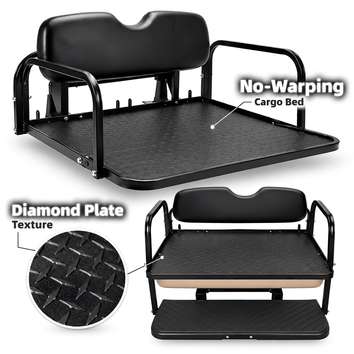
Vendor: GTW Mach3 Rear Flip Seat for Club Car Precedent, Tempo & Onward


Vendor: DoubleTake Fender Flare Set for Phantom Body, Club Car Precedent 04+


